Python’s curve_fit calculates the best-fit parameters for a function with a single independent variable, but is there a way, using curve_fit or something else, to fit for a function with multiple independent variables? For example:
def func(x, y, a, b, c):
    return log(a) + b*log(x) + c*log(y)
where x and y are the independent variable and we would like to fit for a, b, and c.
Answers:
Thank you for visiting the Q&A section on Magenaut. Please note that all the answers may not help you solve the issue immediately. So please treat them as advisements. If you found the post helpful (or not), leave a comment & I’ll get back to you as soon as possible.
Method 1
You can pass curve_fit a multi-dimensional array for the independent variables, but then your func must accept the same thing. For example, calling this array X and unpacking it to x, y for clarity:
import numpy as np
from scipy.optimize import curve_fit

def func(X, a, b, c):
    x,y = X
    return np.log(a) + b*np.log(x) + c*np.log(y)

# some artificially noisy data to fit
x = np.linspace(0.1,1.1,101)
y = np.linspace(1.,2., 101)
a, b, c = 10., 4., 6.
z = func((x,y), a, b, c) * 1 + np.random.random(101) / 100

# initial guesses for a,b,c:
p0 = 8., 2., 7.
print(curve_fit(func, (x,y), z, p0))
Gives the fit:
(array([ 9.99933937,  3.99710083,  6.00875164]), array([[  1.75295644e-03,   9.34724308e-05,  -2.90150983e-04],
   [  9.34724308e-05,   5.09079478e-06,  -1.53939905e-05],
   [ -2.90150983e-04,  -1.53939905e-05,   4.84935731e-05]]))
Method 2
Fitting to an unknown numer of parameters
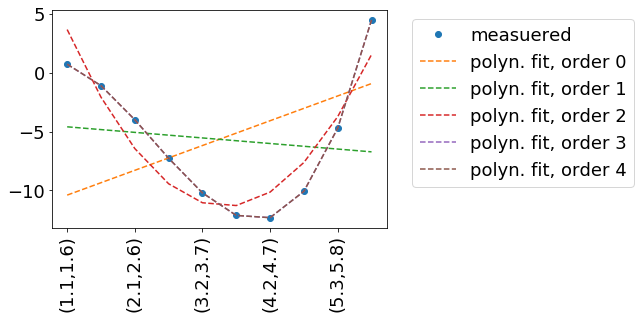
In this example, we try to reproduce some measured data measData.
In this example measData is generated by the function measuredData(x, a=.2, b=-2, c=-.8, d=.1). I practice, we might have measured measData in a way – so we have no idea, how it is described mathematically. Hence the fit.
We fit by a polynomial, which is described by the function polynomFit(inp, *args). As we want to try out different orders of polynomials, it is important to be flexible in the number of input parameters.
The independent variables (x and y in your case) are encoded in the ‘columns’/second dimension of inp.
import numpy as np
import matplotlib
import matplotlib.pyplot as plt
from scipy.optimize import curve_fit

def measuredData(inp, a=.2, b=-2, c=-.8, d=.1):
    x=inp[:,0]
    y=inp[:,1]
    return a+b*x+c*x**2+d*x**3 +y

def polynomFit(inp, *args):
    x=inp[:,0]
    y=inp[:,1]
    res=0
    for order in range(len(args)):
        print(14,order,args[order],x)
        res+=args[order] * x**order
    return res +y


inpData=np.linspace(0,10,20).reshape(-1,2)
inpDataStr=['({:.1f},{:.1f})'.format(a,b) for a,b in inpData]
measData=measuredData(inpData)
fig, ax = plt.subplots()
ax.plot(np.arange(inpData.shape[0]), measData, label='measuered', marker='o', linestyle='none' )

for order in range(5):
    print(27,inpData)
    print(28,measData)
    popt, pcov = curve_fit(polynomFit, xdata=inpData, ydata=measData, p0=[0]*(order+1) )
    fitData=polynomFit(inpData,*popt)
    ax.plot(np.arange(inpData.shape[0]), fitData, label='polyn. fit, order '+str(order), linestyle='--' )
    ax.legend( loc='upper left', bbox_to_anchor=(1.05, 1))
    print(order, popt)

ax.set_xticklabels(inpDataStr, rotation=90)
Result:
Method 3
Yes. We can pass multiple variables for curve_fit. I have written a piece of code:
import numpy as np
x = np.random.randn(2,100)
w = np.array([1.5,0.5]).reshape(1,2)
esp = np.random.randn(1,100)
y = np.dot(w,x)+esp
y = y.reshape(100,)
In the above code I have generated x a 2D data set in shape of (2,100) i.e, there are two variables with 100 data points. I have fit the dependent variable y with independent variables x with some noise.
def model_func(x,w1,w2,b):
  w = np.array([w1,w2]).reshape(1,2)
  b = np.array([b]).reshape(1,1)
  y_p = np.dot(w,x)+b
  return y_p.reshape(100,)
We have defined a model function that establishes relation between y & x.
Note: The shape of output of the model function or predicted y should be (length of x,)
popt, pcov = curve_fit(model_func,x,y)
The popt is an 1D numpy array containing predicted parameters. In our case there are 3 parameters.
Method 4
optimizing a function with multiple input dimensions and a variable number of parameters
This example shows how to fit a polynomial with a two dimensional input (R^2 -> R) by an increasing number of coefficients. The design is very flexible so that the callable f from curve_fit is defined once for any number of non-keyword arguments.
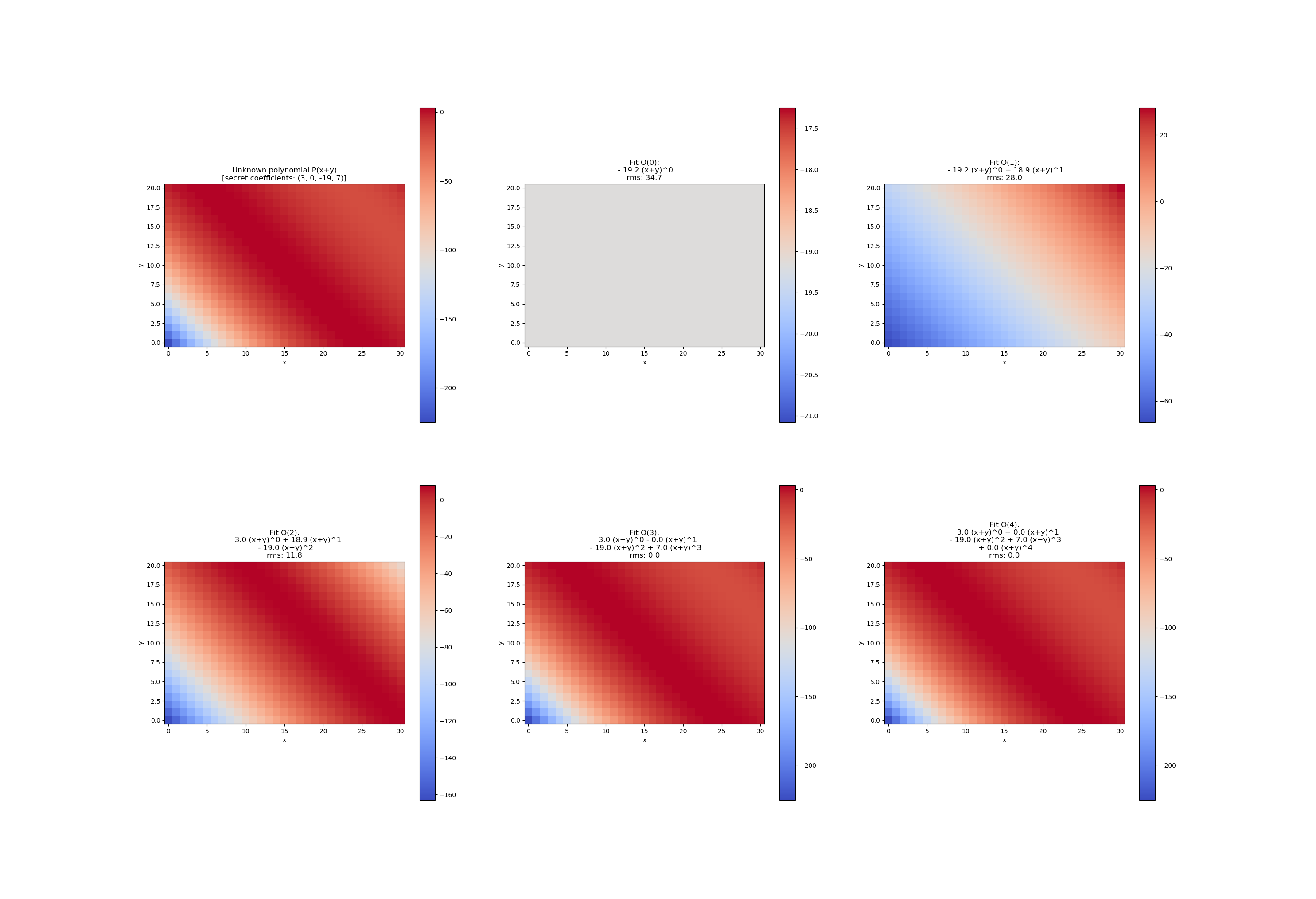
minimal reproducible example
import numpy as np
import matplotlib.pyplot as plt
from scipy.optimize import curve_fit

def poly2d(xy, *coefficients):
    x = xy[:, 0]
    y = xy[:, 1]
    proj = x + y
    res = 0
    for order, coef in enumerate(coefficients):
        res += coef * proj ** order
    return res

nx = 31
ny = 21

range_x = [-1.5, 1.5]
range_y = [-1, 1]
target_coefficients = (3, 0, -19, 7)

xs = np.linspace(*range_x, nx)
ys = np.linspace(*range_y, ny)
im_x, im_y = np.meshgrid(xs, ys)
xdata = np.c_[im_x.flatten(), im_y.flatten()]
im_target = poly2d(xdata, *target_coefficients).reshape(ny, nx)

fig, axs = plt.subplots(2, 3, figsize=(29.7, 21))
axs = axs.flatten()

ax = axs[0]
ax.set_title('Unknown polynomial P(x+y)n[secret coefficients: ' + str(target_coefficients) + ']')
sm = ax.imshow(
    im_target,
    cmap = plt.get_cmap('coolwarm'),
    origin='lower'
    )
fig.colorbar(sm, ax=ax)

for order in range(5):
    ydata=im_target.flatten()
    popt, pcov = curve_fit(poly2d, xdata=xdata, ydata=ydata, p0=[0]*(order+1) )

    im_fit = poly2d(xdata, *popt).reshape(ny, nx)

    ax = axs[1+order]
    title = 'Fit O({:d}):'.format(order)
    for o, p in enumerate(popt):
        if o%2 == 0:
            title += 'n'
        if o == 0:
            title += ' {:=-{w}.1f} (x+y)^{:d}'.format(p, o, w=int(np.log10(max(abs(p), 1))) + 5)
        else:
            title += ' {:=+{w}.1f} (x+y)^{:d}'.format(p, o, w=int(np.log10(max(abs(p), 1))) + 5)
    title += 'nrms: {:.1f}'.format( np.mean((im_fit-im_target)**2)**.5 )
    ax.set_title(title)
    sm = ax.imshow(
        im_fit,
        cmap = plt.get_cmap('coolwarm'),
        origin='lower'
        )
    fig.colorbar(sm, ax=ax)

for ax in axs.flatten():
    ax.set_xlabel('x')
    ax.set_ylabel('y')

plt.show()
P.S. The concept of this answer is identical to my other answer here, but the code example is way more clear. At the time given, I will delete the other answer.
Method 5
Yes, there is: simply give curve_fit a multi-dimensional array for xData.
All methods was sourced from stackoverflow.com or stackexchange.com, is licensed under cc by-sa 2.5, cc by-sa 3.0 and cc by-sa 4.0