Is there a numpy builtin to do something like the following? That is, take a list d and return a list filtered_d with any outlying elements removed based on some assumed distribution of the points in d.
import numpy as np

def reject_outliers(data):
    m = 2
    u = np.mean(data)
    s = np.std(data)
    filtered = [e for e in data if (u - 2 * s < e < u + 2 * s)]
    return filtered

>>> d = [2,4,5,1,6,5,40]
>>> filtered_d = reject_outliers(d)
>>> print filtered_d
[2,4,5,1,6,5]
I say ‘something like’ because the function might allow for varying distributions (poisson, gaussian, etc.) and varying outlier thresholds within those distributions (like the m I’ve used here).
Answers:
Thank you for visiting the Q&A section on Magenaut. Please note that all the answers may not help you solve the issue immediately. So please treat them as advisements. If you found the post helpful (or not), leave a comment & I’ll get back to you as soon as possible.
Method 1
Something important when dealing with outliers is that one should try to use estimators as robust as possible. The mean of a distribution will be biased by outliers but e.g. the median will be much less.
Building on eumiro’s answer:
def reject_outliers(data, m = 2.):
    d = np.abs(data - np.median(data))
    mdev = np.median(d)
    s = d/mdev if mdev else 0.
    return data[s<m]
Here I have replace the mean with the more robust median and the standard deviation with the median absolute distance to the median. I then scaled the distances by their (again) median value so that m is on a reasonable relative scale.
Note that for the data[s<m] syntax to work, data must be a numpy array.
Method 2
This method is almost identical to yours, just more numpyst (also working on numpy arrays only):
def reject_outliers(data, m=2):
    return data[abs(data - np.mean(data)) < m * np.std(data)]
Method 3
Benjamin Bannier’s answer yields a pass-through when the median of distances from the median is 0, so I found this modified version a bit more helpful for cases as given in the example below.
def reject_outliers_2(data, m=2.):
    d = np.abs(data - np.median(data))
    mdev = np.median(d)
    s = d / (mdev if mdev else 1.)
    return data[s < m]
Example:
data_points = np.array([10, 10, 10, 17, 10, 10])
print(reject_outliers(data_points))
print(reject_outliers_2(data_points))
Gives:
[[10, 10, 10, 17, 10, 10]]  # 17 is not filtered
[10, 10, 10, 10, 10]  # 17 is filtered (it's distance, 7, is greater than m)
Method 4
Building on Benjamin’s, using pandas.Series, and replacing MAD with IQR:
def reject_outliers(sr, iq_range=0.5):
    pcnt = (1 - iq_range) / 2
    qlow, median, qhigh = sr.dropna().quantile([pcnt, 0.50, 1-pcnt])
    iqr = qhigh - qlow
    return sr[ (sr - median).abs() <= iqr]
For instance, if you set iq_range=0.6, the percentiles of the interquartile-range would become: 0.20 <--> 0.80, so more outliers will be included.
Method 5
An alternative is to make a robust estimation of the standard deviation (assuming Gaussian statistics). Looking up online calculators, I see that the 90% percentile corresponds to 1.2815σ and the 95% is 1.645σ (http://vassarstats.net/tabs.html?#z)
As a simple example:
import numpy as np

# Create some random numbers
x = np.random.normal(5, 2, 1000)

# Calculate the statistics
print("Mean= ", np.mean(x))
print("Median= ", np.median(x))
print("Max/Min=", x.max(), " ", x.min())
print("StdDev=", np.std(x))
print("90th Percentile", np.percentile(x, 90))

# Add a few large points
x[10] += 1000
x[20] += 2000
x[30] += 1500

# Recalculate the statistics
print()
print("Mean= ", np.mean(x))
print("Median= ", np.median(x))
print("Max/Min=", x.max(), " ", x.min())
print("StdDev=", np.std(x))
print("90th Percentile", np.percentile(x, 90))

# Measure the percentile intervals and then estimate Standard Deviation of the distribution, both from median to the 90th percentile and from the 10th to 90th percentile
p90 = np.percentile(x, 90)
p10 = np.percentile(x, 10)
p50 = np.median(x)
# p50 to p90 is 1.2815 sigma
rSig = (p90-p50)/1.2815
print("Robust Sigma=", rSig)

rSig = (p90-p10)/(2*1.2815)
print("Robust Sigma=", rSig)
The output I get is:
Mean=  4.99760520022
Median=  4.95395274981
Max/Min= 11.1226494654   -2.15388472011
Sigma= 1.976629928
90th Percentile 7.52065379649

Mean=  9.64760520022
Median=  4.95667658782
Max/Min= 2205.43861943   -2.15388472011
Sigma= 88.6263902244
90th Percentile 7.60646688694

Robust Sigma= 2.06772555531
Robust Sigma= 1.99878292462
Which is close to the expected value of 2.
If we want to remove points above/below 5 standard deviations (with 1000 points we would expect 1 value > 3 standard deviations):
y = x[abs(x - p50) < rSig*5]

# Print the statistics again
print("Mean= ", np.mean(y))
print("Median= ", np.median(y))
print("Max/Min=", y.max(), " ", y.min())
print("StdDev=", np.std(y))
Which gives:
Mean=  4.99755359935
Median=  4.95213030447
Max/Min= 11.1226494654   -2.15388472011
StdDev= 1.97692712883
I have no idea which approach is the more efficent/robust
Method 6
I wanted to do something similar, except setting the number to NaN rather than removing it from the data, since if you remove it you change the length which can mess up plotting (i.e. if you’re only removing outliers from one column in a table, but you need it to remain the same as the other columns so you can plot them against each other).
To do so I used numpy’s masking functions:
def reject_outliers(data, m=2):
    stdev = np.std(data)
    mean = np.mean(data)
    maskMin = mean - stdev * m
    maskMax = mean + stdev * m
    mask = np.ma.masked_outside(data, maskMin, maskMax)
    print('Masking values outside of {} and {}'.format(maskMin, maskMax))
    return mask
Method 7
I would like to provide two methods in this answer, solution based on “z score” and solution based on “IQR”.
The code provided in this answer works on both single dim numpy array and multiple numpy array.
Let’s import some modules firstly.
import collections
import numpy as np
import scipy.stats as stat
from scipy.stats import iqr
z score based method
This method will test if the number falls outside the three standard deviations. Based on this rule, if the value is outlier, the method will return true, if not, return false.
def sd_outlier(x, axis = None, bar = 3, side = 'both'):
    assert side in ['gt', 'lt', 'both'], 'Side should be `gt`, `lt` or `both`.'

    d_z = stat.zscore(x, axis = axis)

    if side == 'gt':
        return d_z > bar
    elif side == 'lt':
        return d_z < -bar
    elif side == 'both':
        return np.abs(d_z) > bar
IQR based method
This method will test if the value is less than q1 - 1.5 * iqr or greater than q3 + 1.5 * iqr, which is similar to SPSS’s plot method.
def q1(x, axis = None):
    return np.percentile(x, 25, axis = axis)

def q3(x, axis = None):
    return np.percentile(x, 75, axis = axis)

def iqr_outlier(x, axis = None, bar = 1.5, side = 'both'):
    assert side in ['gt', 'lt', 'both'], 'Side should be `gt`, `lt` or `both`.'

    d_iqr = iqr(x, axis = axis)
    d_q1 = q1(x, axis = axis)
    d_q3 = q3(x, axis = axis)
    iqr_distance = np.multiply(d_iqr, bar)

    stat_shape = list(x.shape)

    if isinstance(axis, collections.Iterable):
        for single_axis in axis:
            stat_shape[single_axis] = 1
    else:
        stat_shape[axis] = 1

    if side in ['gt', 'both']:
        upper_range = d_q3 + iqr_distance
        upper_outlier = np.greater(x - upper_range.reshape(stat_shape), 0)
    if side in ['lt', 'both']:
        lower_range = d_q1 - iqr_distance
        lower_outlier = np.less(x - lower_range.reshape(stat_shape), 0)

    if side == 'gt':
        return upper_outlier
    if side == 'lt':
        return lower_outlier
    if side == 'both':
        return np.logical_or(upper_outlier, lower_outlier)
Finally, if you want to filter out the outliers, use a numpy selector.
Have a nice day.
Method 8
Consider that all the above methods fail when your standard deviation gets very large due to huge outliers.
(Simalar as the average caluclation fails and should rather caluclate the median. Though, the average is “more prone to such an error as the stdDv”.)
You could try to iteratively apply your algorithm or you filter using the interquartile range:
(here “factor” relates to a n*sigma range, yet only when your data follows a Gaussian distribution)
import numpy as np

def sortoutOutliers(dataIn,factor):
    quant3, quant1 = np.percentile(dataIn, [75 ,25])
    iqr = quant3 - quant1
    iqrSigma = iqr/1.34896
    medData = np.median(dataIn)
    dataOut = [ x for x in dataIn if ( (x > medData - factor* iqrSigma) and (x < medData + factor* iqrSigma) ) ]
    return(dataOut)
Method 9
So many answers, but I’m adding a new one that can be useful for the author or even for other users.
You could use the Hampel filter. But you need to work with Series.
Hampel filter returns the Outliers indices, then you can delete them from the Series, and then convert it back to a List.
To use Hampel filter, you can easily install the package with pip:
pip install hampel
Usage:
# Imports
from hampel import hampel
import pandas as pd

list_d = [2, 4, 5, 1, 6, 5, 40]

# List to Series
time_series = pd.Series(list_d)

# Outlier detection with Hampel filter
# Returns the Outlier indices
outlier_indices = hampel(ts = time_series, window_size = 3)

# Drop Outliers indices from Series
filtered_d = time_series.drop(outlier_indices)

filtered_d.values.tolist()

print(f'filtered_d: {filtered_d.values.tolist()}')
And the output will be:
filtered_d: [2, 4, 5, 1, 6, 5]
Where, ts is a pandas Series object and window_size is a total window size will be computed as 2 * window_size + 1.
For this Series I set window_size with the value 3.
The cool thing about working with Series is being able to generate graphics:
# Imports
import matplotlib.pyplot as plt

plt.style.use('seaborn-darkgrid')

# Plot Original Series
time_series.plot(style = 'k-')
plt.title('Original Series')
plt.show()

# Plot Cleaned Series
filtered_d.plot(style = 'k-')
plt.title('Cleaned Series (Without detected Outliers)')
plt.show()
And the output will be:
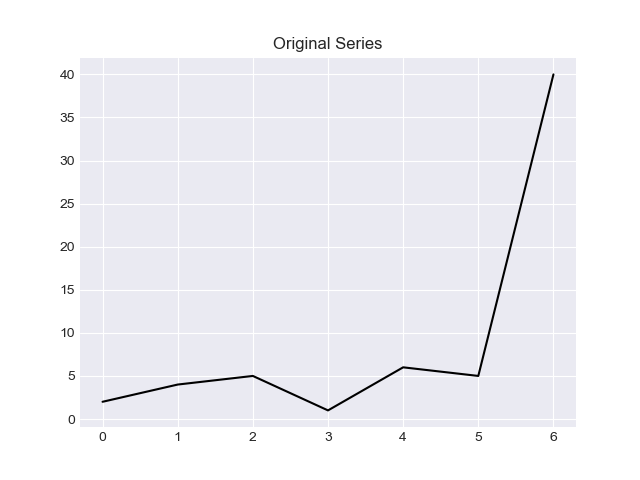
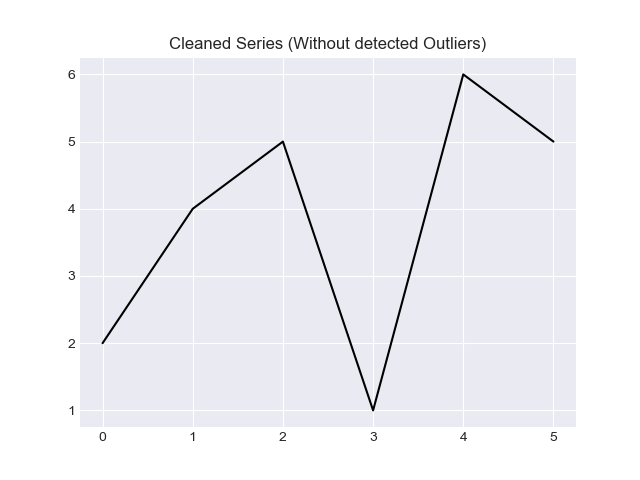
To learn more about Hampel filter, I recommend the following readings:
- Python implementation of the Hampel Filter
- Outlier Detection with Hampel Filter
- Clean-up your time series data with a Hampel Filter
Method 10
if you want to get the index position of the outliers idx_list will return it.
def reject_outliers(data, m = 2.):
        d = np.abs(data - np.median(data))
        mdev = np.median(d)
        s = d/mdev if mdev else 0.
        data_range = np.arange(len(data))
        idx_list = data_range[s>=m]
        return data[s<m], idx_list

data_points = np.array([8, 10, 35, 17, 73, 77])
print(reject_outliers(data_points))

after rejection: [ 8 10 35 17], index positions of outliers: [4 5]
Method 11
For a set of images (each image has 3 dimensions), where I wanted to reject outliers for each pixel I used:
mean = np.mean(imgs, axis=0)
std = np.std(imgs, axis=0)
mask = np.greater(0.5 * std + 1, np.abs(imgs - mean))
masked = np.multiply(imgs, mask)
Then it is possible to compute the mean:
masked_mean = np.divide(np.sum(masked, axis=0), np.sum(mask, axis=0))
(I use it for Background Subtraction)
Method 12
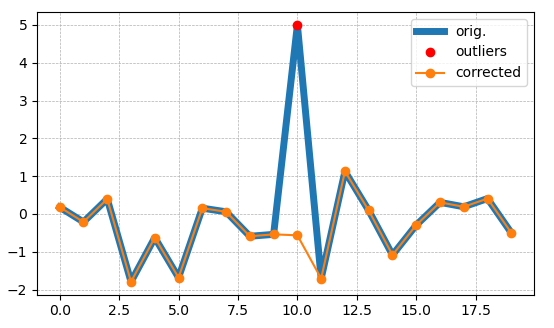
Here I find the outliers in x and substitute them with the median of a window of points (win) around them (taking from Benjamin Bannier answer the median deviation)
def outlier_smoother(x, m=3, win=3, plots=False):
    ''' finds outliers in x, points > m*mdev(x) [mdev:median deviation]
    and replaces them with the median of win points around them '''
    x_corr = np.copy(x)
    d = np.abs(x - np.median(x))
    mdev = np.median(d)
    idxs_outliers = np.nonzero(d > m*mdev)[0]
    for i in idxs_outliers:
        if i-win < 0:
            x_corr[i] = np.median(np.append(x[0:i], x[i+1:i+win+1]))
        elif i+win+1 > len(x):
            x_corr[i] = np.median(np.append(x[i-win:i], x[i+1:len(x)]))
        else:
            x_corr[i] = np.median(np.append(x[i-win:i], x[i+1:i+win+1]))
    if plots:
        plt.figure('outlier_smoother', clear=True)
        plt.plot(x, label='orig.', lw=5)
        plt.plot(idxs_outliers, x[idxs_outliers], 'ro', label='outliers')
        plt.plot(x_corr, '-o', label='corrected')
        plt.legend()

    return x_corr
Method 13
Trim outliers in a numpy array along axis and replace them with min or max values along this axis, whichever is closer. The threshold is z-score:
def np_z_trim(x, threshold=10, axis=0):
    """ Replace outliers in numpy ndarray along axis with min or max values
    within the threshold along this axis, whichever is closer."""
    mean = np.mean(x, axis=axis, keepdims=True)
    std = np.std(x, axis=axis, keepdims=True)
    masked = np.where(np.abs(x - mean) < threshold * std, x, np.nan)
    min = np.nanmin(masked, axis=axis, keepdims=True)
    max = np.nanmax(masked, axis=axis, keepdims=True)
    repl = np.where(np.abs(x - max) < np.abs(x - min), max, min)
    return np.where(np.isnan(masked), repl, masked)
Method 14
My solution drops the top and bottom percentiles, keeping values that are equal to the boundary:
def remove_percentile_outliers(data, percent_to_drop=0.001):
    low, high = data.quantile([percent_to_drop / 2, 1-percent_to_drop / 2])
    return data[(data >= low )&(data <= high)]
All methods was sourced from stackoverflow.com or stackexchange.com, is licensed under cc by-sa 2.5, cc by-sa 3.0 and cc by-sa 4.0