I have a dataframe with panel data, let’s say it’s time series for 100 different objects:
object  period  value
1       1       24
1       2       67
...
1       1000    56
2       1       59
2       2       46
...
2       1000    64
3       1       54
...
100     1       451
100     2       153
...
100     1000    21
I want to add a new column prev_value that will store previous value for each object:
object  period  value  prev_value
1       1       24     nan
1       2       67     24
...
1       99      445    1243
1       1000    56     445
2       1       59     nan
2       2       46     59
...
2       1000    64     784
3       1       54     nan
...
100     1       451    nan
100     2       153    451
...
100     1000    21     1121
Can I use .shift() and .groupby() somehow to do that?
Answers:
Thank you for visiting the Q&A section on Magenaut. Please note that all the answers may not help you solve the issue immediately. So please treat them as advisements. If you found the post helpful (or not), leave a comment & I’ll get back to you as soon as possible.
Method 1
Pandas’ grouped objects have a groupby.DataFrameGroupBy.shift method, which will shift a specified column in each group n periods, just like the regular dataframe’s shift method:
df['prev_value'] = df.groupby('object')['value'].shift()
For the following example dataframe:
print(df)

     object  period  value
0       1       1     24
1       1       2     67
2       1       4     89
3       2       4      5
4       2      23     23
The result would be:
     object  period  value  prev_value
0       1       1     24         NaN
1       1       2     67        24.0
2       1       4     89        67.0
3       2       4      5         NaN
4       2      23     23         5.0
Method 2
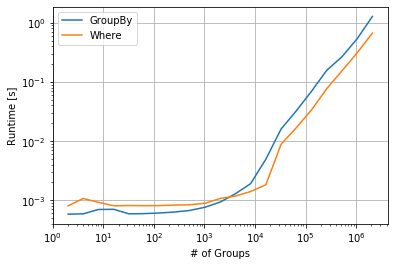
IFF your DataFrame is already sorted by the grouping keys you can use a single shift on the entire DataFrame and where to NaN the rows that overflow into the next group. For larger DataFrames with many groups this can be a bit faster.
df['prev_value'] = df['value'].shift().where(df.object.eq(df.object.shift()))

   object  period  value  prev_value
0       1       1     24         NaN
1       1       2     67        24.0
2       1       4     89        67.0
3       2       4      5         NaN
4       2      23     23         5.0
Some performance related timings:
import perfplot
import pandas as pd
import numpy as np

perfplot.show(
    setup=lambda N: pd.DataFrame({'object': np.repeat(range(N), 5),
                                  'value': np.random.randint(1, 1000, 5*N)}),
    kernels=[
        lambda df: df.groupby('object')['value'].shift(),
        lambda df: df['value'].shift().where(df.object.eq(df.object.shift())),
    ],
    labels=["GroupBy", "Where"],
    n_range=[2 ** k for k in range(1, 22)],
    equality_check=lambda x,y: np.allclose(x, y, equal_nan=True),
    xlabel="# of Groups"
)
All methods was sourced from stackoverflow.com or stackexchange.com, is licensed under cc by-sa 2.5, cc by-sa 3.0 and cc by-sa 4.0