I have a list of lists, something like
[[1, 2, 3,],[4, 5, 6,],[7, 8, 9]].
Represented graphically as:
1 2 3
4 5 6
7 8 9
I’m looking for an elegant approach to check the value of neighbours of a cell, horizontally, vertically and diagonally. For instance, the neighbours of [0][2] are [0][1], [1][1] and [1][2] or the numbers 2, 5, 6.
Now I realise, I could just do a bruteforce attack checking every value a la:
[i-1][j]
[i][j-1]
[i-1][j-1]
[i+1][j]
[i][j+1]
[i+1][j+1]
[i+1][j-1]
[i-1][j+1]
But thats easy, and I figured I can learn more by seeing some more elegant approaches.
Answers:
Thank you for visiting the Q&A section on Magenaut. Please note that all the answers may not help you solve the issue immediately. So please treat them as advisements. If you found the post helpful (or not), leave a comment & I’ll get back to you as soon as possible.
Method 1
# Size of "board"
X = 10
Y = 10

neighbors = lambda x, y : [(x2, y2) for x2 in range(x-1, x+2)
                               for y2 in range(y-1, y+2)
                               if (-1 < x <= X and
                                   -1 < y <= Y and
                                   (x != x2 or y != y2) and
                                   (0 <= x2 <= X) and
                                   (0 <= y2 <= Y))]

>>> print(neighbors(5, 5))
[(4, 4), (4, 5), (4, 6), (5, 4), (5, 6), (6, 4), (6, 5), (6, 6)]
I don’t know if this is considered clean, but this one-liner gives you all neighbors by iterating over them and discarding any edge cases.
Method 2
Assuming you have a square matrix:
from itertools import product

size = 3

def neighbours(cell):
    for c in product(*(range(n-1, n+2) for n in cell)):
        if c != cell and all(0 <= n < size for n in c):
            yield c
Using itertools.product and thanks to Python’s yield expression and star operator, the function is pretty dry but still readable enough.
Given a matrix size of 3, you can then (if needed) collect the neighbours in a list:
>>> list(neighbours((2,2)))
[(1, 1), (1, 2), (2, 1)]
What the function does can be visualized as follows:
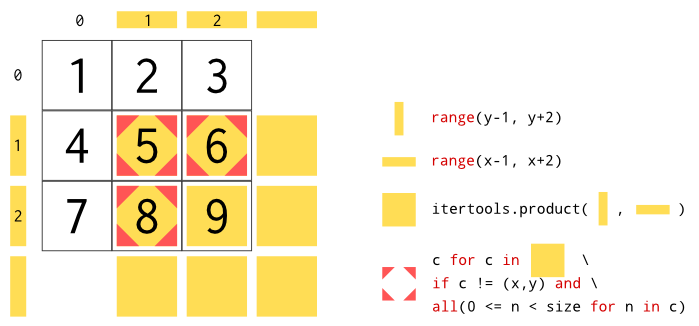
Method 3
mb…
from itertools import product, starmap

x, y = (8, 13)
cells = starmap(lambda a,b: (x+a, y+b), product((0,-1,+1), (0,-1,+1)))

// [(8, 12), (8, 14), (7, 13), (7, 12), (7, 14), (9, 13), (9, 12), (9, 14)]
print(list(cells)[1:])
Method 4
for x_ in range(max(0,x-1),min(height,x+2)):
  for y_ in range(max(0,y-1),min(width,y+2)):
    if (x,y)==(x_,y_): continue
    # do stuff with the neighbours

>>> a=[[1, 2, 3], [4, 5, 6], [7, 8, 9]]
>>> width=height=3
>>> x,y=0,2
>>> for x_ in range(max(0,x-1),min(height,x+2)):
...   for y_ in range(max(0,y-1),min(width,y+2)):
...     if (x,y)==(x_,y_): continue
...     print a[x_][y_]
...
2
5
6
Method 5
If someone is curious about alternative way to pick direct (non-diagonal) neighbors, here you go:
neighbors = [(x+a[0], y+a[1]) for a in
                    [(-1,0), (1,0), (0,-1), (0,1)]
                    if ( (0 <= x+a[0] < w) and (0 <= y+a[1] < h))]
Method 6
There’s no cleaner way to do this. If you really want you could create a function:
def top(matrix, x, y):
     try:
         return matrix[x][y - 1];
     except IndexError:
         return None
Method 7
Here is your list:
(x - 1, y - 1) (x, y - 1) (x + 1, y - 1)
(x - 1, y)     (x, y)     (x + 1, y)
(x - 1, y + 1) (x, y + 1) (x + 1, y + 1)
So the horizontal neighbors of (x, y) are (x +/- 1, y).
The vertical neighbors are (x, y +/- 1).
Diagonal neighbors are (x +/- 1, y +/- 1).
These rules apply for an infinite matrix.
To make sure the neighbors fit into a finite matrix, if the initial (x, y) is at the edge, just apply one more restriction to the coordinates of neighbors – the matrix size.
Method 8
>>> import itertools
>>> def sl(lst, i, j):
    il, iu = max(0, i-1), min(len(lst)-1, i+1)
    jl, ju = max(0, j-1), min(len(lst[0])-1, j+1)
    return (il, iu), (jl, ju)

>>> lst = [[1, 2, 3], [4, 5, 6], [7, 8, 9]]
>>> tup = 0, 2
>>> [lst[i][j] for i, j in itertools.product(*sl(lst, *tup)) if (i, j) != tup]
[2, 5, 6]
I don’t know how elegant it seems to you, but it seems to work w/o any hard-coding.
Method 9
This generates all indices:
def neighboring( array ):
    nn,mm = len(array), len(array[0])
    offset = (0,-1,1) # 0 first so the current cell is the first in the gen
    indices = ( (i,j) for i in range(nn) for j in range(mm) )
    for i,j in indices:
        all_neigh =  ( (i+x,j+y) for x in offset for y in offset )
        valid = ( (i,j) for i,j in all_neigh if (0<=i<nn) and (0<=j<mm) ) # -1 is a valid index in normal lists, but not here so throw it out
        yield valid.next(), valid ## first is the current cell, next are the neightbors

for (x,y), neigh in neighboring( l ):
    print l[x][y], [l[x][y] for x,y in neigh]
Method 10
If lambdas daunt you here you are .But lambdas make your code look [email protected]_comp has a very clean solution TBH
k,l=(2,3)
x = (0,-1,+1)
y = (0,-1,+1)
cell_u = ((k+a,l+b) for a in x for b in y)
print(list(cell_u))
Method 11
Inspired by one of the previous answers.
You can use min() and max() functions to shorten the calculations:
width = 3
height = 3

[(x2, y2) for x2 in range(max(0, x-1), min(width, x+2))
                    for y2 in range(max(0, y-1), min(height, y+2))
                    if (x2, y2) != (x, y)]
Method 12
Thank you to @JS_is_bad for a great hint about the neighbors. Here is the running code for this problem:
    def findNeighbours(l,elem):
    #This try is for escaping from unbound error that happens
    #when we try to iterate through indices that are not in array
    try:
        #Iterate through each item of multidimensional array using enumerate
        for row,i in enumerate(l):
            try:
                #Identifying the column index of the givem element
                column=i.index(elem)
            except ValueError:
                continue
            x,y=row,column

    #    hn=list(((x,y+1),(x,y-1))) #horizontal neighbours=(x,y+/-1)
    #    vn=list(((x+1,y),(x-1,y))) #vertical neighbours=(x+/-1,y)
    #    dn=list(((x+1,y+1),(x-1,y-1),(x+1,y-1),(x-1,y+1))) #diagonal neighbours=(x+/-1,y+/-1)
        #Creating a list with values that are actual neighbors for the extracted index of array
        neighbours=[(x,y+1),(x,y-1),(x+1,y),(x-1,y),(x+1,y+1),(x-1,y-1),(x+1,y-1),(x-1,y+1)]
        #Creating a universe of indices from given array
        index_list=[(i,j) for i in range(len(l)) for j in range(len(l[i]))]
        #Looping through index_list and nested loop for neighbours but filter for matched ones
        # and extract the value of respective index
        return_values=[l[index[0]][index[1]] for index in index_list for neighbour in neighbours if index==neighbour]
        return return_values,neighbours
    except UnboundLocalError:
        return []
Method 13
Inspired by johniek’s answer here is my solution which also checks for boundaries.
def get_neighbours(node, grid_map):
   row_index, col_index = node
   height, width = len(grid_map), len(grid_map[0])
   cells = list(starmap(lambda a, b: (row_index + a, col_index + b), product((0, -1, +1), (0, -1, +1))))
   cells.pop(0) #  do not include original node
   cells = list(filter(lambda cell: cell[0] in range(height) and cell[1] in range(width), cells))
   return cells
Method 14
def numCells(grid):
    x=len(grid)
    y=len(grid[0])
    c=0
    for i in range(x):
        for j in range(y):
            value_=grid[i][j]
            f=1
            for i2 in range(max(0,i-1),min(x,i+2)):
                for j2 in range(max(0,j-1),min(y,j+2)):
                    if (i2,j2) != (i,j) and value_<=grid[i2][j2]:
                        flag=0
                        break
                if flag ==0:
                    break
                else:
                    c+=1
    return c
Method 15
maybe you are checking a sudoku box. If the box is n x n and current cell is (x,y) start checking:
startingRow = x / n * n;
startingCol = y/ n * n
All methods was sourced from stackoverflow.com or stackexchange.com, is licensed under cc by-sa 2.5, cc by-sa 3.0 and cc by-sa 4.0