I am interested in plotting a legend in my scatterplot. My current code looks like this
x=[1,2,3,4]
y=[5,6,7,8]
classes = [2,4,4,2]
plt.scatter(x, y, c=classes, label=classes)
plt.legend()
The problem is that when the plot is created, the legend is shown as an array instead of showing the unique labels and their classes.
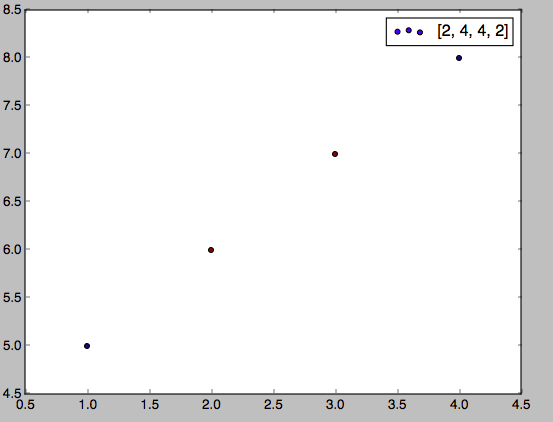
I am aware this is a question discussed previously in threads such as this one, however I feel that my problem is even simpler and the solution there does not fits it. Also, in that example the person is specifying the colors however in my case I do know beforehand how many colors I’ll need. Moreover, in this example the user is creating multiple scatters, each one with a unique color. Again, this is not what I want. My goal is to simply create the plot using an x,y array and the labels. Is this possible?
Thanks.
Answers:
Thank you for visiting the Q&A section on Magenaut. Please note that all the answers may not help you solve the issue immediately. So please treat them as advisements. If you found the post helpful (or not), leave a comment & I’ll get back to you as soon as possible.
Method 1
Actually both linked questions provide a way how to achieve the desired result.
The easiest method is to create as many scatter plots as unique classes exist and give each a single color and legend entry.
import matplotlib.pyplot as plt

x=[1,2,3,4]
y=[5,6,7,8]
classes = [2,4,4,2]
unique = list(set(classes))
colors = [plt.cm.jet(float(i)/max(unique)) for i in unique]
for i, u in enumerate(unique):
    xi = [x[j] for j  in range(len(x)) if classes[j] == u]
    yi = [y[j] for j  in range(len(x)) if classes[j] == u]
    plt.scatter(xi, yi, c=colors[i], label=str(u))
plt.legend()

plt.show()
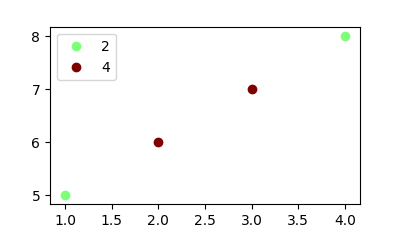
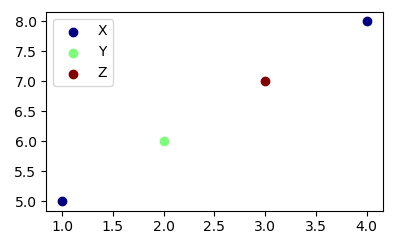
In case the classes are string labels, the solution would look slightly different, in that you need to get the colors from their index instead of using the classes themselves.
import numpy as np
import matplotlib.pyplot as plt

x=[1,2,3,4]
y=[5,6,7,8]
classes = ['X','Y','Z','X']
unique = np.unique(classes)
colors = [plt.cm.jet(i/float(len(unique)-1)) for i in range(len(unique))]
for i, u in enumerate(unique):
    xi = [x[j] for j  in range(len(x)) if classes[j] == u]
    yi = [y[j] for j  in range(len(x)) if classes[j] == u]
    plt.scatter(xi, yi, c=colors[i], label=str(u))
plt.legend()

plt.show()
Method 2
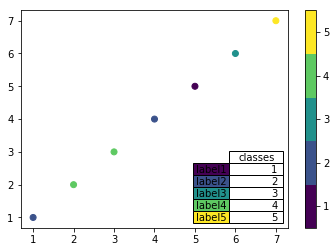
Maybe manually filling a table could be useful here. Another idea is using colorbar if your classes are contiguous numbers. I’m showing both approaches in one.
import matplotlib.pyplot as plt
import numpy as np

x=[1,2,3,4,5,6,7]
y=[1,2,3,4,5,6,7]
classes = [2,4,4,2,1,3,5]
cmap = plt.cm.get_cmap("viridis",5)
plt.scatter(x, y, c=classes, label=classes,cmap=cmap,vmin=0.5,vmax=5.5)
plt.colorbar()
unique_classes = list(set(classes))
plt.table(cellText=[[x] for x in unique_classes], loc='lower right',
          colWidths=[0.2],rowColours=cmap(np.array(unique_classes)-1),
         rowLabels=['label%d'%x for x in unique_classes],
          colLabels=['classes'])
All methods was sourced from stackoverflow.com or stackexchange.com, is licensed under cc by-sa 2.5, cc by-sa 3.0 and cc by-sa 4.0