Maybe groupby is the wrong approach. Seems like it should work but I’m not seeing it…
I want to group an event by it’s outcome. Here is my DataFrame (df):
Status  Event
SUCCESS Run
SUCCESS Walk
SUCCESS Run
FAILED  Walk
Here is my desired result:
Event   SUCCESS FAILED
Run     2       1
Walk    0       1
I’m trying to make a grouped object but I can’t figure out how to call it to display what I want.
grouped = df['Status'].groupby(df['Event'])
Answers:
Thank you for visiting the Q&A section on Magenaut. Please note that all the answers may not help you solve the issue immediately. So please treat them as advisements. If you found the post helpful (or not), leave a comment & I’ll get back to you as soon as possible.
Method 1
try this:
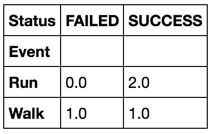
 pd.crosstab(df.Event, df.Status)

Status  FAILED  SUCCESS
Event
Run          0        2
Walk         1        1


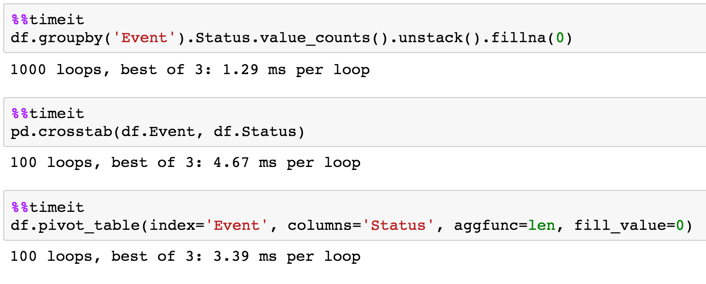
len("df.groupby('Event').Status.value_counts().unstack().fillna(0)")
61

len("df.pivot_table(index='Event', columns='Status', aggfunc=len, fill_value=0)")
74

len("pd.crosstab(df.Event, df.Status)")
32
Method 2
I’d do:
df.groupby('Event').Status.value_counts().unstack().fillna(0)
Or use the fill_value argument:
df.groupby('Event').Status.value_counts().unstack(fill_value=0)
Timing
Method 3
An alternative solution, using pivot_table() method:
In [5]: df.pivot_table(index='Event', columns='Status', aggfunc=len, fill_value=0)
Out[5]:
Status  FAILED  SUCCESS
Event
Run          0        2
Walk         1        1
Timing against 700K DF:
In [74]: df.shape
Out[74]: (700000, 2)

In [75]: # (c) Merlin

In [76]: %%timeit
   ....: pd.crosstab(df.Event, df.Status)
   ....:
1 loop, best of 3: 333 ms per loop

In [77]: # (c) piRSquared

In [78]: %%timeit
   ....: df.groupby('Event').Status.value_counts().unstack().fillna(0)
   ....:
1 loop, best of 3: 325 ms per loop

In [79]: # (c) MaxU

In [80]: %%timeit
   ....: df.pivot_table(index='Event', columns='Status',
   ....:                aggfunc=len, fill_value=0)
   ....:
1 loop, best of 3: 367 ms per loop

In [81]: # (c) ayhan

In [82]: %%timeit
   ....: (df.assign(ones = np.ones(len(df)))
   ....:    .pivot_table(index='Event', columns='Status',
   ....:                 aggfunc=np.sum, values = 'ones')
   ....: )
   ....:
1 loop, best of 3: 264 ms per loop

In [83]: # (c) Divakar

In [84]: %%timeit
   ....: unq1,ID1 = np.unique(df['Event'],return_inverse=True)
   ....: unq2,ID2 = np.unique(df['Status'],return_inverse=True)
   ....: # Get linear indices/tags corresponding to grouped headers
   ....: tag = ID1*(ID2.max()+1) + ID2
   ....: # Setup 2D Numpy array equivalent of expected Dataframe
   ....: out = np.zeros((len(unq1),len(unq2)),dtype=int)
   ....: unqID, count = np.unique(tag,return_counts=True)
   ....: np.put(out,unqID,count)
   ....: # Finally convert to Dataframe
   ....: df_out = pd.DataFrame(out,columns=unq2)
   ....: df_out.index = unq1
   ....:
1 loop, best of 3: 2.25 s per loop
Conclusion: the @ayhan‘s solution currently wins:
(df.assign(ones = np.ones(len(df)))
   .pivot_table(index='Event', columns='Status', values = 'ones',
                aggfunc=np.sum, fill_value=0)
)
Method 4
Here’s a NumPy based approach –
# Get unique header strings for input dataframes
unq1,ID1 = np.unique(df['Event'],return_inverse=True)
unq2,ID2 = np.unique(df['Status'],return_inverse=True)

# Get linear indices/tags corresponding to grouped headers
tag = ID1*(ID2.max()+1) + ID2

# Setup 2D Numpy array equivalent of expected Dataframe
out = np.zeros((len(unq1),len(unq2)),dtype=int)
unqID, count = np.unique(tag,return_counts=True)
np.put(out,unqID,count)

# Finally convert to Dataframe
df_out = pd.DataFrame(out,columns=unq2)
df_out.index = unq1
Sample input, output on a more generic case –
In [179]: df
Out[179]:
  Event   Status
0   Sit     PASS
1   Run  SUCCESS
2  Walk  SUCCESS
3   Run     PASS
4   Run  SUCCESS
5  Walk   FAILED
6  Walk     PASS

In [180]: df_out
Out[180]:
      FAILED  PASS  SUCCESS
Run        0     1        2
Sit        0     1        0
Walk       1     1        1
All methods was sourced from stackoverflow.com or stackexchange.com, is licensed under cc by-sa 2.5, cc by-sa 3.0 and cc by-sa 4.0