Let’s say I have the following 2D numpy array consisting of four rows and three columns:
>>> a = numpy.arange(12).reshape(4,3)
>>> print(a)
[[ 0  1  2]
 [ 3  4  5]
 [ 6  7  8]
 [ 9 10 11]]
What would be an efficient way to generate a 1D array that contains the sum of all columns (like [18, 22, 26])? Can this be done without having the need to loop through all columns?
Answers:
Thank you for visiting the Q&A section on Magenaut. Please note that all the answers may not help you solve the issue immediately. So please treat them as advisements. If you found the post helpful (or not), leave a comment & I’ll get back to you as soon as possible.
Method 1
Check out the documentation for numpy.sum, paying particular attention to the axis parameter. To sum over columns:
>>> import numpy as np
>>> a = np.arange(12).reshape(4,3)
>>> a.sum(axis=0)
array([18, 22, 26])
Or, to sum over rows:
>>> a.sum(axis=1)
array([ 3, 12, 21, 30])
Other aggregate functions, like numpy.mean, numpy.cumsum and numpy.std, e.g., also take the axis parameter.
From the Tentative Numpy Tutorial:
Many unary operations, such as computing the sum of all the elements
in the array, are implemented as methods of thendarrayclass. By
default, these operations apply to the array as though it were a list
of numbers, regardless of its shape. However, by specifying theaxis
parameter you can apply an operation along the specified axis of an
array:
Method 2
Other alternatives for summing the columns are
numpy.einsum('ij->j', a)
and
numpy.dot(a.T, numpy.ones(a.shape[0]))
If the number of rows and columns is in the same order of magnitude, all of the possibilities are roughly equally fast:
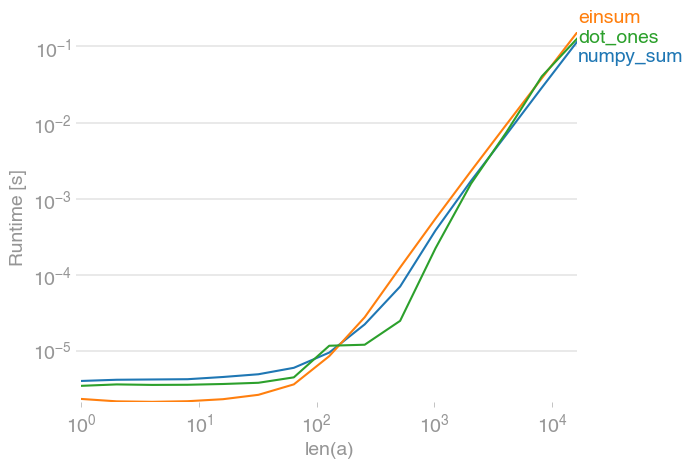
If there are only a few columns, however, both the einsum and the dot solution significantly outperform numpy’s sum (note the log-scale):
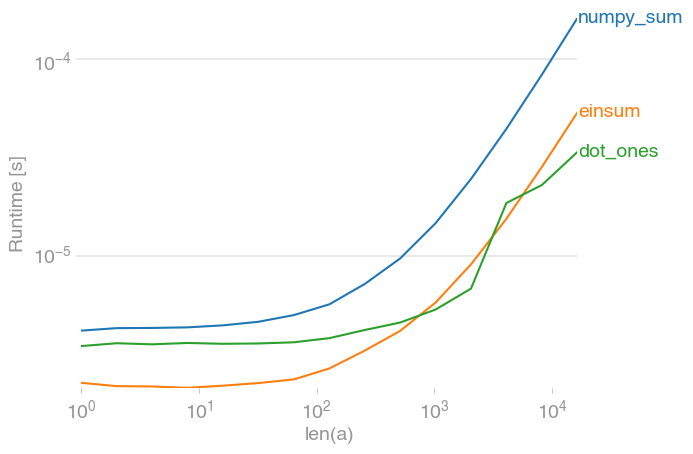
Code to reproduce the plots:
import numpy
import perfplot


def numpy_sum(a):
    return numpy.sum(a, axis=1)


def einsum(a):
    return numpy.einsum('ij->i', a)


def dot_ones(a):
    return numpy.dot(a, numpy.ones(a.shape[1]))


perfplot.save(
    "out1.png",
    # setup=lambda n: numpy.random.rand(n, n),
    setup=lambda n: numpy.random.rand(n, 3),
    n_range=[2**k for k in range(15)],
    kernels=[numpy_sum, einsum, dot_ones],
    logx=True,
    logy=True,
    xlabel='len(a)',
    )
Method 3
Use the axis argument:
>> numpy.sum(a, axis=0)
  array([18, 22, 26])
Method 4
Use numpy.sum. for your case, it is
sum = a.sum(axis=0)
Method 5
Then NumPy sum function takes an optional axis argument that specifies along which axis you would like the sum performed:
>>> a = numpy.arange(12).reshape(4,3)
>>> a.sum(0)
array([18, 22, 26])
Or, equivalently:
>>> numpy.sum(a, 0)
array([18, 22, 26])
Method 6
a.sum(0)
should solve the problem. It is a 2d np.array and you will get the sum of all column. axis=0 is the dimension that points downwards and axis=1 the one that points to the right.
All methods was sourced from stackoverflow.com or stackexchange.com, is licensed under cc by-sa 2.5, cc by-sa 3.0 and cc by-sa 4.0