I’ve installed Anaconda and created two extra environments: py3k (which holds Python 3.3) and py34 (which holds Python 3.4). Besides those, I have a default environment named ‘root’ which the Anaconda installer created by default and which holds Python 2.7. This last one is the default, whenever I launch ‘ipython’ from the terminal it gives me version 2.7. In order to work with Python 3.4, I need to issue the commands (in the shell)
source activate py34
ipython
which change the default environment to Python 3.4. This works fine, but it’s annoying since most of the time I work on Python 3.4, instead of Python 2.7 (which I hold for teaching purposes, it’s a rather long story). Anyway, I’ll like to know how to change the default environment to Python 3.4, bearing in mind that I don’t want to reinstall everything from scratch.
Answers:
Thank you for visiting the Q&A section on Magenaut. Please note that all the answers may not help you solve the issue immediately. So please treat them as advisements. If you found the post helpful (or not), leave a comment & I’ll get back to you as soon as possible.
Method 1
If you just want to temporarily change to another environment, use
source activate environment-name
ETA: This may be deprecated. I believe the current correct command is:
source conda activate environment-name
(you can create environment-name with conda create)
To change permanently, there is no method except creating a startup script that runs the above code.
Typically it’s best to just create new environments. However, if you really want to change the Python version in the default environment, you can do so as follows:
First, make sure you have the latest version of conda by running
conda update conda
Then run
conda install python=3.5
This will attempt to update all your packages in your root environment to Python 3 versions. If it is not possible (e.g., because some package is not built for Python 3.5), it will give you an error message indicating which package(s) caused the issue.
If you installed packages with pip, you’ll have to reinstall them.
Method 2
Overview
Some people have multiple Anaconda environments with different versions of python for compatibility reasons. In this case, you should have a script that sets your default environment. With this method, you can preserve the versions of python you use in your environments.
The following assumes environment_name is the name of your environment
Mac / Linux:
Edit your bash profile so that the last line is source activate environment_name. In Mac OSX this is ~/.bash_profile, in other environments this may be ~/.bashrc
Example:
Here’s how i did it on Mac OSX
-
Open Terminal and type:
nano ~/.bash_profile -
Go to end of file and type the following, where “p3.5” is my environment:
source activate p3.5 - Exit File. Start a new terminal window.
-
Type the following to see what environment is active
conda info -e
The result shows that I’m using my p3.5 environment by default.
For Windows:
Create a command file (.cmd) with activate environment_name and follow these instructions to have it execute whenever you open a command prompt
- Create a batch file command, e.g. “my_conda.cmd”, put it in the Application Data folder.
- Configure it to be started automatically whenever you open
cmd. This setting is in Registry:
key: HKCUSOFTWAREMicrosoftCommand Processor
value: AutoRun
type: REG_EXPAND_SZ
data: “%AppData%my_conda.cmd”
from this answer: https://superuser.com/a/302553/143794
Method 3
Under Linux there is an easier way to set the default environment by modifying ~/.bashrc or ~/.bash_profile
At the end you’ll find something like
# added by Anaconda 2.1.0 installer
export PATH="~/anaconda/bin:$PATH"
Replace it with
# set python3 as default
export PATH="~/anaconda/envs/python3/bin:$PATH"
and thats all there is to it.
Method 4
For windows Anaconda comes with Anaconda Prompt which is a shortcut to cmd and can be used run conda commands without adding anaconda in PATH variable.
Find the location of it, copy and rename the copy (say myenv_prompt). Right click myenv_prompt and select properties in the context menu.
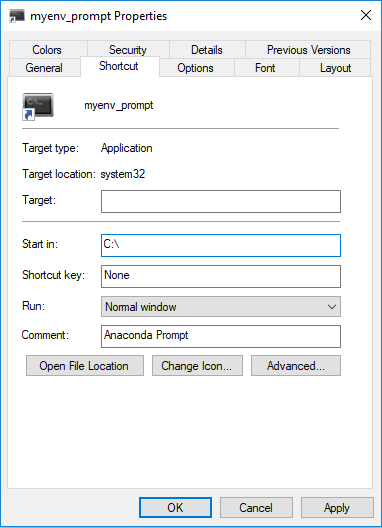
The Target form of Properties window should already be filled with text, something like %windir%system32cmd.exe "/K" C:UsersxxxAppDataLocalContinuumMiniconda3Scriptsactivate.bat C:UsersxxxAppDataLocalContinuumMiniconda3
There are three parts of this command 1)start …cmd.exe 2)run …acitvate.bat with environment 3)…Miniconda3
Change 3rd part to path of the environment (say myenv) you want as default i.e. fill the Target form something like %windir%system32cmd.exe "/K" C:UsersxxxAppDataLocalContinuumMiniconda3Scriptsactivate.bat C:UsersxxxAppDataLocalContinuumMiniconda3envsmyenv
Now myenv_prompt will act as shortcut to start cmd with myenv as the default environment for python. This shortcut you can keep in start menu or pinned in taskbar.
One advantage of this method is that you can create a few shortcuts each having different environment as default environment. Also you can set the default folder by filling Start in form of the Properties window
Hope this helps
PS:It is not required to find Anaconda Prompt and can be done by changing target of any shortcut. But you will require to know path of cmd.exe and activate.bat
Method 5
The correct answer (as of Dec 2018) is… you can’t. Upgrading conda install python=3.6 may work, but it might not if you have packages that are necessary, but cannot be uninstalled.
Anaconda uses a default environment named base and you cannot create a new (e.g. python 3.6) environment with the same name. This is intentional. If you want your base Anaconda to be python 3.6, the right way to do this is to install Anaconda for python 3.6. As a package manager, the goal of Anaconda is to make different environments encapsulated, hence why you must source activate into them and why you can’t just quietly switch the base package at will as this could lead to many issues on production systems.
Method 6
Just activate your py34 environment when you load your terminal/shell.
If you use Bash, put the line:
conda activate py34
in your .bash_profile (or .bashrc):
$ echo 'conda activate py34' >> ~/.bash_profile
Every time you run a new terminal, conda environment py34 will be loaded.
Method 7
Change permanent
conda install python={version}
Change Temporarily
View your environments
run conda info --envs on your terminal window or an Anconda Prompt
If It doesn’t show environment that you want to install
run conda create -n py36 python=3.6 anaconda for python 3.6 change version as your prefer
Activating an environment (use Anaconda prompt)
run activate envnme envnme you can find by this commandconda info --envs as a example when you run conda info --envs it show
base *  C:UsersDulangaHeshanAnaconda3

 py36    C:UsersDulangaHeshanAnaconda3envspy36
then run activate py36
to check run python --version
In Windows, it is good practice to deactivate one environment before activating another.
https://docs.conda.io/projects/conda/en/latest/user-guide/tasks/manage-environments.html?highlight=deactivate%20environment
Method 8
On Windows, create a batch file with the following line in it:
start cmd /k "C:Anaconda3Scriptsactivate.bat C:Anaconda3 & activate env"
The first path contained in quotes is the path to the activate.bat file in the Anaconda installation. The path on your system might be different. The name following the activate command of course should be your desired environment name.
Then run the batch file when you need to open an Anaconda prompt.
Method 9
If you want Anaconda Navigator to default to Virtual Env you created, go to file > Preference and select default conda env in drop down lint:
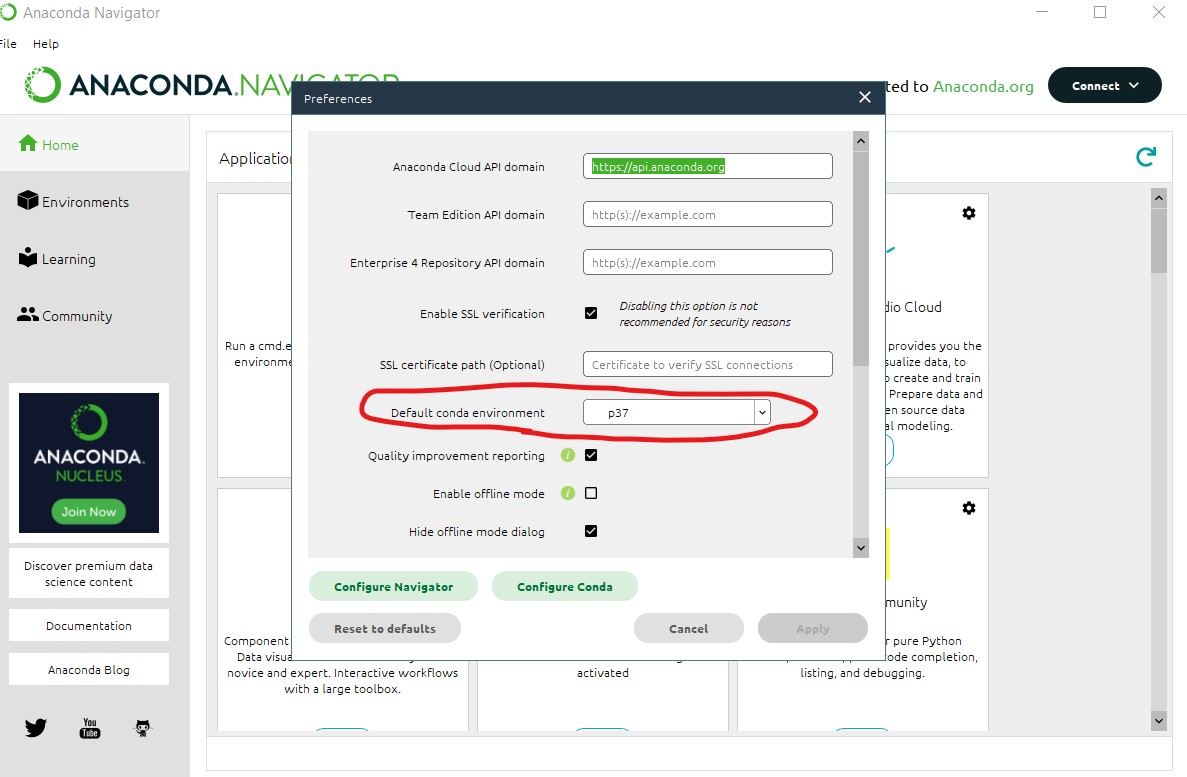
If you want Anaconda command automatically opens to virtual env without having to type activate envName, do this:
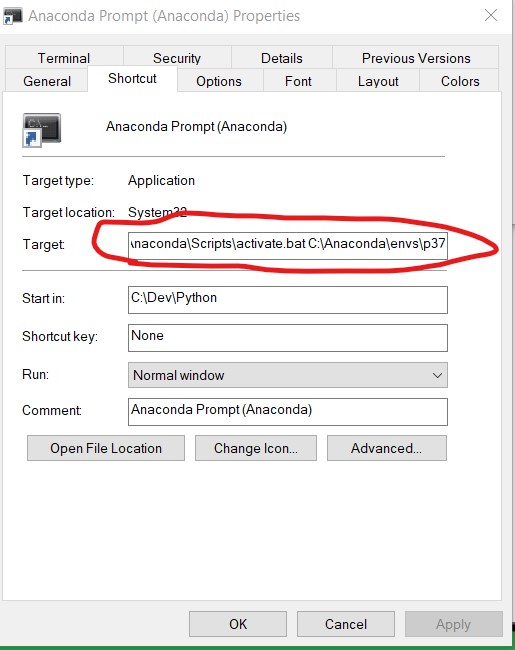
Right click on conda shortcut > go to properties and change the Target to something like this:
%windir%System32cmd.exe "/K" C:AnacondaScriptsactivate.bat C:Anacondaenvsp37
Optionally you can set your default working dir as well, like I did in snapshop below:
gl
Method 10
I wasn’t satisfied with any of the answers presented here, since activating an environment takes a few seconds on my platform (for whatever reason)
I modified my path variable so that the environment I want as default has priority over the actual default.
In my case I used the following commands to accomplish that for the environment “py35”:
setx PATH "%userprofile%Anaconda3envspy35;%PATH%"
setx PATH "%userprofile%Anaconda3envspy35Scripts;%PATH%"
to find out where your environment is stored, activate it and enter where python.
I’m not sure yet if this approach has any downsides. Since it also changes the default path of the conda executable. If that should be the case, please comment.
Method 11
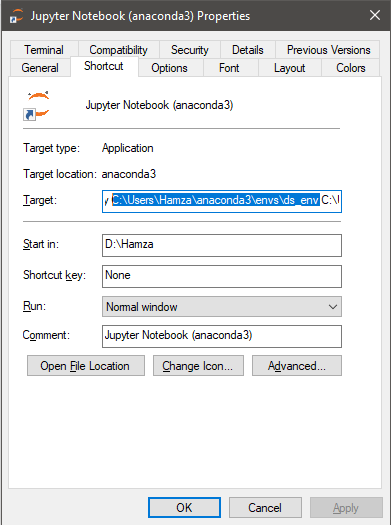
For Jupyter and Windows users, you can change the Target path in your Jupyter Notebook (anaconda3) shortcut from C:Users<YourUserName>anaconda3 to C:Users<YourUserName>anaconda3envs<YourEnvironmentName>
you could do the same thing for the Anaconda Prompt..etc.
After changing the path you can check your active environment by opening a terminal in Jupyter and run conda info --envs.
Method 12
Here is the solution I found for autoactivating my preferred environment on a Windows 10 system:
- Open anaconda prompt & use ‘conda env list’ to find the location of the environment you wish to use.
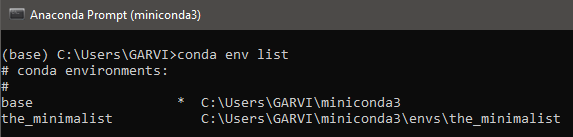
- Go to the start menu, right-click ‘Anaconda Prompt’ and go to file location.

- Create a copy of this shortcut file
- Open its properties & change the target to the location of your preferred environment.
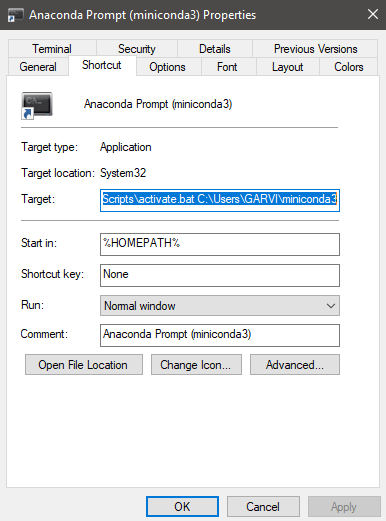
Now every time you open anaconda prompt through this shortcut it will automatically load your chosen environment.
Method 13
I got this when installing a library using anaconda. My version went from Python 3.* to 2.7 and a lot of my stuff stopped working.
The best solution I found was to first see the most recent version available:
conda search python
Then update to the version you want:
conda install python=3.*.*
Source: http://chris35wills.github.io/conda_python_version/
Other helpful commands:
conda info
python --version
Method 14
Create a shortcut of anaconda prompt onto desktop or taskbar, and then in the properties of that shortcut make sure u modify the last path in “Target:” to the path of ur environment:
C:UsersBenBoualiAnaconda3 WILL CHANGE INTO
C:UsersBenBoualiAnaconda3envstensorflow-gpu
and this way u can use that shortcut to open a certain environment when clicking it, you can add it to ur path too and now you’ll be able to run it from windows run box by just typing in the name of the shortcut.
Method 15
Tried both source activate default_3_9 and source conda activate default_3_9
but worked conda activate default_3_9
Method 16
activate.py is hardcoded to emit conda activate basen into your shell profile when you evaluate the shell hook produced by conda shell.zsh hook.
you can suppress this hardcoded “auto-activate base” via:
conda config --set auto_activate_base false
then, in ~/.zshrc, ~/.bashrc or wherever you source your shell profile from, you can append the following (after the conda shell hook) to explicitly activate the environment of your choosing:
conda activate py34
All methods was sourced from stackoverflow.com or stackexchange.com, is licensed under cc by-sa 2.5, cc by-sa 3.0 and cc by-sa 4.0