I am drawing a plot using matplotlib and python like the sample code below.
x = array([0,1,2,3])
y = array([20,21,22,23])
plot(x,y)
show()
As it is the code above on the x axis I will see drawn values 0.0, 0.5, 1.0, 1.5 i.e. the same values of my reference x values.
Is there anyway to map each point of x to a different string? So for example I want x axis to show months names( strings Jun, July,...) or other strings like people names ( "John", "Arnold", ... ) or clock time ( "12:20", "12:21", "12:22", .. ).
Do you know what I can do or what function to have a look at?
For my purpose could it be matplotlib.ticker of help?
Answers:
Thank you for visiting the Q&A section on Magenaut. Please note that all the answers may not help you solve the issue immediately. So please treat them as advisements. If you found the post helpful (or not), leave a comment & I’ll get back to you as soon as possible.
Method 1
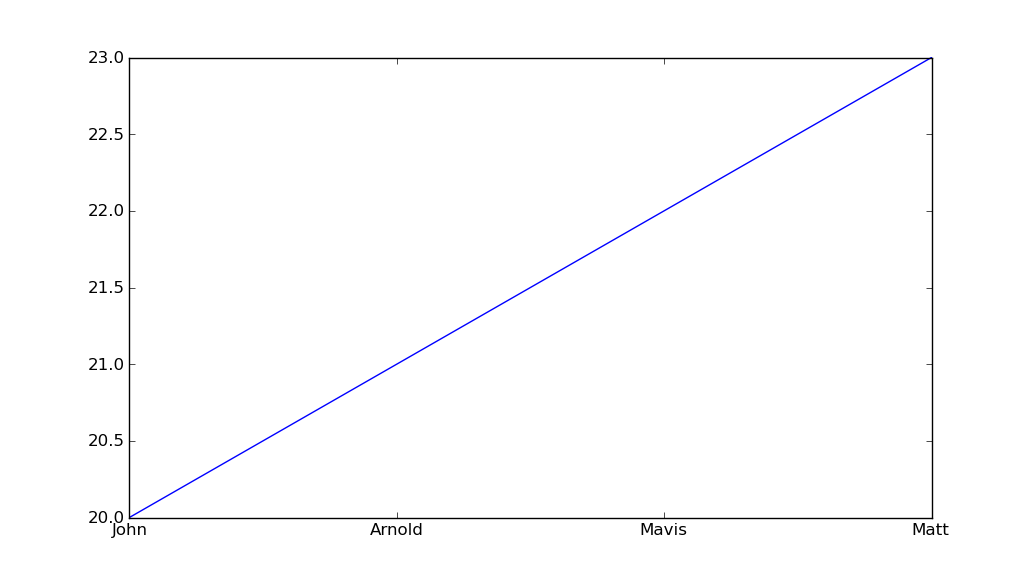
You can manually set xticks (and yticks) using pyplot.xticks:
import matplotlib.pyplot as plt
import numpy as np

x = np.array([0,1,2,3])
y = np.array([20,21,22,23])
my_xticks = ['John','Arnold','Mavis','Matt']
plt.xticks(x, my_xticks)
plt.plot(x, y)
plt.show()
Method 2
This worked for me. Each month on X axis
str_month_list = ['January','February','March','April','May','June','July','August','September','October','November','December']
ax.set_xticks(range(0,12))
ax.set_xticklabels(str_month_list)
Method 3
For a more elaborate example:
def plot_with_error_bands(x: np.ndarray, y: np.ndarray, yerr: np.ndarray,
                          xlabel: str, ylabel: str,
                          title: str,
                          curve_label: Optional[str] = None,
                          error_band_label: Optional[str] = None,
                          x_vals_as_symbols: Optional<div class="su-list" style="margin-left:0px"></div>] = None,
                          color: Optional[str] = None, ecolor: Optional[str] = None,
                          linewidth: float = 1.0,
                          style: Optional[str] = 'default',
                          capsize: float = 3.0,
                          alpha: float = 0.2,
                          show: bool = False
                          ):
    """
    note:
        - example values for color and ecolor:
            color='tab:blue', ecolor='tab:blue'
        - capsize is the length of the horizontal line for the error bar. Larger number makes it longer horizontally.
        - alpha value create than 0.2 make the error bands color for filling it too dark. Really consider not changing.
        - sample values for curves and error_band labels:
            curve_label: str = 'mean with error bars',
            error_band_label: str = 'error band',
    refs:
        - for making the seaborn and matplot lib look the same see: https://stackoverflow.com/questions/54522709/my-seaborn-and-matplotlib-plots-look-the-same
    """
    if style == 'default':
        # use the standard matplotlib
        plt.style.use("default")
    elif style == 'seaborn' or style == 'sns':
        # looks idential to seaborn
        import seaborn as sns
        sns.set()
    elif style == 'seaborn-darkgrid':
        # uses the default colours of matplot but with blue background of seaborn
        plt.style.use("seaborn-darkgrid")
    elif style == 'ggplot':
        # other alternative to something that looks like seaborn
        plt.style.use('ggplot')

    # ax = plt.gca()
    # fig = plt.gcf(
    # fig, axs = plt.subplots(nrows=1, ncols=1, sharex=True, tight_layout=True)
    # - if symbols in x axis instead of raw x value
    if x_vals_as_symbols is not None:
        # plt.xticks(x, [f'val{v}' for v in x]) to test
        plt.xticks(x, x_vals_as_symbols)
    # - plot bands
    plt.errorbar(x=x, y=y, yerr=yerr, color=color, ecolor=ecolor,
                 capsize=capsize, linewidth=linewidth, label=curve_label)
    plt.fill_between(x=x, y1=y - yerr, y2=y + yerr, alpha=alpha, label=error_band_label)
    plt.grid(True)
    if curve_label or error_band_label:
        plt.legend()
    plt.title(title)
    plt.xlabel(xlabel)
    plt.ylabel(ylabel)

    if show:
        plt.show()
e.g.
def plot_with_error_bands_xticks_test():
    import numpy as np  # v 1.19.2
    import matplotlib.pyplot as plt  # v 3.3.2

    # the number of x values to consider in a given range e.g. [0,1] will sample 10 raw features x sampled at in [0,1] interval
    num_x: int = 5
    # the repetitions for each x feature value e.g. multiple measurements for sample x=0.0 up to x=1.0 at the end
    rep_per_x: int = 5
    total_size_data_set: int = num_x * rep_per_x
    print(f'{total_size_data_set=}')
    # - create fake data set
    # only consider 10 features from 0 to 1
    x = np.linspace(start=0.0, stop=2*np.pi, num=num_x)

    # to introduce fake variation add uniform noise to each feature and pretend each one is a new observation for that feature
    noise_uniform: np.ndarray = np.random.rand(rep_per_x, num_x)
    # same as above but have the noise be the same for each x (thats what the 1 means)
    noise_normal: np.ndarray = np.random.randn(rep_per_x, 1)
    # signal function
    sin_signal: np.ndarray = np.sin(x)
    cos_signal: np.ndarray = np.cos(x)
    # [rep_per_x, num_x]
    y1: np.ndarray = sin_signal + noise_uniform + noise_normal
    y2: np.ndarray = cos_signal + noise_uniform + noise_normal

    y1mean = y1.mean(axis=0)
    y1err = y1.std(axis=0)
    y2mean = y2.mean(axis=0)
    y2err = y2.std(axis=0)

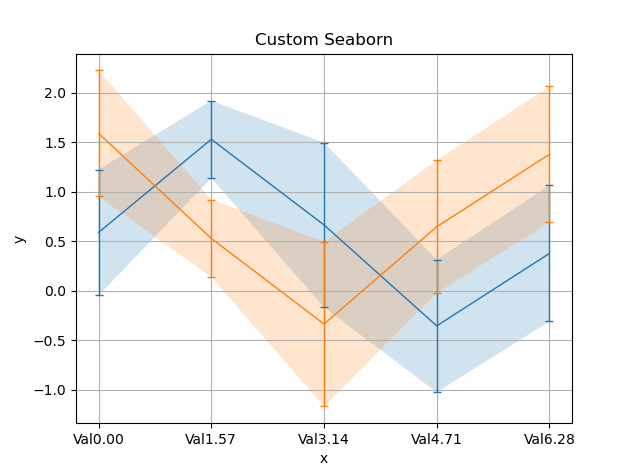
    x_vals_as_symbols: list[str] = [f'Val{v:0.2f}' for v in x]
    plot_with_error_bands(x=x, y=y1mean, yerr=y1err, xlabel='x', ylabel='y', title='Custom Seaborn', x_vals_as_symbols=x_vals_as_symbols)
    plot_with_error_bands(x=x, y=y2mean, yerr=y2err, xlabel='x', ylabel='y', title='Custom Seaborn', x_vals_as_symbols=x_vals_as_symbols)
    plt.show()
output:
All methods was sourced from stackoverflow.com or stackexchange.com, is licensed under cc by-sa 2.5, cc by-sa 3.0 and cc by-sa 4.0