r = {'is_claimed': 'True', 'rating': 3.5}
r = json.dumps(r)
file.write(str(r['rating']))
I am not able to access my data in the JSON. What am I doing wrong?
TypeError: string indices must be integers, not str
Answers:
Thank you for visiting the Q&A section on Magenaut. Please note that all the answers may not help you solve the issue immediately. So please treat them as advisements. If you found the post helpful (or not), leave a comment & I’ll get back to you as soon as possible.
Method 1
json.dumps() converts a dictionary to str object, not a json(dict) object! So you have to load your str into a dict to use it by using json.loads() method
See json.dumps() as a save method and json.loads() as a retrieve method.
This is the code sample which might help you understand it more:
import json

r = {'is_claimed': 'True', 'rating': 3.5}
r = json.dumps(r)
loaded_r = json.loads(r)
loaded_r['rating'] #Output 3.5
type(r) #Output str
type(loaded_r) #Output dict
Method 2
json.dumps() returns the JSON string representation of the python dict. See the docs
You can’t do r['rating'] because r is a string, not a dict anymore
Perhaps you meant something like
r = {'is_claimed': 'True', 'rating': 3.5}
json = json.dumps(r) # note i gave it a different name
file.write(str(r['rating']))
Method 3
json.dumps() is used to decode JSON data
json.loadstake a string as input and returns a dictionary as output.json.dumpstake a dictionary as input and returns a string as output.
import json

# initialize different data
str_data = 'normal string'
int_data = 1
float_data = 1.50
list_data = [str_data, int_data, float_data]
nested_list = [int_data, float_data, list_data]
dictionary = {
    'int': int_data,
    'str': str_data,
    'float': float_data,
    'list': list_data,
    'nested list': nested_list
}

# convert them to JSON data and then print it
print('String :', json.dumps(str_data))
print('Integer :', json.dumps(int_data))
print('Float :', json.dumps(float_data))
print('List :', json.dumps(list_data))
print('Nested List :', json.dumps(nested_list, indent=4))
print('Dictionary :', json.dumps(dictionary, indent=4))  # the json data will be indented
output:
String : "normal string"
Integer : 1
Float : 1.5
List : ["normal string", 1, 1.5]
Nested List : [
    1,
    1.5,
    [
        "normal string",
        1,
        1.5
    ]
]
Dictionary : {
    "int": 1,
    "str": "normal string",
    "float": 1.5,
    "list": [
        "normal string",
        1,
        1.5
    ],
    "nested list": [
        1,
        1.5,
        [
            "normal string",
            1,
            1.5
        ]
    ]
}
- Python Object to JSON Data Conversion
|                 Python                 |  JSON  |
|:--------------------------------------:|:------:|
|                  dict                  | object |
|               list, tuple              |  array |
|                   str                  | string |
| int, float, int- & float-derived Enums | number |
|                  True                  |  true  |
|                  False                 |  false |
|                  None                  |  null  |
UPDATE
In the JSON file
nested_dictionary = {
    'one': nested_list,
    'two': dictionary,

}

json_dict = {'Nested Dictionary': nested_dictionary,
             'Multiple':[nested_dictionary, nested_dictionary, nested_dictionary]
            }

with open("test_nested.json", "w") as outfile:
    json.dump(json_dict, outfile, indent=4, sort_keys=False)
chart response
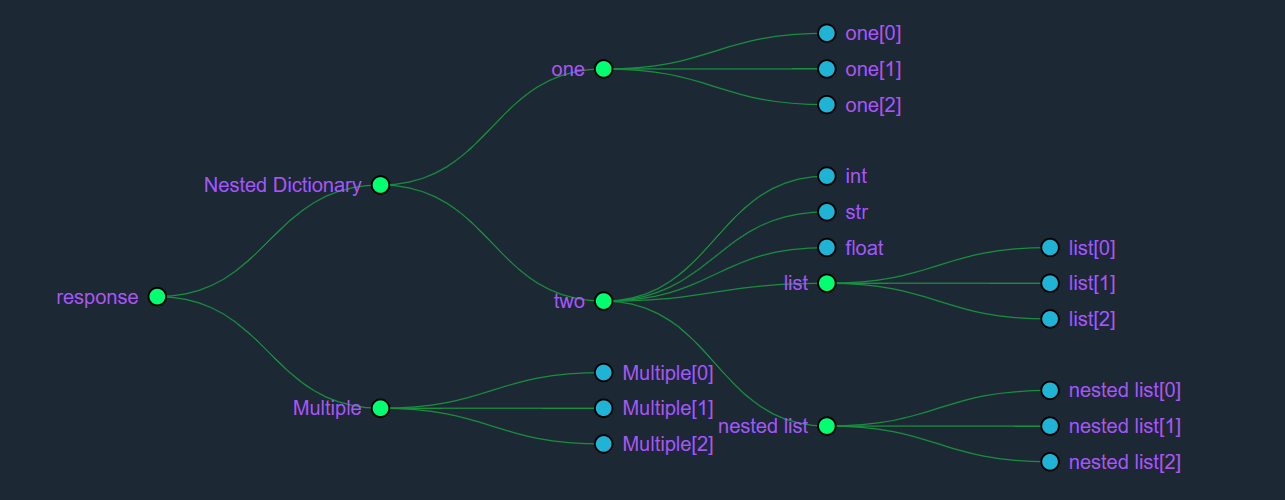
output into test_nested.json
{
    "Nested Dictionary": {
        "one": [
            1,
            1.5,
            [
                "normal string",
                1,
                1.5
            ]
        ],
        "two": {
            "int": 1,
            "str": "normal string",
            "float": 1.5,
            "list": [
                "normal string",
                1,
                1.5
            ],
            "nested list": [
                1,
                1.5,
                [
                    "normal string",
                    1,
                    1.5
                ]
            ]
        }
    },
    "Multiple": [
        {
            "one": [
                1,
                1.5,
                [
                    "normal string",
                    1,
                    1.5
                ]
            ],
            "two": {
                "int": 1,
                "str": "normal string",
                "float": 1.5,
                "list": [
                    "normal string",
                    1,
                    1.5
                ],
                "nested list": [
                    1,
                    1.5,
                    [
                        "normal string",
                        1,
                        1.5
                    ]
                ]
            }
        },
        {
            "one": [
                1,
                1.5,
                [
                    "normal string",
                    1,
                    1.5
                ]
            ],
            "two": {
                "int": 1,
                "str": "normal string",
                "float": 1.5,
                "list": [
                    "normal string",
                    1,
                    1.5
                ],
                "nested list": [
                    1,
                    1.5,
                    [
                        "normal string",
                        1,
                        1.5
                    ]
                ]
            }
        },
        {
            "one": [
                1,
                1.5,
                [
                    "normal string",
                    1,
                    1.5
                ]
            ],
            "two": {
                "int": 1,
                "str": "normal string",
                "float": 1.5,
                "list": [
                    "normal string",
                    1,
                    1.5
                ],
                "nested list": [
                    1,
                    1.5,
                    [
                        "normal string",
                        1,
                        1.5
                    ]
                ]
            }
        }
    ]
}
class instance to JSON
- A simple solution:
class Foo(object):
    def __init__(
            self,
            data_str,
            data_int,
            data_float,
            data_list,
            data_n_list,
            data_dict,
            data_n_dict):
        self.str_data = data_str
        self.int_data = data_int
        self.float_data = data_float
        self.list_data = data_list
        self.nested_list = data_n_list
        self.dictionary = data_dict
        self.nested_dictionary = data_n_dict


foo = Foo(
    str_data,
    int_data,
    float_data,
    list_data,
    nested_list,
    dictionary,
    nested_dictionary)

# Because the JSON object is a Python dictionary.
result = json.dumps(foo.__dict__, indent=4)
# See table above.

# or with built-in function that accesses .__dict__ for you, called vars()
# result = json.dumps(vars(foo), indent=4)

print(result) # same as before
- Even simpler
class Bar:
    def toJSON(self):
        return json.dumps(self, default=lambda o: o.__dict__,
                          sort_keys=False, indent=4)


bar = Bar()
bar.web = "Stackoverflow"
bar.type = "Knowledge"
bar.is_the_best = True
bar.user = Bar()
bar.user.name = "Milovan"
bar.user.age = 34

print(bar.toJSON())
chart response
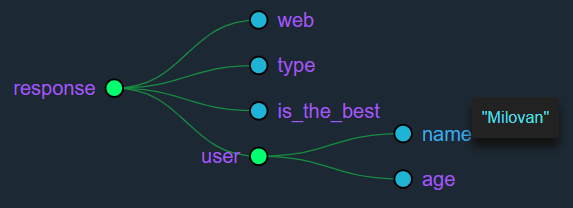
output:
{
    "web": "Stackoverflow",
    "type": "Knowledge",
    "is_the_best": true,
    "user": {
        "name": "Milovan",
        "age": 34
    }
}
Method 4
No need to convert it in a string by using json.dumps()
r = {'is_claimed': 'True', 'rating': 3.5}
file.write(r['is_claimed'])
file.write(str(r['rating']))
You can get the values directly from the dict object.
Method 5
Defining r as a dictionary should do the trick:
>>> r: dict = {'is_claimed': 'True', 'rating': 3.5}
>>> print(r['rating'])
3.5
>>> type(r)
<class 'dict'>
Method 6
You can create a nested dictionary in the above example by declaring a new dictionary inside the default dictionary.
import json
dictionary = {
'fruit':{"Grapes": "10","color": "green"},
'vegetable':{"chilli": "4","color": "red"},
}
result = json.dumps(dictionary, indent = 3)
print(result)
Here, I have used indent=3
Reference: https://favtutor.com/blogs/dict-to-json-python
All methods was sourced from stackoverflow.com or stackexchange.com, is licensed under cc by-sa 2.5, cc by-sa 3.0 and cc by-sa 4.0