I have a Python datetime object that I want to convert to unix time, or seconds/milliseconds since the 1970 epoch.
How do I do this?
Answers:
Thank you for visiting the Q&A section on Magenaut. Please note that all the answers may not help you solve the issue immediately. So please treat them as advisements. If you found the post helpful (or not), leave a comment & I’ll get back to you as soon as possible.
Method 1
It appears to me that the simplest way to do this is
import datetime

epoch = datetime.datetime.utcfromtimestamp(0)

def unix_time_millis(dt):
    return (dt - epoch).total_seconds() * 1000.0
Method 2
In Python 3.3, added new method timestamp:
import datetime
seconds_since_epoch = datetime.datetime.now().timestamp()
Your question stated that you needed milliseconds, which you can get like this:
milliseconds_since_epoch = datetime.datetime.now().timestamp() * 1000
If you use timestamp on a naive datetime object, then it assumed that it is in the local timezone. Use timezone-aware datetime objects if this is not what you intend to happen.
Method 3
>>> import datetime
>>> # replace datetime.datetime.now() with your datetime object
>>> int(datetime.datetime.now().strftime("%s")) * 1000
1312908481000
Or the help of the time module (and without date formatting):
>>> import datetime, time
>>> # replace datetime.datetime.now() with your datetime object
>>> time.mktime(datetime.datetime.now().timetuple()) * 1000
1312908681000.0
Answered with help from: http://pleac.sourceforge.net/pleac_python/datesandtimes.html
Documentation:
Method 4
You can use Delorean to travel in space and time!
import datetime
import delorean
dt = datetime.datetime.utcnow()
delorean.Delorean(dt, timezone="UTC").epoch
http://delorean.readthedocs.org/en/latest/quickstart.html
Method 5
This is how I do it:
from datetime import datetime
from time import mktime

dt = datetime.now()
sec_since_epoch = mktime(dt.timetuple()) + dt.microsecond/1000000.0

millis_since_epoch = sec_since_epoch * 1000
Method 6
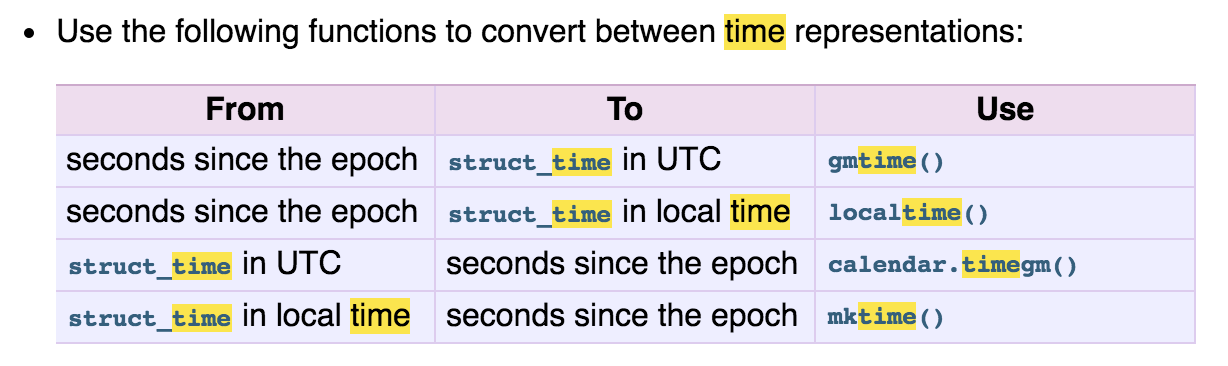
Recommendedations from the Python 2.7 docs for the time module
Method 7
from datetime import datetime
from calendar import timegm

# Note: if you pass in a naive dttm object it's assumed to already be in UTC
def unix_time(dttm=None):
    if dttm is None:
       dttm = datetime.utcnow()

    return timegm(dttm.utctimetuple())

print "Unix time now: %d" % unix_time()
print "Unix timestamp from an existing dttm: %d" % unix_time(datetime(2014, 12, 30, 12, 0))
Method 8
Here’s another form of a solution with normalization of your time object:
def to_unix_time(timestamp):
    epoch = datetime.datetime.utcfromtimestamp(0) # start of epoch time
    my_time = datetime.datetime.strptime(timestamp, "%Y/%m/%d %H:%M:%S.%f") # plugin your time object
    delta = my_time - epoch
    return delta.total_seconds() * 1000.0
Method 9
>>> import datetime
>>> import time
>>> import calendar

>>> #your datetime object
>>> now = datetime.datetime.now()
>>> now
datetime.datetime(2013, 3, 19, 13, 0, 9, 351812)

>>> #use datetime module's timetuple method to get a `time.struct_time` object.[1]
>>> tt = datetime.datetime.timetuple(now)
>>> tt
time.struct_time(tm_year=2013, tm_mon=3, tm_mday=19, tm_hour=13, tm_min=0, tm_sec=9,     tm_wday=1, tm_yday=78, tm_isdst=-1)

>>> #If your datetime object is in utc you do this way. [2](see the first table on docs)
>>> sec_epoch_utc = calendar.timegm(tt) * 1000
>>> sec_epoch_utc
1363698009

>>> #If your datetime object is in local timeformat you do this way
>>> sec_epoch_loc = time.mktime(tt) * 1000
>>> sec_epoch_loc
1363678209.0
[1] http://docs.python.org/2/library/datetime.html#datetime.date.timetuple
[2] http://docs.python.org/2/library/time.html
Method 10
A bit of pandas code:
import pandas

def to_millis(dt):
    return int(pandas.to_datetime(dt).value / 1000000)
Method 11
import time
seconds_since_epoch = time.mktime(your_datetime.timetuple()) * 1000
Method 12
Here is a function I made based on the answer above
def getDateToEpoch(myDateTime):
    res = (datetime.datetime(myDateTime.year,myDateTime.month,myDateTime.day,myDateTime.hour,myDateTime.minute,myDateTime.second) - datetime.datetime(1970,1,1)).total_seconds()
    return res
You can wrap the returned value like this : str(int(res))
To return it without a decimal value to be used as string or just int (without the str)
Method 13
A lot of these answers don’t work for python 2 or don’t preserve the milliseconds from the datetime. This works for me
def datetime_to_ms_epoch(dt):
    microseconds = time.mktime(dt.timetuple()) * 1000000 + dt.microsecond
    return int(round(microseconds / float(1000)))
Method 14
This other solution for covert datetime to unixtimestampmillis.
private static readonly DateTime UnixEpoch = new DateTime(1970, 1, 1, 0, 0, 0, DateTimeKind.Utc);

    public static long GetCurrentUnixTimestampMillis()
    {
        DateTime localDateTime, univDateTime;
        localDateTime = DateTime.Now;
        univDateTime = localDateTime.ToUniversalTime();
        return (long)(univDateTime - UnixEpoch).TotalMilliseconds;
    }
All methods was sourced from stackoverflow.com or stackexchange.com, is licensed under cc by-sa 2.5, cc by-sa 3.0 and cc by-sa 4.0