The contents of this post were originally meant to be a part of
Pandas Merging 101,
but due to the nature and size of the content required to fully do
justice to this topic, it has been moved to its own QnA.
Given two simple DataFrames;
left = pd.DataFrame({'col1' : ['A', 'B', 'C'], 'col2' : [1, 2, 3]})
right = pd.DataFrame({'col1' : ['X', 'Y', 'Z'], 'col2' : [20, 30, 50]})

left

  col1  col2
0    A     1
1    B     2
2    C     3

right

  col1  col2
0    X    20
1    Y    30
2    Z    50
The cross product of these frames can be computed, and will look something like:
A       1      X      20
A       1      Y      30
A       1      Z      50
B       2      X      20
B       2      Y      30
B       2      Z      50
C       3      X      20
C       3      Y      30
C       3      Z      50
What is the most performant method of computing this result?
Answers:
Thank you for visiting the Q&A section on Magenaut. Please note that all the answers may not help you solve the issue immediately. So please treat them as advisements. If you found the post helpful (or not), leave a comment & I’ll get back to you as soon as possible.
Method 1
Let’s start by establishing a benchmark. The easiest method for solving this is using a temporary “key” column:
# pandas <= 1.1.X
def cartesian_product_basic(left, right):
    return (
       left.assign(key=1).merge(right.assign(key=1), on='key').drop('key', 1))

cartesian_product_basic(left, right)
# pandas >= 1.2 (est)
left.merge(right, how="cross")
  col1_x  col2_x col1_y  col2_y
0      A       1      X      20
1      A       1      Y      30
2      A       1      Z      50
3      B       2      X      20
4      B       2      Y      30
5      B       2      Z      50
6      C       3      X      20
7      C       3      Y      30
8      C       3      Z      50
How this works is that both DataFrames are assigned a temporary “key” column with the same value (say, 1). merge then performs a many-to-many JOIN on “key”.
While the many-to-many JOIN trick works for reasonably sized DataFrames, you will see relatively lower performance on larger data.
A faster implementation will require NumPy. Here are some famous NumPy implementations of 1D cartesian product. We can build on some of these performant solutions to get our desired output. My favourite, however, is @senderle’s first implementation.
def cartesian_product(*arrays):
    la = len(arrays)
    dtype = np.result_type(*arrays)
    arr = np.empty([len(a) for a in arrays] + [la], dtype=dtype)
    for i, a in enumerate(np.ix_(*arrays)):
        arr[...,i] = a
    return arr.reshape(-1, la)
Generalizing: CROSS JOIN on Unique or Non-Unique Indexed DataFrames
Disclaimer
These solutions are optimised for DataFrames with non-mixed scalar dtypes. If dealing with mixed dtypes, use at your
own risk!
This trick will work on any kind of DataFrame. We compute the cartesian product of the DataFrames’ numeric indices using the aforementioned cartesian_product, use this to reindex the DataFrames, and
def cartesian_product_generalized(left, right):
    la, lb = len(left), len(right)
    idx = cartesian_product(np.ogrid[:la], np.ogrid[:lb])
    return pd.DataFrame(
        np.column_stack([left.values[idx[:,0]], right.values[idx[:,1]]]))

cartesian_product_generalized(left, right)

   0  1  2   3
0  A  1  X  20
1  A  1  Y  30
2  A  1  Z  50
3  B  2  X  20
4  B  2  Y  30
5  B  2  Z  50
6  C  3  X  20
7  C  3  Y  30
8  C  3  Z  50

np.array_equal(cartesian_product_generalized(left, right),
               cartesian_product_basic(left, right))
True
And, along similar lines,
left2 = left.copy()
left2.index = ['s1', 's2', 's1']

right2 = right.copy()
right2.index = ['x', 'y', 'y']


left2
   col1  col2
s1    A     1
s2    B     2
s1    C     3

right2
  col1  col2
x    X    20
y    Y    30
y    Z    50

np.array_equal(cartesian_product_generalized(left, right),
               cartesian_product_basic(left2, right2))
True
This solution can generalise to multiple DataFrames. For example,
def cartesian_product_multi(*dfs):
    idx = cartesian_product(*[np.ogrid[:len(df)] for df in dfs])
    return pd.DataFrame(
        np.column_stack([df.values[idx[:,i]] for i,df in enumerate(dfs)]))

cartesian_product_multi(*[left, right, left]).head()

   0  1  2   3  4  5
0  A  1  X  20  A  1
1  A  1  X  20  B  2
2  A  1  X  20  C  3
3  A  1  X  20  D  4
4  A  1  Y  30  A  1
Further Simplification
A simpler solution not involving @senderle’s cartesian_product is possible when dealing with just two DataFrames. Using np.broadcast_arrays, we can achieve almost the same level of performance.
def cartesian_product_simplified(left, right):
    la, lb = len(left), len(right)
    ia2, ib2 = np.broadcast_arrays(*np.ogrid[:la,:lb])

    return pd.DataFrame(
        np.column_stack([left.values[ia2.ravel()], right.values[ib2.ravel()]]))

np.array_equal(cartesian_product_simplified(left, right),
               cartesian_product_basic(left2, right2))
True
Performance Comparison
Benchmarking these solutions on some contrived DataFrames with unique indices, we have
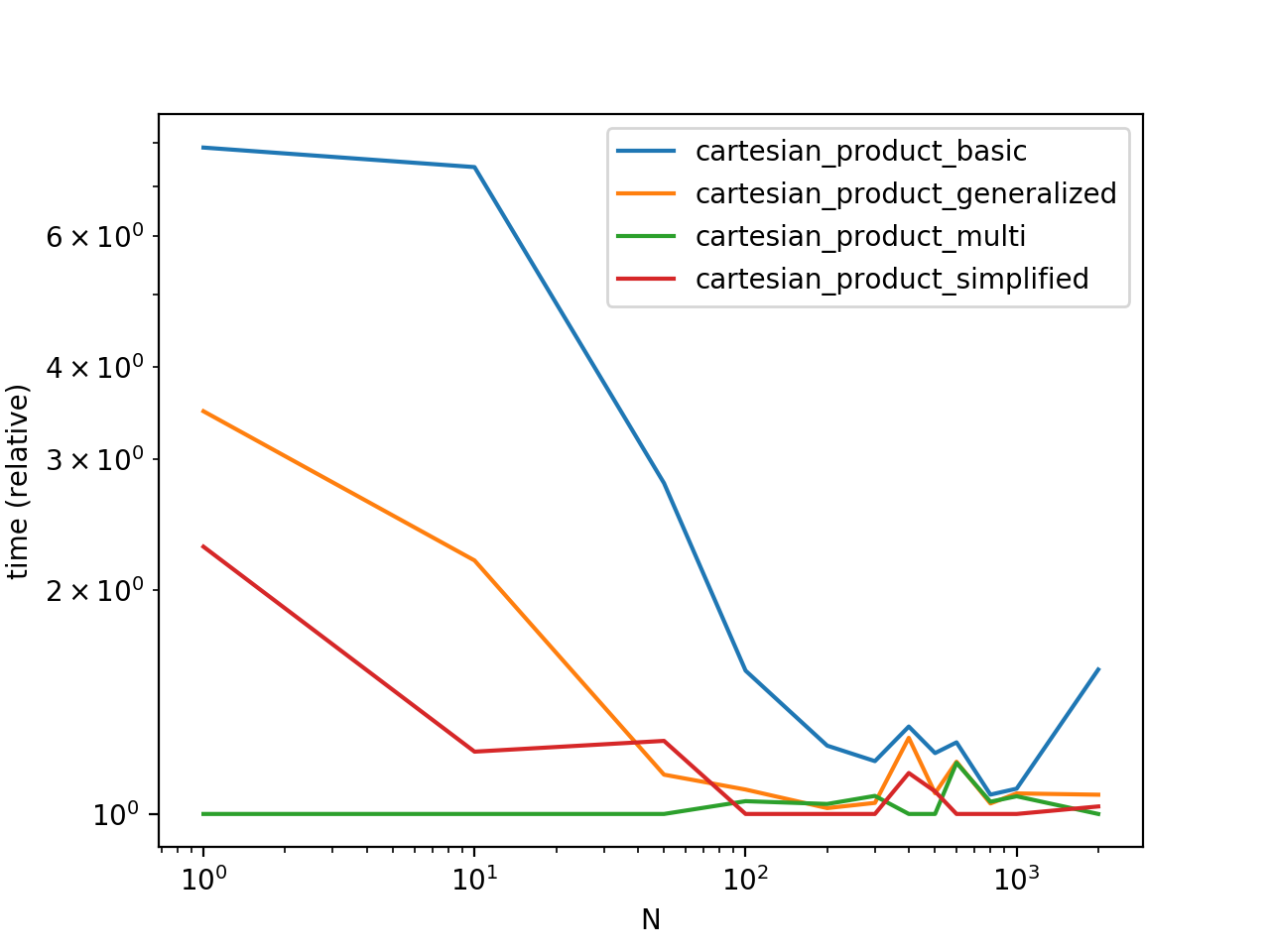
Do note that timings may vary based on your setup, data, and choice of cartesian_product helper function as applicable.
Performance Benchmarking Code
This is the timing script. All functions called here are defined above.
from timeit import timeit
import pandas as pd
import matplotlib.pyplot as plt

res = pd.DataFrame(
       index=['cartesian_product_basic', 'cartesian_product_generalized',
              'cartesian_product_multi', 'cartesian_product_simplified'],
       columns=[1, 10, 50, 100, 200, 300, 400, 500, 600, 800, 1000, 2000],
       dtype=float
)

for f in res.index:
    for c in res.columns:
        # print(f,c)
        left2 = pd.concat([left] * c, ignore_index=True)
        right2 = pd.concat([right] * c, ignore_index=True)
        stmt = '{}(left2, right2)'.format(f)
        setp = 'from __main__ import left2, right2, {}'.format(f)
        res.at[f, c] = timeit(stmt, setp, number=5)

ax = res.div(res.min()).T.plot(loglog=True)
ax.set_xlabel("N");
ax.set_ylabel("time (relative)");

plt.show()
Continue Reading
Jump to other topics in Pandas Merging 101 to continue learning:
- Merging basics – basic types of joins
- Index-based joins
- Generalizing to multiple DataFrames
- Cross join *
* you are here
Method 2
After pandas 1.2.0 merge now have option cross
left.merge(right, how='cross')
Using itertools product and recreate the value in dataframe
import itertools
l=list(itertools.product(left.values.tolist(),right.values.tolist()))
pd.DataFrame(list(map(lambda x : sum(x,[]),l)))
   0  1  2   3
0  A  1  X  20
1  A  1  Y  30
2  A  1  Z  50
3  B  2  X  20
4  B  2  Y  30
5  B  2  Z  50
6  C  3  X  20
7  C  3  Y  30
8  C  3  Z  50
Method 3
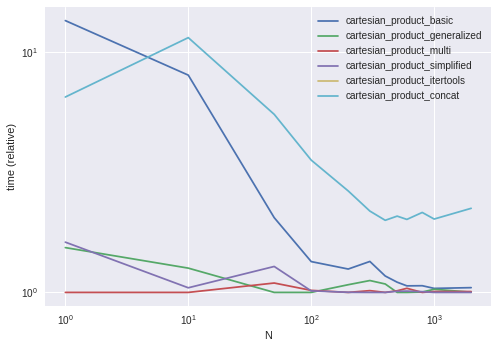
Here’s an approach with triple concat
m = pd.concat([pd.concat([left]*len(right)).sort_index().reset_index(drop=True),
       pd.concat([right]*len(left)).reset_index(drop=True) ], 1)

    col1  col2 col1  col2
0     A     1    X    20
1     A     1    Y    30
2     A     1    Z    50
3     B     2    X    20
4     B     2    Y    30
5     B     2    Z    50
6     C     3    X    20
7     C     3    Y    30
8     C     3    Z    50
Method 4
I think the simplest way would be to add a dummy column to each data frame, do an inner merge on it and then drop that dummy column from the resulting cartesian dataframe:
left['dummy'] = 'a'
right['dummy'] = 'a'

cartesian = left.merge(right, how='inner', on='dummy')

del cartesian['dummy']
All methods was sourced from stackoverflow.com or stackexchange.com, is licensed under cc by-sa 2.5, cc by-sa 3.0 and cc by-sa 4.0