There is the option to turn off trackbacks/pingbacks under Settings > Discussion.
But I’d like remove the X-Pingback header WordPress sends and completely remove the the trackback endpoint.
Is there a way to do this?
Answers:
Thank you for visiting the Q&A section on Magenaut. Please note that all the answers may not help you solve the issue immediately. So please treat them as advisements. If you found the post helpful (or not), leave a comment & I’ll get back to you as soon as possible.
Method 1
<?php
/*
Plugin Name: [RPC] XMLRPCless Blog
Plugin URI: http://earnestodev.com/
Description: Disable XMLRPC advertising/functionality blog-wide.
Version: 0.0.7
Author: EarnestoDev
Author URI: http://earnestodev.com/
*/
// Disable X-Pingback HTTP Header.
add_filter('wp_headers', function($headers, $wp_query){
    if(isset($headers['X-Pingback'])){
        // Drop X-Pingback
        unset($headers['X-Pingback']);
    }
    return $headers;
}, 11, 2);
// Disable XMLRPC by hijacking and blocking the option.
add_filter('pre_option_enable_xmlrpc', function($state){
    return '0'; // return $state; // To leave XMLRPC intact and drop just Pingback
});
// Remove rsd_link from filters (<link rel="EditURI" />).
add_action('wp', function(){
    remove_action('wp_head', 'rsd_link');
}, 9);
// Hijack pingback_url for get_bloginfo (<link rel="pingback" />).
add_filter('bloginfo_url', function($output, $property){
    return ($property == 'pingback_url') ? null : $output;
}, 11, 2);
// Just disable pingback.ping functionality while leaving XMLRPC intact?
add_action('xmlrpc_call', function($method){
    if($method != 'pingback.ping') return;
    wp_die(
        'Pingback functionality is disabled on this Blog.',
        'Pingback Disabled!',
        array('response' => 403)
    );
});
?>
Use this for a plugin in /wp-content/plugins or /wp-content/mu-plugins (for auto-activation). Or functions.php.
Funny thing is I sell a WordPress Remote Publishing Library and gave you the code to disable XMLRPC 🙂 Bad for reputation.
Method 2
@EarnestoDev had a great answer, but it’s a little outdated now since recent xml-rcp exploits.
I’ve made an updated version that I think blocks all possible access to it. Take note though that there are a few plugins out there that utilize the XML-RPC pingback/trackback functionality and could have issues if you are using them:
- WordPress Mobile App
- JetPack LibSyn (for podcasts)
- Some parts of BuddyPress
- Windows Live Writer
- IFTTT
- A few gallery plugins
Here’s an updated version below. To download it you can copy it into a plugin file, drop in in mu-plugins or download it on github:
<?php
/*
Plugin Name:        BYE BYE Pingback
Plugin URI:         https://github.com/Wordpress-Development/bye-bye-pingback/
Description:        Banishment of wordpress pingback
Version:            1.0.0
Author:             bryanwillis
Author URI:         https://github.com/bryanwillis/
*/

// If this file is called directly, abort.
if ( ! defined( 'WPINC' ) ) {
    die;
}

/**
 * Htaccess directive block xmlrcp for extra security.
 * Here are some rewrite examples:
 *   404 - RewriteRule xmlrpc.php$ - [R=404,L]
 *   301 - RewriteRule ^xmlrpc.php$ index.php [R=301]
 * If you want custom 404 make sure your server is finding it by also adding this 'ErrorDocument 404 /index.php?error=404' or 'ErrorDocument 404 /wordpress/index.php?error=404' for sites in subdirectory.
 */
add_filter('mod_rewrite_rules', 'noxmlrpc_mod_rewrite_rules'); // should we put this inside wp_loaded or activation hook
function noxmlrpc_mod_rewrite_rules($rules) {
  $insert = "RewriteRule xmlrpc.php$ - [F,L]";
  $rules = preg_replace('!RewriteRule!', "$insertnnRewriteRule", $rules, 1);
  return $rules;
}

register_activation_hook(__FILE__, 'noxmlrpc_htaccess_activate');
function noxmlrpc_htaccess_activate() {
  flush_rewrite_rules(true);
}

register_deactivation_hook(__FILE__, 'noxmlrpc_htaccess_deactivate');
function noxmlrpc_htaccess_deactivate() {
  remove_filter('mod_rewrite_rules', 'noxmlrpc_mod_rewrite_rules');
  flush_rewrite_rules(true);
}


// Remove rsd_link from filters- link rel="EditURI"
add_action('wp', function(){
    remove_action('wp_head', 'rsd_link');
}, 9);


// Remove pingback from head (link rel="pingback")
if (!is_admin()) {
    function link_rel_buffer_callback($buffer) {
        $buffer = preg_replace('/(<link.*?rel=("|')pingback("|').*?href=("|')(.*?)("|')(.*?)?/?>|<link.*?href=("|')(.*?)("|').*?rel=("|')pingback("|')(.*?)?/?>)/i', '', $buffer);
                return $buffer;
    }
    function link_rel_buffer_start() {
        ob_start("link_rel_buffer_callback");
    }
    function link_rel_buffer_end() {
        ob_flush();
    }
    add_action('template_redirect', 'link_rel_buffer_start', -1);
    add_action('get_header', 'link_rel_buffer_start');
    add_action('wp_head', 'link_rel_buffer_end', 999);
}


// Return pingback_url empty (<link rel="pingback" href>).
add_filter('bloginfo_url', function($output, $property){
    return ($property == 'pingback_url') ? null : $output;
}, 11, 2);


// Disable xmlrcp/pingback
add_filter( 'xmlrpc_enabled', '__return_false' );
add_filter( 'pre_update_option_enable_xmlrpc', '__return_false' );
add_filter( 'pre_option_enable_xmlrpc', '__return_zero' );

// Disable trackbacks
add_filter( 'rewrite_rules_array', function( $rules ) {
    foreach( $rules as $rule => $rewrite ) {
        if( preg_match( '/trackback/?$$/i', $rule ) ) {
            unset( $rules[$rule] );
        }
    }
    return $rules;
});


// Disable X-Pingback HTTP Header.
add_filter('wp_headers', function($headers, $wp_query){
    if(isset($headers['X-Pingback'])){
        unset($headers['X-Pingback']);
    }
    return $headers;
}, 11, 2);


add_filter( 'xmlrpc_methods', function($methods){
    unset( $methods['pingback.ping'] );
    unset( $methods['pingback.extensions.getPingbacks'] );
    unset( $methods['wp.getUsersBlogs'] ); // Block brute force discovery of existing users
    unset( $methods['system.multicall'] );
    unset( $methods['system.listMethods'] );
    unset( $methods['system.getCapabilities'] );
    return $methods;
});


// Just disable pingback.ping functionality while leaving XMLRPC intact?
add_action('xmlrpc_call', function($method){
    if($method != 'pingback.ping') return;
    wp_die(
        'This site does not have pingback.',
        'Pingback not Enabled!',
        array('response' => 403)
    );
});
Also, if you want to close all existing pingback follow these steps:
1) Open phpmyadmin and navigate to SQL section:
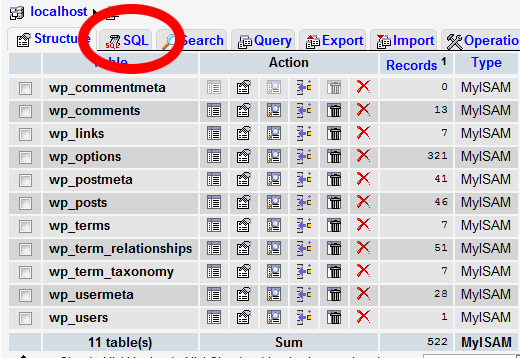
2) Enter the following:
UPDATE wp_posts SET ping_status="closed";
3) All existing pingbacks should now be closed
All methods was sourced from stackoverflow.com or stackexchange.com, is licensed under cc by-sa 2.5, cc by-sa 3.0 and cc by-sa 4.0