It seems like half the tutorials in the Codex and around the blogosphere use query_posts() and half use WP_Query.
They all do similar things, so when should I use one over the others?
Answers:
Thank you for visiting the Q&A section on Magenaut. Please note that all the answers may not help you solve the issue immediately. So please treat them as advisements. If you found the post helpful (or not), leave a comment & I’ll get back to you as soon as possible.
Method 1
-
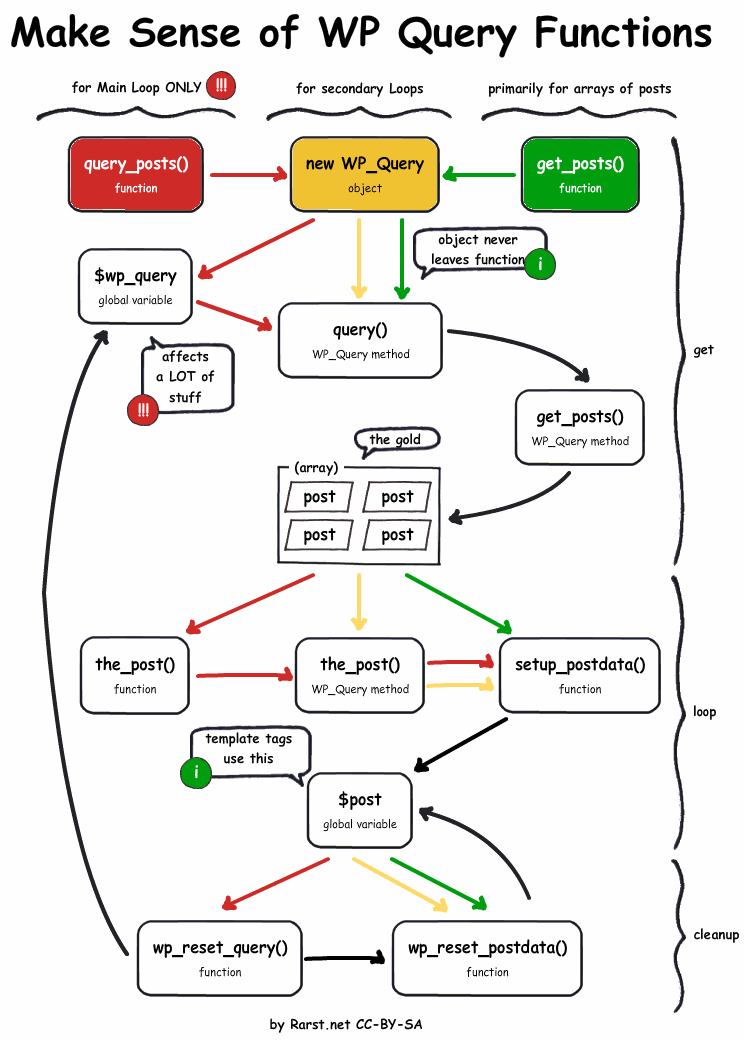
query_posts()is overly simplistic and a problematic way to modify the main query of a page by replacing it with new instance of the query. It is inefficient (re-runs SQL queries) and will outright fail in some circumstances (especially often when dealing with posts pagination). Any modern WP code should use more reliable methods, like making use of thepre_get_postshook, for this purpose. TL;DR don’t use query_posts() ever. -
get_posts()is very similar in usage and accepts the same arguments (with some nuances, like different defaults), but returns an array of posts, doesn’t modify global variables and is safe to use anywhere. -
WP_Queryis the class that powers both behind the scenes, but you can also create and work with your own instance of it. A bit more complex, fewer restrictions, also safe to use anywhere.
Method 2
query_posts – You should never ever use query_posts. Apart from what @Rarst has said, the really big issue with query_posts is, it breaks the main query object ( stored in $wp_query ). A lot of plugins and custom code relies on the main query object, so breaking the main query object means that you are breaking the functionalities of plugins and custom code. Just one such function is the all important pagination function, so if you break the main query, you break pagination.
To prove how bad query_posts is, on any template, do the following and compare the results
var_dump( $wp_query );
query_posts( '&posts_per_page=-1' );
var_dump( $wp_query );
get_posts and WP_Query are the correct way to construct secondary queries ( like related posts, sliders, featured content and content on static front pages ) with. It should be noted, you should not use any of the two in favor of the main query on the home page, single page or any type of archive page as it will break page functionality. If you need to modify the main query, use pre_get_posts to do so, and not a custom query. (UPDATE: For static front pages and true pages, see Using pre_get_posts on true pages and static front pages*)
In essence, WP_Query is used by the main query and is also used by get_posts, but although get_posts() uses WP_Query, there are a few differences
-
get_postsare faster thanWP_Query. The margin depends on the amount of total posts of the site. The reason for this is,get_postspasses'no_found_rows' => trueby default toWP_Querywhich skips/legally breaks pagination. With'no_found_rows' => true,WP_Querygets the amount of posts queried, then bails out, where by default, it further search for all posts matching the query in order to calculate pagination.For this reason,
get_posts()should be used for non paginated queries only. Paginatingget_postsis really one big mess.WP_Queryshould be used for all paginated queries -
get_posts()aren’t influenced by theposts_*filters whereWP_Querygets influenced by these filters. The reason is thatget_posts, by default, passes'suppress_filters' => truetoWP_Query -
get_postshas a couple of extra parameters likeinclude,exclude,numberpostsandcategory. These parameters do get changed into valid parameters forWP_Querybefore being passed toWP_Query.includegets changed intopost__in,excludeintopost__not_in,categoryintocatandnumberpostsintoposts_per_page. Just a note, all of the parameters that can be passed toWP_Queryworks withget_posts, you can ignore and not use the default parameters ofget_posts -
get_postsreturns just the$postsproperty ofWP_QuerywhileWP_Queryreturns the complete object. This object is quite useful when it comes to conditionals, pagination and other useful info that can be used inside the loop. -
get_postsdoesn’t use the loop, but aforeachloop to display posts. Also, no template tags are available by default.setup_postdata( $post )has to be used to make the template tags available.WP_Queryuses the loop and template tags are available by default -
get_postspasses'ignore_sticky_posts' => 1toWP_Query, soget_postsby default ignores sticky posts
Based on the above, whether to use get_posts or WP_Query is up to you and what do you actually need from the query. The above should guide you in your choice
Method 3
The basic difference is that query_posts() is really only for modifying the current Loop. Once you’re done it’s necessary to reset the loop and send it on its merry way. This method is also a little easier to understand, simply because your “query” is basically a URL string that you pass to the function, like so:
query_posts('meta_key=color&meta_value=blue');
On the other hand, WP_Query is more of a general purpose tool, and is more like directly writing MySQL queries than query_posts() is. You can also use it anywhere (not just in the Loop) and it doesn’t interfere with any currently running post queries.
I tend to use WP_Query more often, as it happens. Really, it’s going to come down to your specific case.
Method 4
There is simply no need to use query_posts(). All it does is instantiates a new WP_Query object and reassigns that new object to global wp_query.
For reference, the following is that actual query_posts() function.
 function query_posts($query) {
        $GLOBALS['wp_query'] = new WP_Query();
        return $GLOBALS['wp_query']->query($query);
    }
Instantiate your own WP_Query object if you want to create an in depth custom query script. Or use get_posts() if all you need to do is some light manipulation here and there.
In either case, I highly recommend doing yourself a favor and going to wp_includes/query.php and perusing the WP_Query class.
Method 5
Make sure that you use wp_reset_query() after using query_posts() because it will affect other query result also.
Method 6
If I recall reading right, essentially “the loop” is doing WP_Query in the core files, but in an easier to understand way.
Method 7
- query_posts(): might be used in one and only case if you need to modify main query . It sets a lot of global variables;
- get_posts(): it is very similar in mechanics and accepts same arguments, but returns array of posts
- WP_Query: you can create and work with own object of it. Bit more complex, less restrictions, it is safe to use anywhere.
All methods was sourced from stackoverflow.com or stackexchange.com, is licensed under cc by-sa 2.5, cc by-sa 3.0 and cc by-sa 4.0