What are the differences between .aspx and .ashx pages?
I use ashx now when I need to handle a request that was called from code and returned with a response, but I would like a more technical answer please.
Answers:
Thank you for visiting the Q&A section on Magenaut. Please note that all the answers may not help you solve the issue immediately. So please treat them as advisements. If you found the post helpful (or not), leave a comment & I’ll get back to you as soon as possible.
Method 1
Page is a special case handler.
Generic Web handler (*.ashx, extension based processor) is the default HTTP handler for all Web handlers that do not have a UI and that include the @WebHandler directive.
ASP.NET page handler (*.aspx) is the default HTTP handler for all ASP.NET pages.
Among the built-in HTTP handlers there are also Web service handler (*.asmx) and Trace handler (trace.axd)
MSDN says:
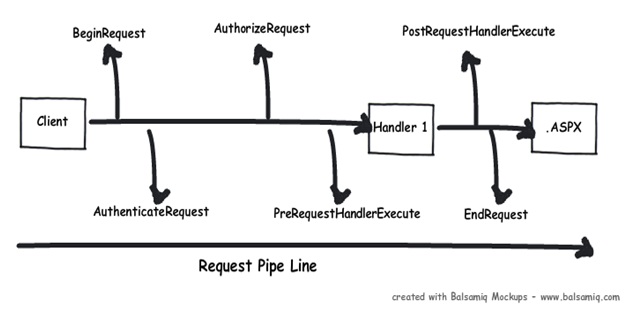
An ASP.NET HTTP handler is the process
(frequently referred to as the
“endpoint”) that runs in response to a
request made to an ASP.NET Web
application. The most common handler
is an ASP.NET page handler that
processes .aspx files. When users
request an .aspx file, the request is
processed by the page through the page
handler.
The image below illustrates this:
As to your second question:
Does ashx handle more connections than aspx?
Don’t think so (but for sure, at least not less than).
Method 2
.aspx uses a full lifecycle (Init, Load, PreRender) and can respond to button clicks etc.
An .ashx has just a single ProcessRequest method.
Method 3
.aspx is a rendered page. If you need a view, use an .aspx page.
If all you need is backend functionality but will be staying on the same view, use an .ashx page.
Method 4
For folks that have programmed in nodeJs before, particularly using expressJS. I think of .ashx as a middleware that calls the next function. While .aspx will be the controller that actually responds to the request either around res.redirect, res.send or whatever.
All methods was sourced from stackoverflow.com or stackexchange.com, is licensed under cc by-sa 2.5, cc by-sa 3.0 and cc by-sa 4.0