When trying to use this code:
var model = new MasterEntities();

var customer = new Customers();
customer.Sessionid = 25641;

model.Customers.Add(customer);
model.SaveChanges();
I get:
{“Cannot insert the value NULL into column ‘Sessionid’, table
‘master.dbo.Column’; column does not allow nulls. INSERT
fails.rnThe statement has been terminated.”}
The column “Sessionid” is actually the primary key and is marked with [KEY] like this:
 public class Customers
    {
        [Key]
        public long Sessionid { get; set; }
        public long? Pers { get; set; }
    }
So according to this question, it seems as if when the property is marked with [KEY], EF ignores my own declaration of Sessionid since it expects the database to assign the value.
So how can I solve this? If I remove [KEY] I get the "entity type has no key defined" exception…
Answers:
Thank you for visiting the Q&A section on Magenaut. Please note that all the answers may not help you solve the issue immediately. So please treat them as advisements. If you found the post helpful (or not), leave a comment & I’ll get back to you as soon as possible.
Method 1
I solved it by adding [DatabaseGenerated(DatabaseGeneratedOption.None)] like this:
public class Customers
    {
        [Key]
        [DatabaseGenerated(DatabaseGeneratedOption.None)]
        public long Sessionid { get; set; }
        public long? Pers { get; set; }
    }
Method 2
You can configure SQL to auto-generate (and auto-increment) the primary key for the table upon inserts. Then just remove the [Key] in C# and you don’t need to set the ID in the application manually, the db will generate it for you.
Method 3
I have encountered this problem multiple times while working with Microsoft SQL Server and I have followed the same way to fix it. To solve this problem, make sure Identity Specification is set to Yes. Here’s how it looks like:
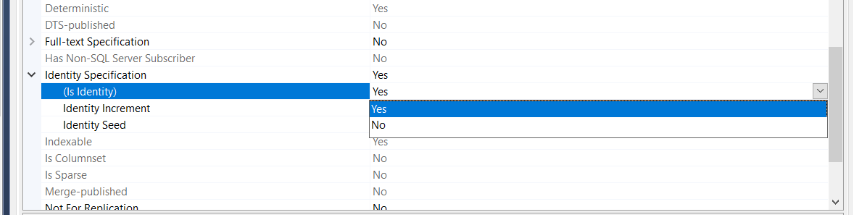
In this way the column number auto increments as a primary key normally would.
HOW?: right-click the table that contains the column, choose Design, select the primary key and in Column Properties window find Identity Specification and set it to Yes.
All methods was sourced from stackoverflow.com or stackexchange.com, is licensed under cc by-sa 2.5, cc by-sa 3.0 and cc by-sa 4.0