I have two simple one-dimensional arrays in NumPy. I should be able to concatenate them using numpy.concatenate. But I get this error for the code below:
TypeError: only length-1 arrays can be converted to Python scalars
Code
import numpy
a = numpy.array([1, 2, 3])
b = numpy.array([5, 6])
numpy.concatenate(a, b)
Why?
Answers:
Thank you for visiting the Q&A section on Magenaut. Please note that all the answers may not help you solve the issue immediately. So please treat them as advisements. If you found the post helpful (or not), leave a comment & I’ll get back to you as soon as possible.
Method 1
The line should be:
numpy.concatenate([a,b])
The arrays you want to concatenate need to be passed in as a sequence, not as separate arguments.
From the NumPy documentation:
numpy.concatenate((a1, a2, ...), axis=0)Join a sequence of arrays together.
It was trying to interpret your b as the axis parameter, which is why it complained it couldn’t convert it into a scalar.
Method 2
There are several possibilities for concatenating 1D arrays, e.g.,
import numpy as np

np.r_[a, a]
np.stack([a, a]).reshape(-1)
np.hstack([a, a])
np.concatenate([a, a])
All those options are equally fast for large arrays; for small ones, concatenate has a slight edge:
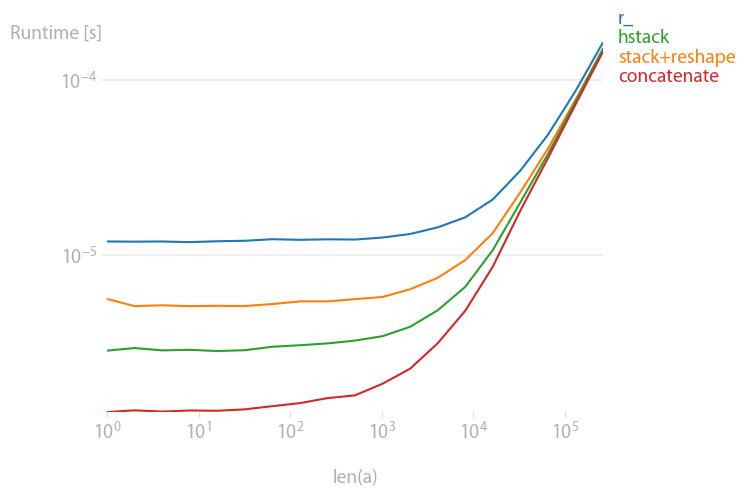
The plot was created with perfplot:
import numpy
import perfplot

perfplot.show(
    setup=lambda n: numpy.random.rand(n),
    kernels=[
        lambda a: numpy.r_[a, a],
        lambda a: numpy.stack([a, a]).reshape(-1),
        lambda a: numpy.hstack([a, a]),
        lambda a: numpy.concatenate([a, a]),
    ],
    labels=["r_", "stack+reshape", "hstack", "concatenate"],
    n_range=[2 ** k for k in range(19)],
    xlabel="len(a)",
)
Method 3
The first parameter to concatenate should itself be a sequence of arrays to concatenate:
numpy.concatenate((a,b)) # Note the extra parentheses.
Method 4
An alternative ist to use the short form of “concatenate” which is either “r_[…]” or “c_[…]” as shown in the example code beneath (see http://wiki.scipy.org/NumPy_for_Matlab_Users for additional information):
%pylab
vector_a = r_[0.:10.] #short form of "arange"
vector_b = array([1,1,1,1])
vector_c = r_[vector_a,vector_b]
print vector_a
print vector_b
print vector_c, 'nn'

a = ones((3,4))*4
print a, 'n'
c = array([1,1,1])
b = c_[a,c]
print b, 'nn'

a = ones((4,3))*4
print a, 'n'
c = array([[1,1,1]])
b = r_[a,c]
print b

print type(vector_b)
Which results in:
[ 0.  1.  2.  3.  4.  5.  6.  7.  8.  9.]
[1 1 1 1]
[ 0.  1.  2.  3.  4.  5.  6.  7.  8.  9.  1.  1.  1.  1.]


[[ 4.  4.  4.  4.]
 [ 4.  4.  4.  4.]
 [ 4.  4.  4.  4.]]

[[ 4.  4.  4.  4.  1.]
 [ 4.  4.  4.  4.  1.]
 [ 4.  4.  4.  4.  1.]]


[[ 4.  4.  4.]
 [ 4.  4.  4.]
 [ 4.  4.  4.]
 [ 4.  4.  4.]]

[[ 4.  4.  4.]
 [ 4.  4.  4.]
 [ 4.  4.  4.]
 [ 4.  4.  4.]
 [ 1.  1.  1.]]
Method 5
Here are more approaches for doing this by using numpy.ravel(), numpy.array(), utilizing the fact that 1D arrays can be unpacked into plain elements:
# we'll utilize the concept of unpacking
In [15]: (*a, *b)
Out[15]: (1, 2, 3, 5, 6)

# using `numpy.ravel()`
In [14]: np.ravel((*a, *b))
Out[14]: array([1, 2, 3, 5, 6])

# wrap the unpacked elements in `numpy.array()`
In [16]: np.array((*a, *b))
Out[16]: array([1, 2, 3, 5, 6])
Method 6
Some more facts from the numpy docs :
With syntax as numpy.concatenate((a1, a2, ...), axis=0, out=None)
axis = 0 for row-wise concatenation
axis = 1 for column-wise concatenation
>>> a = np.array([[1, 2], [3, 4]])
>>> b = np.array([[5, 6]])

# Appending below last row
>>> np.concatenate((a, b), axis=0)
array([[1, 2],
       [3, 4],
       [5, 6]])

# Appending after last column
>>> np.concatenate((a, b.T), axis=1)    # Notice the transpose
array([[1, 2, 5],
       [3, 4, 6]])

# Flattening the final array
>>> np.concatenate((a, b), axis=None)
array([1, 2, 3, 4, 5, 6])
I hope it helps !
All methods was sourced from stackoverflow.com or stackexchange.com, is licensed under cc by-sa 2.5, cc by-sa 3.0 and cc by-sa 4.0