minAreaRect in OpenCV returns a rotated rectangle. How do I crop this part of the image which is inside the rectangle?
boxPoints returns the co-ordinates of the corner points of the rotated rectangle so one can access the pixels by looping through the points inside the box, but is there a faster way to crop in Python?
EDIT
See code in my answer below.
Answers:
Thank you for visiting the Q&A section on Magenaut. Please note that all the answers may not help you solve the issue immediately. So please treat them as advisements. If you found the post helpful (or not), leave a comment & I’ll get back to you as soon as possible.
Method 1
here a function that does this task:
import cv2
import numpy as np

def crop_minAreaRect(img, rect):

    # rotate img
    angle = rect[2]
    rows,cols = img.shape[0], img.shape[1]
    M = cv2.getRotationMatrix2D((cols/2,rows/2),angle,1)
    img_rot = cv2.warpAffine(img,M,(cols,rows))

    # rotate bounding box
    rect0 = (rect[0], rect[1], 0.0)
    box = cv2.boxPoints(rect0)
    pts = np.int0(cv2.transform(np.array(<div class="su-box su-box-style-default" id="" style="border-color:#000000;border-radius:3px"><div class="su-box-title" style="background-color:#333333;color:#FFFFFF;border-top-left-radius:1px;border-top-right-radius:1px">This is box title</div><div class="su-box-content su-u-clearfix su-u-trim" style="border-bottom-left-radius:1px;border-bottom-right-radius:1px"></div></div>), M))[0]
    pts[pts < 0] = 0

    # crop
    img_crop = img_rot[pts[1][1]:pts[0][1],
                       pts[1][0]:pts[2][0]]

    return img_crop
here an example usage
# generate image
img = np.zeros((1000, 1000), dtype=np.uint8)
img = cv2.line(img,(400,400),(511,511),1,120)
img = cv2.line(img,(300,300),(700,500),1,120)

# find contours / rectangle
_,contours,_ = cv2.findContours(img, 1, 1)
rect = cv2.minAreaRect(contours[0])

# crop
img_croped = crop_minAreaRect(img, rect)

# show
import matplotlib.pylab as plt
plt.figure()
plt.subplot(1,2,1)
plt.imshow(img)
plt.subplot(1,2,2)
plt.imshow(img_croped)
plt.show()
this is the output
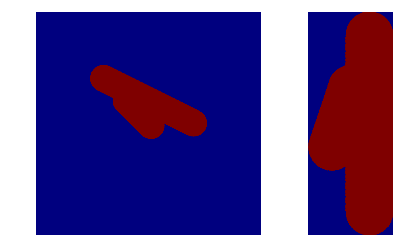
Method 2
Here’s the code to perform the above task. To speed up the process, instead of first rotating the entire image and cropping, part of the image which has the rotated rectangle is first cropped, then rotated, and cropped again to give the final result.
# Let cnt be the contour and img be the input

rect = cv2.minAreaRect(cnt)
box = cv2.boxPoints(rect)
box = np.int0(box)

W = rect[1][0]
H = rect[1][1]

Xs = [i[0] for i in box]
Ys = [i[1] for i in box]
x1 = min(Xs)
x2 = max(Xs)
y1 = min(Ys)
y2 = max(Ys)

angle = rect[2]
if angle < -45:
    angle += 90

# Center of rectangle in source image
center = ((x1+x2)/2,(y1+y2)/2)
# Size of the upright rectangle bounding the rotated rectangle
size = (x2-x1, y2-y1)
M = cv2.getRotationMatrix2D((size[0]/2, size[1]/2), angle, 1.0)
# Cropped upright rectangle
cropped = cv2.getRectSubPix(img, size, center)
cropped = cv2.warpAffine(cropped, M, size)
croppedW = H if H > W else W
croppedH = H if H < W else W
# Final cropped & rotated rectangle
croppedRotated = cv2.getRectSubPix(cropped, (int(croppedW),int(croppedH)), (size[0]/2, size[1]/2))
Method 3
@AbdulFatir was on to a good solution but as the comments stated(@Randika @epinal) it wasn’t quite working for me either so I modified it slightly and it seems to be working for my case. here is the image I am using.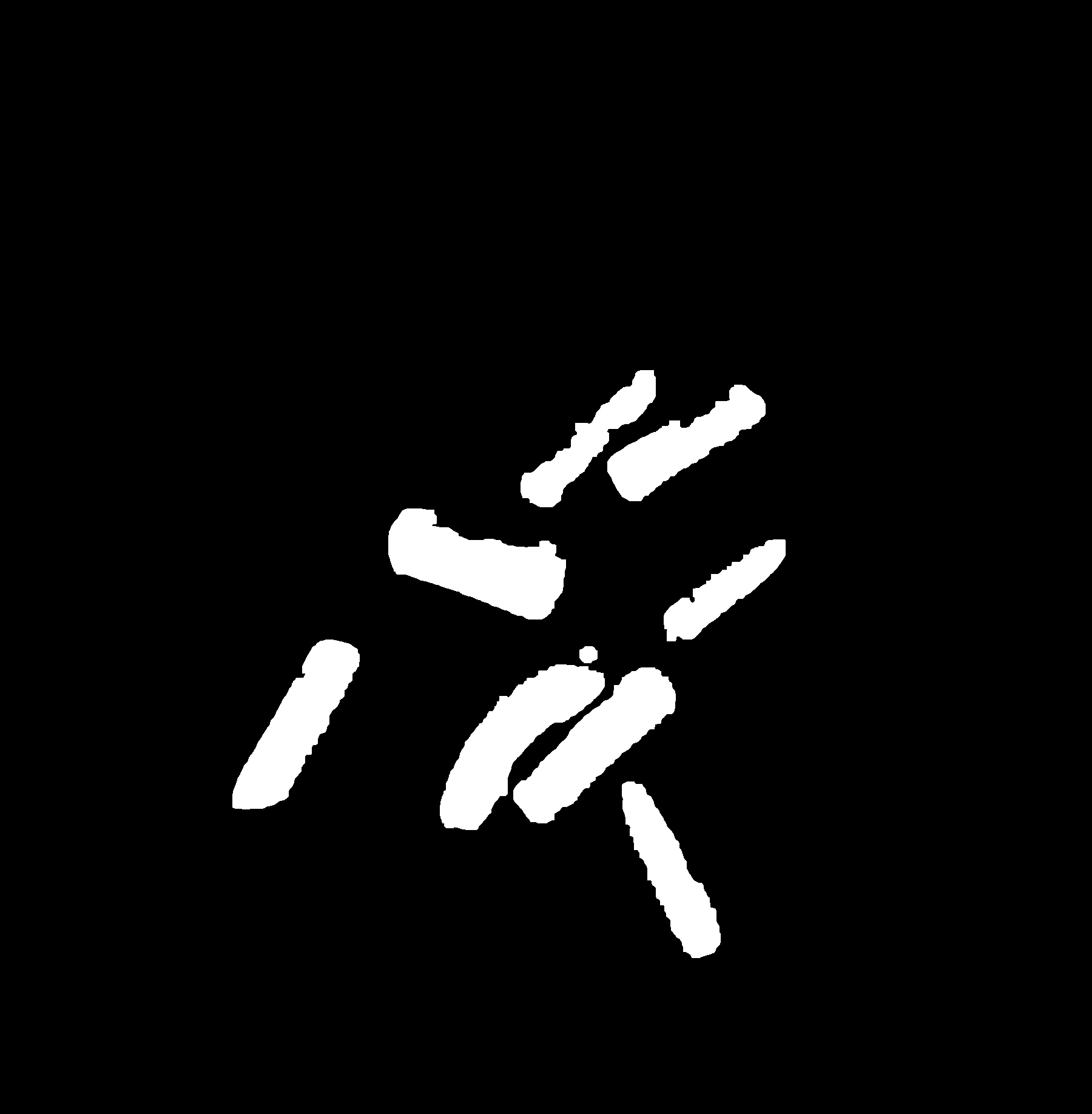
im, contours, hierarchy = cv2.findContours(open_mask, cv2.RETR_TREE, cv2.CHAIN_APPROX_SIMPLE)
print("num of contours: {}".format(len(contours)))


mult = 1.2   # I wanted to show an area slightly larger than my min rectangle set this to one if you don't
img_box = cv2.cvtColor(img.copy(), cv2.COLOR_GRAY2BGR)
for cnt in contours:
    rect = cv2.minAreaRect(cnt)
    box = cv2.boxPoints(rect)
    box = np.int0(box)
    cv2.drawContours(img_box, <div class="su-box su-box-style-default" id="" style="border-color:#000000;border-radius:3px"><div class="su-box-title" style="background-color:#333333;color:#FFFFFF;border-top-left-radius:1px;border-top-right-radius:1px">This is box title</div><div class="su-box-content su-u-clearfix su-u-trim" style="border-bottom-left-radius:1px;border-bottom-right-radius:1px"></div></div>, 0, (0,255,0), 2) # this was mostly for debugging you may omit

    W = rect[1][0]
    H = rect[1][1]

    Xs = [i[0] for i in box]
    Ys = [i[1] for i in box]
    x1 = min(Xs)
    x2 = max(Xs)
    y1 = min(Ys)
    y2 = max(Ys)

    rotated = False
    angle = rect[2]

    if angle < -45:
        angle+=90
        rotated = True

    center = (int((x1+x2)/2), int((y1+y2)/2))
    size = (int(mult*(x2-x1)),int(mult*(y2-y1)))
    cv2.circle(img_box, center, 10, (0,255,0), -1) #again this was mostly for debugging purposes

    M = cv2.getRotationMatrix2D((size[0]/2, size[1]/2), angle, 1.0)

    cropped = cv2.getRectSubPix(img_box, size, center)
    cropped = cv2.warpAffine(cropped, M, size)

    croppedW = W if not rotated else H
    croppedH = H if not rotated else W

    croppedRotated = cv2.getRectSubPix(cropped, (int(croppedW*mult), int(croppedH*mult)), (size[0]/2, size[1]/2))

    plt.imshow(croppedRotated)
    plt.show()

plt.imshow(img_box)
plt.show()
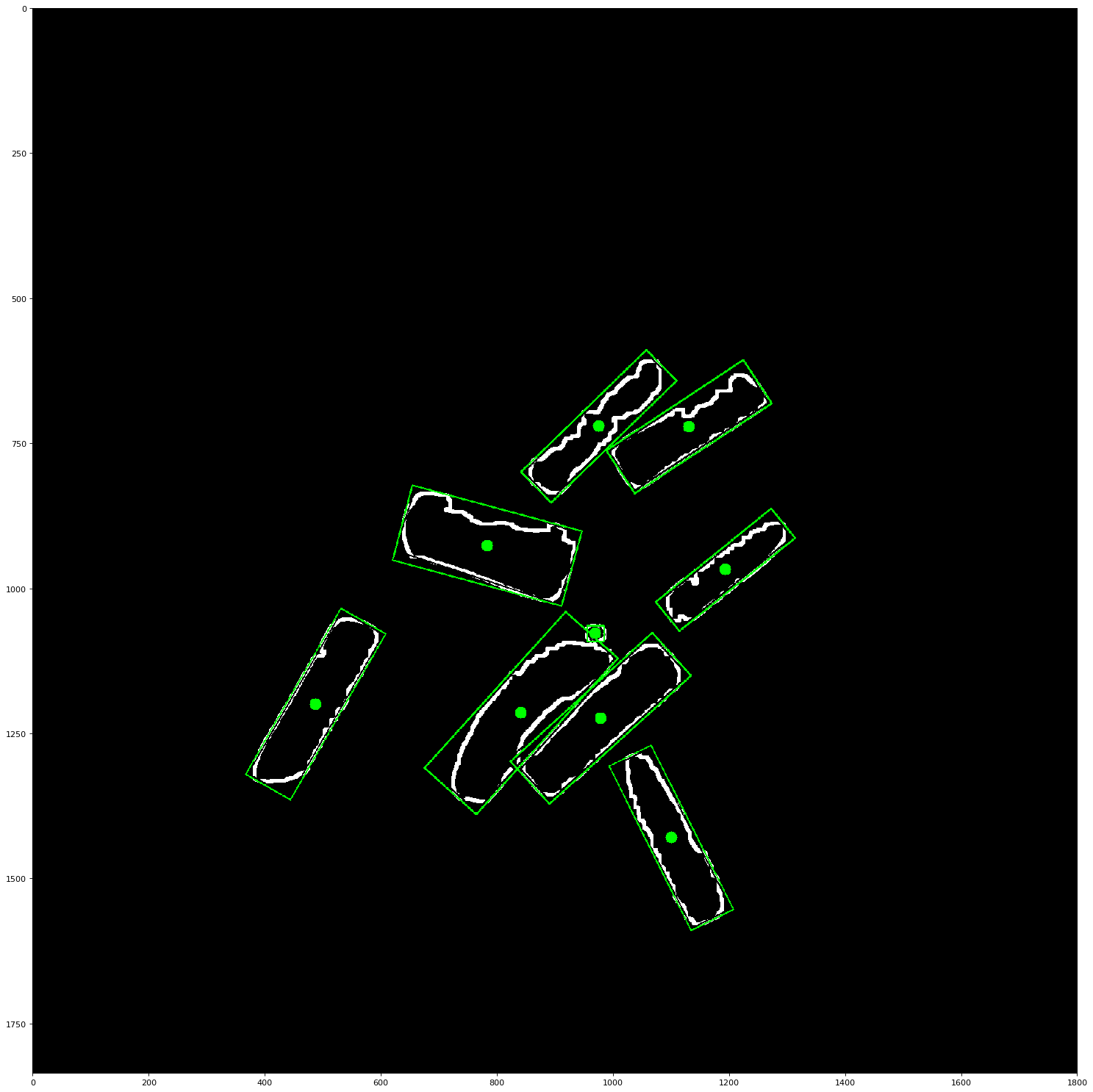
This should produce a series of images like these:
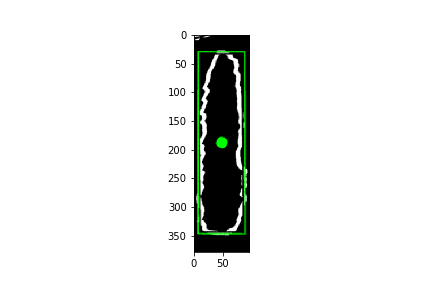
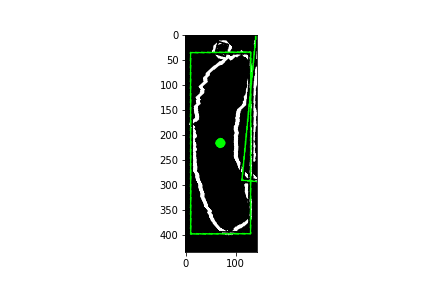
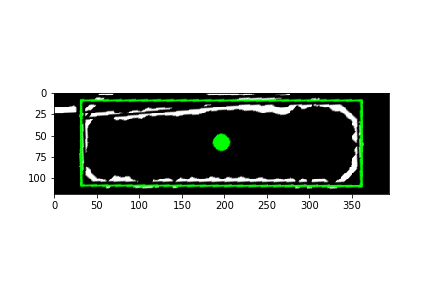
And it will also give a result image like this:
Method 4
You have not given sample code, so I am answering without code also.
You could proceed as follows:
- From corners of rectangle, determine angle alpha of rotation against horizontal axis.
- Rotate image by alpha so that cropped rectangle is parallel to image borders. Make sure that the temporary image is larger in size so that no information gets lost (cf: Rotate image without cropping OpenCV)
- Crop image using numpy slicing (cf: How to crop an image in OpenCV using Python)
- Rotate image back by -alpha.
Method 5
Unfortunately, the answer of Oliver Wilken didn’t result in the images shown. Maybe because of a different openCV version? Here my adopted version which adds several features:
- scaling and padding of the rect, i.e. to get also parts outside the original rect
- the angle of the resulting image can configured in respect to the rect, i.e. an angle of 0 or 90 [deg] will return the rect horizontally or vertically
- return of the translation matrix to rotate other things, e.g. points, lines,…
- helper functions for numpy and openCV array indexing and rect manipulation
Code
import cv2
import numpy as np


def img_rectangle_cut(img, rect=None, angle=None):
    """Translate an image, defined by a rectangle. The image is cropped to the size of the rectangle
    and the cropped image can be rotated.
    The rect must be of the from (tuple(center_xy), tuple(width_xy), angle).
    The angle are in degrees.
    PARAMETER
    ---------
    img: ndarray
    rect: tuple, optional
        define the region of interest. If None, it takes the whole picture
    angle: float, optional
        angle of the output image in respect to the rectangle.
        I.e. angle=0 will return an image where the rectangle is parallel to the image array axes
        If None, no rotation is applied.
    RETURNS
    -------
    img_return: ndarray
    rect_return: tuple
        the rectangle in the returned image
    t_matrix: ndarray
        the translation matrix
    """
    if rect is None:
        if angle is None:
            angle = 0
        rect = (tuple(np.array(img.shape) * .5), img.shape, 0)
    box = cv2.boxPoints(rect)

    rect_target = rect_rotate(rect, angle=angle)
    pts_target = cv2.boxPoints(rect_target)

    # get max dimensions
    size_target = np.int0(np.ceil(np.max(pts_target, axis=0) - np.min(pts_target, axis=0)))

    # translation matrix
    t_matrix = cv2.getAffineTransform(box[:3].astype(np.float32),
                                      pts_target[:3].astype(np.float32))

    # cv2 needs the image transposed
    img_target = cv2.warpAffine(cv2.transpose(img), t_matrix, tuple(size_target))

    # undo transpose
    img_target = cv2.transpose(img_target)
    return img_target, rect_target, t_matrix


def reshape_cv(x, axis=-1):
    """openCV and numpy have a different array indexing (row, cols) vs (cols, rows), compensate it here."""
    if axis < 0:
        axis = len(x.shape) + axis
    return np.array(x).astype(np.float32)[(*[slice(None)] * axis, slice(None, None, -1))]

def connect(x):
    """Connect data for a polar or closed loop plot, i.e. np.append(x, [x[0]], axis=0)."""
    if isinstance(x, np.ma.MaskedArray):
        return np.ma.append(x, [x[0]], axis=0)
    else:
        return np.append(x, [x[0]], axis=0)


def transform_np(x, t_matrix):
    """Apply a transform on a openCV indexed array and return a numpy indexed array."""
    return transform_cv2np(reshape_cv(x), t_matrix)


def transform_cv2np(x, t_matrix):
    """Apply a transform on a numpy indexed array and return a numpy indexed array."""
    return reshape_cv(cv2.transform(np.array([x]).astype(np.float32), t_matrix)[0])


def rect_scale_pad(rect, scale=1., pad=40.):
    """Scale and/or pad a rectangle."""
    return (rect[0],
            tuple((np.array(rect[1]) + pad) * scale),
            rect[2])


def rect_rotate(rect, angle=None):
    """Rotate a rectangle by an angle in respect to it's center.
    The rect must be of the from (tuple(center_xy), tuple(width_xy), angle).
    The angle is in degrees.
    """
    if angle is None:
        angle = rect[2]
    rad = np.deg2rad(np.abs(angle))
    rot_matrix_2d = np.array([[np.cos(rad), np.sin(rad)],
                              [np.sin(rad), np.cos(rad)]])

    # cal. center of rectangle
    center = np.sum(np.array(rect[1]).reshape(1, -1) * rot_matrix_2d, axis=-1) * .5
    center = np.abs(center)

    return tuple(center), rect[1], angle
Example:
# Generate Image
img = np.zeros((1200, 660), dtype=np.uint8)

# Draw some lines and gen. points
x_0 = np.array([150,600])
x_1 = np.int0(x_0 + np.array((100, 100)))
x_2 = np.int0(x_0 + np.array((100, -100))*2.5)
img = cv2.line(img,tuple(x_0),tuple(x_1),1,120)
img = cv2.line(img,tuple(x_0),tuple(x_2),1,120)
points = np.array([x_0, x_1, x_2])

# Get Box
rect = cv2.minAreaRect(np.argwhere(img))

# Apply transformation
rect_scale = rect_scale_pad(rect, scale = 1., pad = 40.)
img_return, rect_target, t_matrix = img_rectangle_cut(
    img,
    rect_scale,
    angle=0,
    angle_normalize=True  # True <-> angel=0 vertical; angel=90 horizontal
   )

# PLOT
fig, ax = plt.subplots(ncols=2, figsize=(10,5))
ax = ax.flatten()
ax[0].imshow(img)

box_i = reshape_cv(cv2.boxPoints(rect))
ax[0].plot(*connect(box_i).T, 'o-', color='gray', alpha=.75, label='Original Box')
box_i = reshape_cv(cv2.boxPoints(rect_scale))
ax[0].plot(*connect(box_i).T, 'o-', color='green', alpha=.75, label='Scaled Box')
ax[0].plot(*points.T, 'o', label='Points')


ax[1].imshow(img_return)
box_i = transform_cv2np(cv2.boxPoints(rect), t_matrix)
ax[1].plot(*connect(box_i).T, 'o-', color='gray', alpha=.75, label='Original Box')

point_t = transform_np(points, t_matrix)
ax[1].plot(*point_t.T, 'o', label='Points')

ax[0].set_title('Original')
ax[1].set_title('Translated')

for axi in ax:
    axi.legend(loc=1)

plt.tight_layout()
![Crop Rectangle returned by minAreaRect OpenCV [Python]](https://magenaut.com/wp-content/uploads/2022/08/il4qd.png "il4qd")
All methods was sourced from stackoverflow.com or stackexchange.com, is licensed under cc by-sa 2.5, cc by-sa 3.0 and cc by-sa 4.0