I want to create a plot consisting of several subplots with shared x/y axes.
It should look something like this from the documentation (though my subplots will be scatterblots): (code here)
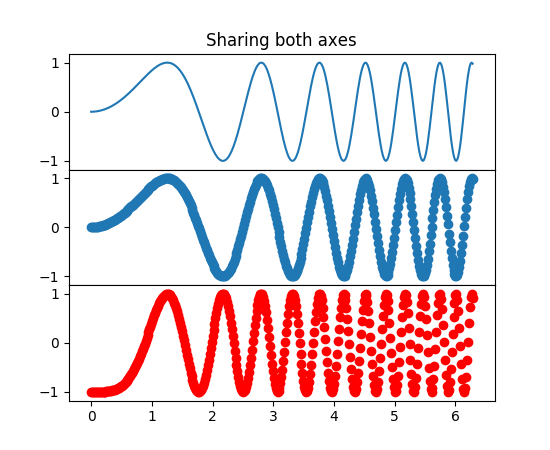
But I want to create the subplots dynamically!
So the number of subplots depends on the output of a previous function. (It will probably be around 3 to 15 subplots per diagram, each from a distinct dataset, depending on the input of my script.)
Can anyone tell me how to accomplish that?
Answers:
Thank you for visiting the Q&A section on Magenaut. Please note that all the answers may not help you solve the issue immediately. So please treat them as advisements. If you found the post helpful (or not), leave a comment & I’ll get back to you as soon as possible.
Method 1
Suppose you know total subplots and total columns you want to use:
import matplotlib.pyplot as plt

# Subplots are organized in a Rows x Cols Grid
# Tot and Cols are known

Tot = number_of_subplots
Cols = number_of_columns

# Compute Rows required

Rows = Tot // Cols
Rows += Tot % Cols

# Create a Position index

Position = range(1,Tot + 1)
First instance of Rows accounts only for rows completely filled by subplots, then is added one more Row if 1 or 2 or … Cols – 1 subplots still need location.
Then create figure and add subplots with a for loop.
# Create main figure

fig = plt.figure(1)
for k in range(Tot):

  # add every single subplot to the figure with a for loop

  ax = fig.add_subplot(Rows,Cols,Position[k])
  ax.plot(x,y)      # Or whatever you want in the subplot

plt.show()
Please note that you need the range Position to move the subplots into the right place.
Method 2
Based on this post, what you want to do is something like this:
import matplotlib.pyplot as plt

# Start with one
fig = plt.figure()
ax = fig.add_subplot(111)
ax.plot([1,2,3])

# Now later you get a new subplot; change the geometry of the existing
n = len(fig.axes)
for i in range(n):
    fig.axes[i].change_geometry(n+1, 1, i+1)

# Add the new
ax = fig.add_subplot(n+1, 1, n+1)
ax.plot([4,5,6])

plt.show()
However, Paul H‘s answer points to the submodule called gridspec which might make the above easier. I am leaving that as an exercise for the reader ^_~.
Method 3
import matplotlib.pyplot as plt
from pylab import *
import numpy as np

x = np.linspace(0, 2*np.pi, 400)
y = np.sin(x**2)

subplots_adjust(hspace=0.000)
number_of_subplots=3

for i,v in enumerate(xrange(number_of_subplots)):
    v = v+1
    ax1 = subplot(number_of_subplots,1,v)
    ax1.plot(x,y)

plt.show()
This code works but you will need to correct the axes. I used to subplot to plot 3 graphs all in the same column. All you need to do is assign an integer to number_of_plots variable. If the X and Y values are different for each plot you will need to assign them for each plot.
subplot works as follows, if for example I had a subplot values of 3,1,1. This creates a 3×1 grid and places the plot in the 1st position. In the next interation if my subplot values were 3,1,2 it again creates a 3×1 grid but places the plot in the 2nd position and so forth.
Method 4
Instead of counting your own number of rows and columns, I found it easier to create the subplots using plt.subplots first, then iterate through the axes object to add plots.
import matplotlib.pyplot as plt
import numpy as np

fig, axes = plt.subplots(nrows=3, ncols=2, figsize=(12, 8))
x_array = np.random.randn(6, 10)
y_array = np.random.randn(6, 10)

i = 0
for row in axes:
    for ax in row:
        x = x_array[i]
        y = y_array[i]
        ax.scatter(x, y)
        ax.set_title("Plot " + str(i))
        i += 1
plt.tight_layout()
plt.show()
Here I use i to iterate through elements of x_array and y_array, but you can likewise easily iterate through functions, or columns of dataframes to dynamically generate graphs.
All methods was sourced from stackoverflow.com or stackexchange.com, is licensed under cc by-sa 2.5, cc by-sa 3.0 and cc by-sa 4.0