I have a string. I want to generate all permutations from that string, by changing the order of characters in it. For example, say:
x='stack'
what I want is a list like this,
l=['stack','satck','sackt'.......]
Currently I am iterating on the list cast of the string, picking 2 letters randomly and transposing them to form a new string, and adding it to set cast of l. Based on the length of the string, I am calculating the number of permutations possible and continuing iterations till set size reaches the limit.
There must be a better way to do this.
Answers:
Thank you for visiting the Q&A section on Magenaut. Please note that all the answers may not help you solve the issue immediately. So please treat them as advisements. If you found the post helpful (or not), leave a comment & I’ll get back to you as soon as possible.
Method 1
The itertools module has a useful method called permutations(). The documentation says:
itertools.permutations(iterable[, r])
Return successive r length permutations of elements in the iterable.
If r is not specified or is None, then r defaults to the length of the
iterable and all possible full-length permutations are generated.Permutations are emitted in lexicographic sort order. So, if the input
iterable is sorted, the permutation tuples will be produced in sorted
order.
You’ll have to join your permuted letters as strings though.
>>> from itertools import permutations
>>> perms = [''.join(p) for p in permutations('stack')]
>>> perms
[‘stack’, ‘stakc’, ‘stcak’, ‘stcka’, ‘stkac’, ‘stkca’, ‘satck’,
‘satkc’, ‘sactk’, ‘sackt’, ‘saktc’, ‘sakct’, ‘sctak’, ‘sctka’,
‘scatk’, ‘scakt’, ‘sckta’, ‘sckat’, ‘sktac’, ‘sktca’, ‘skatc’,
‘skact’, ‘skcta’, ‘skcat’, ‘tsack’, ‘tsakc’, ‘tscak’, ‘tscka’,
‘tskac’, ‘tskca’, ‘tasck’, ‘taskc’, ‘tacsk’, ‘tacks’, ‘taksc’,
‘takcs’, ‘tcsak’, ‘tcska’, ‘tcask’, ‘tcaks’, ‘tcksa’, ‘tckas’,
‘tksac’, ‘tksca’, ‘tkasc’, ‘tkacs’, ‘tkcsa’, ‘tkcas’, ‘astck’,
‘astkc’, ‘asctk’, ‘asckt’, ‘asktc’, ‘askct’, ‘atsck’, ‘atskc’,
‘atcsk’, ‘atcks’, ‘atksc’, ‘atkcs’, ‘acstk’, ‘acskt’, ‘actsk’,
‘actks’, ‘ackst’, ‘ackts’, ‘akstc’, ‘aksct’, ‘aktsc’, ‘aktcs’,
‘akcst’, ‘akcts’, ‘cstak’, ‘cstka’, ‘csatk’, ‘csakt’, ‘cskta’,
‘cskat’, ‘ctsak’, ‘ctska’, ‘ctask’, ‘ctaks’, ‘ctksa’, ‘ctkas’,
‘castk’, ‘caskt’, ‘catsk’, ‘catks’, ‘cakst’, ‘cakts’, ‘cksta’,
‘cksat’, ‘cktsa’, ‘cktas’, ‘ckast’, ‘ckats’, ‘kstac’, ‘kstca’,
‘ksatc’, ‘ksact’, ‘kscta’, ‘kscat’, ‘ktsac’, ‘ktsca’, ‘ktasc’,
‘ktacs’, ‘ktcsa’, ‘ktcas’, ‘kastc’, ‘kasct’, ‘katsc’, ‘katcs’,
‘kacst’, ‘kacts’, ‘kcsta’, ‘kcsat’, ‘kctsa’, ‘kctas’, ‘kcast’,
‘kcats’]
If you find yourself troubled by duplicates, try fitting your data into a structure with no duplicates like a set:
>>> perms = [''.join(p) for p in permutations('stacks')]
>>> len(perms)
720
>>> len(set(perms))
360
Thanks to @pst for pointing out that this is not what we’d traditionally think of as a type cast, but more of a call to the set() constructor.
Method 2
You can get all N! permutations without much code
def permutations(string, step = 0):

    # if we've gotten to the end, print the permutation
    if step == len(string):
        print "".join(string)

    # everything to the right of step has not been swapped yet
    for i in range(step, len(string)):

        # copy the string (store as array)
        string_copy = [character for character in string]

        # swap the current index with the step
        string_copy[step], string_copy[i] = string_copy[i], string_copy[step]

        # recurse on the portion of the string that has not been swapped yet (now it's index will begin with step + 1)
        permutations(string_copy, step + 1)
Method 3
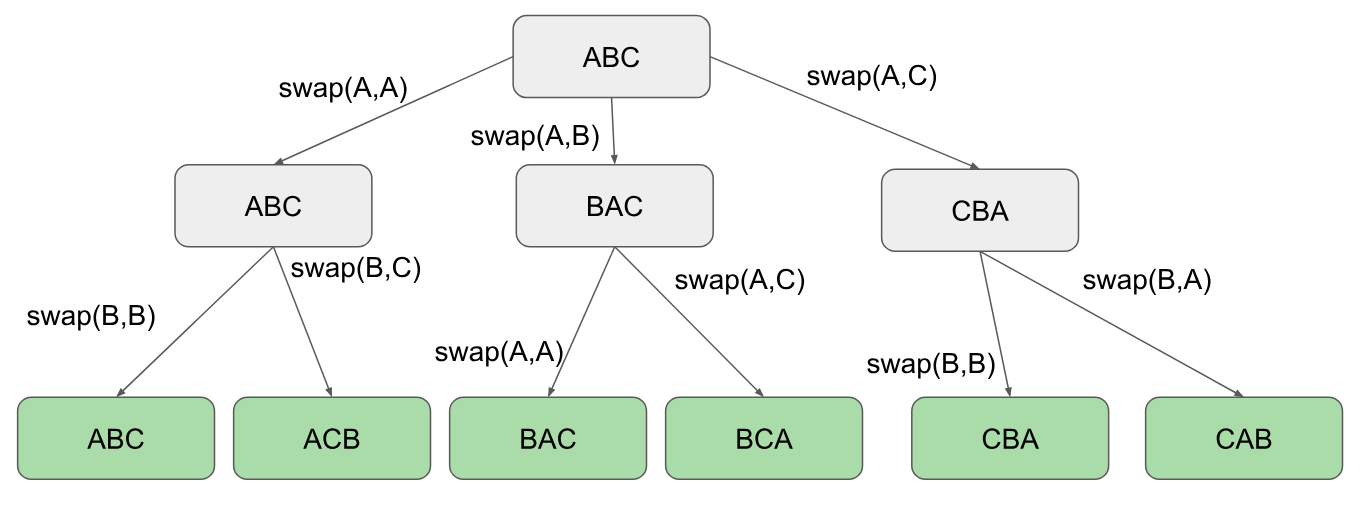
Here is another way of doing the permutation of string with minimal code based on bactracking.
We basically create a loop and then we keep swapping two characters at a time,
Inside the loop we’ll have the recursion. Notice,we only print when indexers reaches the length of our string.
Example:
ABC
i for our starting point and our recursion param
j for our loop
here is a visual help how it works from left to right top to bottom (is the order of permutation)
the code :
def permute(data, i, length):
    if i==length:
        print(''.join(data) )
    else:
        for j in range(i,length):
            #swap
            data[i], data[j] = data[j], data[i]
            permute(data, i+1, length)
            data[i], data[j] = data[j], data[i]


string = "ABC"
n = len(string)
data = list(string)
permute(data, 0, n)
Method 4
Stack Overflow users have already posted some strong solutions but I wanted to show yet another solution. This one I find to be more intuitive
The idea is that for a given string: we can recurse by the algorithm (pseudo-code):
permutations = char + permutations(string – char) for char in string
I hope it helps someone!
def permutations(string):
    """
    Create all permutations of a string with non-repeating characters
    """
    permutation_list = []
    if len(string) == 1:
        return [string]
    else:
        for char in string:
            [permutation_list.append(char + a) for a in permutations(string.replace(char, "", 1))]
    return permutation_list
Method 5
Here’s a simple function to return unique permutations:
def permutations(string):
    if len(string) == 1:
        return string

    recursive_perms = []
    for c in string:
        for perm in permutations(string.replace(c,'',1)):
            recursive_perms.append(c+perm)

    return set(recursive_perms)
Method 6
Here is another approach different from what @Adriano and @illerucis posted. This has a better runtime, you can check that yourself by measuring the time:
def removeCharFromStr(str, index):
    endIndex = index if index == len(str) else index + 1
    return str[:index] + str[endIndex:]

# 'ab' -> a + 'b', b + 'a'
# 'abc' ->  a + bc, b + ac, c + ab
#           a + cb, b + ca, c + ba
def perm(str):
    if len(str) <= 1:
        return {str}
    permSet = set()
    for i, c in enumerate(str):
        newStr = removeCharFromStr(str, i)
        retSet = perm(newStr)
        for elem in retSet:
            permSet.add(c + elem)
    return permSet
For an arbitrary string “dadffddxcf” it took 1.1336 sec for the permutation library, 9.125 sec for this implementation and 16.357 secs for @Adriano’s and @illerucis’ version. Of course you can still optimize it.
Method 7
itertools.permutations is good, but it doesn’t deal nicely with sequences that contain repeated elements. That’s because internally it permutes the sequence indices and is oblivious to the sequence item values.
Sure, it’s possible to filter the output of itertools.permutations through a set to eliminate the duplicates, but it still wastes time generating those duplicates, and if there are several repeated elements in the base sequence there will be lots of duplicates. Also, using a collection to hold the results wastes RAM, negating the benefit of using an iterator in the first place.
Fortunately, there are more efficient approaches. The code below uses the algorithm of the 14th century Indian mathematician Narayana Pandita, which can be found in the Wikipedia article on Permutation. This ancient algorithm is still one of the fastest known ways to generate permutations in order, and it is quite robust, in that it properly handles permutations that contain repeated elements.
def lexico_permute_string(s):
    ''' Generate all permutations in lexicographic order of string `s`

        This algorithm, due to Narayana Pandita, is from
        https://en.wikipedia.org/wiki/Permutation#Generation_in_lexicographic_order

        To produce the next permutation in lexicographic order of sequence `a`

        1. Find the largest index j such that a[j] < a[j + 1]. If no such index exists,
        the permutation is the last permutation.
        2. Find the largest index k greater than j such that a[j] < a[k].
        3. Swap the value of a[j] with that of a[k].
        4. Reverse the sequence from a[j + 1] up to and including the final element a[n].
    '''

    a = sorted(s)
    n = len(a) - 1
    while True:
        yield ''.join(a)

        #1. Find the largest index j such that a[j] < a[j + 1]
        for j in range(n-1, -1, -1):
            if a[j] < a[j + 1]:
                break
        else:
            return

        #2. Find the largest index k greater than j such that a[j] < a[k]
        v = a[j]
        for k in range(n, j, -1):
            if v < a[k]:
                break

        #3. Swap the value of a[j] with that of a[k].
        a[j], a[k] = a[k], a[j]

        #4. Reverse the tail of the sequence
        a[j+1:] = a[j+1:][::-1]

for s in lexico_permute_string('data'):
    print(s)
output
aadt
aatd
adat
adta
atad
atda
daat
data
dtaa
taad
tada
tdaa
Of course, if you want to collect the yielded strings into a list you can do
list(lexico_permute_string('data'))
or in recent Python versions:
[*lexico_permute_string('data')]
Method 8
Here’s a slightly improved version of illerucis‘s code for returning a list of all permutations of a string s with distinct characters (not necessarily in lexicographic sort order), without using itertools:
def get_perms(s, i=0):
    """
    Returns a list of all (len(s) - i)! permutations t of s where t[:i] = s[:i].
    """
    # To avoid memory allocations for intermediate strings, use a list of chars.
    if isinstance(s, str):
        s = list(s)

    # Base Case: 0! = 1! = 1.
    # Store the only permutation as an immutable string, not a mutable list.
    if i >= len(s) - 1:
        return ["".join(s)]

    # Inductive Step: (len(s) - i)! = (len(s) - i) * (len(s) - i - 1)!
    # Swap in each suffix character to be at the beginning of the suffix.
    perms = get_perms(s, i + 1)
    for j in range(i + 1, len(s)):
        s[i], s[j] = s[j], s[i]
        perms.extend(get_perms(s, i + 1))
        s[i], s[j] = s[j], s[i]
    return perms
Method 9
See itertools.combinations or itertools.permutations.
Method 10
why do you not simple do:
from itertools import permutations
perms = [''.join(p) for p in permutations(['s','t','a','c','k'])]
print perms
print len(perms)
print len(set(perms))
you get no duplicate as you can see :
 ['stack', 'stakc', 'stcak', 'stcka', 'stkac', 'stkca', 'satck', 'satkc',
'sactk', 'sackt', 'saktc', 'sakct', 'sctak', 'sctka', 'scatk', 'scakt', 'sckta',
 'sckat', 'sktac', 'sktca', 'skatc', 'skact', 'skcta', 'skcat', 'tsack',
'tsakc', 'tscak', 'tscka', 'tskac', 'tskca', 'tasck', 'taskc', 'tacsk', 'tacks',
'taksc', 'takcs', 'tcsak', 'tcska', 'tcask', 'tcaks', 'tcksa', 'tckas', 'tksac',
'tksca', 'tkasc', 'tkacs', 'tkcsa', 'tkcas', 'astck', 'astkc', 'asctk', 'asckt',
'asktc', 'askct', 'atsck', 'atskc', 'atcsk', 'atcks', 'atksc', 'atkcs', 'acstk',
'acskt', 'actsk', 'actks', 'ackst', 'ackts', 'akstc', 'aksct', 'aktsc', 'aktcs',
'akcst', 'akcts', 'cstak', 'cstka', 'csatk', 'csakt', 'cskta', 'cskat', 'ctsak',
'ctska', 'ctask', 'ctaks', 'ctksa', 'ctkas', 'castk', 'caskt', 'catsk', 'catks',
'cakst', 'cakts', 'cksta', 'cksat', 'cktsa', 'cktas', 'ckast', 'ckats', 'kstac',
'kstca', 'ksatc', 'ksact', 'kscta', 'kscat', 'ktsac', 'ktsca', 'ktasc', 'ktacs',
'ktcsa', 'ktcas', 'kastc', 'kasct', 'katsc', 'katcs', 'kacst', 'kacts', 'kcsta',
'kcsat', 'kctsa', 'kctas', 'kcast', 'kcats']
    120
    120
    [Finished in 0.3s]
Method 11
def permute(seq):
    if not seq:
        yield seq
    else:
        for i in range(len(seq)):
            rest = seq[:i]+seq[i+1:]
            for x in permute(rest):
                yield seq[i:i+1]+x

print(list(permute('stack')))
Method 12
All Possible Word with stack
from itertools import permutations
for i in permutations('stack'):
    print(''.join(i))
permutations(iterable, r=None)
Return successive r length permutations of elements in the iterable.
If r is not specified or is None, then r defaults to the length of the iterable and all possible full-length permutations are generated.
Permutations are emitted in lexicographic sort order. So, if the input iterable is sorted, the permutation tuples will be produced in sorted order.
Elements are treated as unique based on their position, not on their value. So if the input elements are unique, there will be no repeat values in each permutation.
Method 13
With recursive approach.
def permute(word):
    if len(word) == 1:
        return [word]
    permutations = permute(word[1:])
    character = word[0]
    result = []
    for p in permutations:
        for i in range(len(p)+1):
            result.append(p[:i] + character + p[i:])
    return result


running code.

>>> permute('abc')
['abc', 'bac', 'bca', 'acb', 'cab', 'cba']
Method 14
Yet another initiative and recursive solution. The idea is to select a letter as a pivot and then create a word.
def find_premutations(alphabet):

    words = []
    word =''

    def premute(new_word, alphabet):
        if not alphabet:
            words.append(word)
        else:
            for i in range(len(alphabet)):
                premute(new_word=word + alphabet[i], alphabet=alphabet[0:i] + alphabet[i+1:])

    premute(word, alphabet)
    return words


# let us try it with 'abc'
a = 'abc'
find_premutations(a)
Output:
abc
acb
bac
bca
cab
cba
Method 15
Here’s a really simple generator version:
def find_all_permutations(s, curr=[]):
    if len(s) == 0:
        yield curr
    else:
        for i, c in enumerate(s):
            for combo in find_all_permutations(s[:i]+s[i+1:], curr + [c]):
                yield "".join(combo)
I think it’s not so bad!
Method 16
def f(s):
  if len(s) == 2:
    X = [s, (s[1] + s[0])]
      return X
else:
    list1 = []
    for i in range(0, len(s)):
        Y = f(s[0:i] + s[i+1: len(s)])
        for j in Y:
            list1.append(s[i] + j)
    return list1
s = raw_input()
z = f(s)
print z
Method 17
Here’s a simple and straightforward recursive implementation;
def stringPermutations(s):
    if len(s) < 2:
        yield s
        return
    for pos in range(0, len(s)):
        char = s[pos]
        permForRemaining = list(stringPermutations(s[0:pos] + s[pos+1:]))
        for perm in permForRemaining:
            yield char + perm
Method 18
from itertools import permutations
perms = [''.join(p) for p in permutations('ABC')]

perms = [''.join(p) for p in permutations('stack')]
Method 19
def perm(string):
   res=[]
   for j in range(0,len(string)):
       if(len(string)>1):
           for i in perm(string[1:]):
               res.append(string[0]+i)
       else:
           return [string];
       string=string[1:]+string[0];
   return res;
l=set(perm("abcde"))
This is one way to generate permutations with recursion, you can understand the code easily by taking strings ‘a’,’ab’ & ‘abc’ as input.
You get all N! permutations with this, without duplicates.
Method 20
Everyone loves the smell of their own code. Just sharing the one I find the simplest:
def get_permutations(word):
    if len(word) == 1:
        yield word

    for i, letter in enumerate(word):
        for perm in get_permutations(word[:i] + word[i+1:]):
            yield letter + perm
Method 21
This program does not eliminate the duplicates, but I think it is one of the most efficient approaches:
s=raw_input("Enter a string: ")
print "Permutations :n",s
size=len(s)
lis=list(range(0,size))
while(True):
    k=-1
    while(k>-size and lis[k-1]>lis[k]):
        k-=1
    if k>-size:
        p=sorted(lis[k-1:])
        e=p[p.index(lis[k-1])+1]
        lis.insert(k-1,'A')
        lis.remove(e)
        lis[lis.index('A')]=e
        lis[k:]=sorted(lis[k:])
        list2=[]
        for k in lis:
                list2.append(s[k])
        print "".join(list2)
    else:
                break
Method 22
With Recursion
# swap ith and jth character of string
def swap(s, i, j):
    q = list(s)
    q[i], q[j] = q[j], q[i]
    return ''.join(q)


# recursive function
def _permute(p, s, permutes):
    if p >= len(s) - 1:
        permutes.append(s)
        return

    for i in range(p, len(s)):
        _permute(p + 1, swap(s, p, i), permutes)


# helper function
def permute(s):
    permutes = []
    _permute(0, s, permutes)
    return permutes


# TEST IT
s = "1234"
all_permute = permute(s)
print(all_permute)
With Iterative approach (Using Stack)
# swap ith and jth character of string
def swap(s, i, j):
    q = list(s)
    q[i], q[j] = q[j], q[i]
    return ''.join(q)


# iterative function
def permute_using_stack(s):
    stk = [(0, s)]

    permutes = []

    while len(stk) > 0:
        p, s = stk.pop(0)

        if p >= len(s) - 1:
            permutes.append(s)
            continue

        for i in range(p, len(s)):
            stk.append((p + 1, swap(s, p, i)))

    return permutes


# TEST IT
s = "1234"
all_permute = permute_using_stack(s)
print(all_permute)
With Lexicographically sorted
# swap ith and jth character of string
def swap(s, i, j):
    q = list(s)
    q[i], q[j] = q[j], q[i]
    return ''.join(q)


# finds next lexicographic string if exist otherwise returns -1
def next_lexicographical(s):
    for i in range(len(s) - 2, -1, -1):
        if s[i] < s[i + 1]:
            m = s[i + 1]
            swap_pos = i + 1

            for j in range(i + 1, len(s)):
                if m > s[j] > s[i]:
                    m = s[j]
                    swap_pos = j

            if swap_pos != -1:
                s = swap(s, i, swap_pos)
                s = s[:i + 1] + ''.join(sorted(s[i + 1:]))
                return s

    return -1


# helper function
def permute_lexicographically(s):
    s = ''.join(sorted(s))
    permutes = []
    while True:
        permutes.append(s)
        s = next_lexicographical(s)
        if s == -1:
            break
    return permutes


# TEST IT
s = "1234"
all_permute = permute_lexicographically(s)
print(all_permute)
Method 23
This is a recursive solution with n! which accepts duplicate elements in the string
import math

def getFactors(root,num):
    sol = []
    # return condition
    if len(num) == 1:
            return [root+num]
    # looping in next iteration
    for i in range(len(num)):
        # Creating a substring with all remaining char but the taken in this iteration
        if i > 0:
            rem = num[:i]+num[i+1:]
        else:
            rem = num[i+1:]
        # Concatenating existing solutions with the solution of this iteration
        sol = sol + getFactors(root + num[i], rem)
    return sol
I validated the solution taking into account two elements, the number of combinations is n! and the result can not contain duplicates. So:
inpt = "1234"
results = getFactors("",inpt)

if len(results) == math.factorial(len(inpt)) | len(results) != len(set(results)):
    print("Wrong approach")
else:
    print("Correct Approach")
Method 24
Simpler solution using permutations.
from itertools import permutations

def stringPermutate(s1):
    length=len(s1)
    if length < 2:
        return s1

    perm = [''.join(p) for p in permutations(s1)]

    return set(perm)
Method 25
The itertools module in the standard library has a function for this which is simply called permutations.
import itertools

def minion_game(s):
    vow ="aeiou"
    lsword=[]
    ta=[]
    for a in range(1,len(s)+1):
        t=list(itertools.permutations(s,a))
        lsword.append(t)

    for i in range(0,len(lsword)):
        for xa in lsword[i]:
            if vow.startswith(xa):
                ta.append("".join(xa))

    print(ta)

minion_game("banana")
Method 26
def permute_all_chars(list, begin, end):

    if (begin == end):
        print(list)
        return

    for current_position in range(begin, end + 1):
        list[begin], list[current_position] = list[current_position], list[begin]
        permute_all_chars(list, begin + 1, end)
        list[begin], list[current_position] = list[current_position], list[begin]


given_str = 'ABC'
list = []
for char in given_str:
    list.append(char)
permute_all_chars(list, 0, len(list) -1)
All methods was sourced from stackoverflow.com or stackexchange.com, is licensed under cc by-sa 2.5, cc by-sa 3.0 and cc by-sa 4.0