I intend to fit a 2D Gaussian function to images showing a laser beam to get its parameters like FWHM and position. So far I tried to understand how to define a 2D Gaussian function in Python and how to pass x and y variables to it.
I’ve written a little script which defines that function, plots it, adds some noise to it and then tries to fit it using curve_fit. Everything seems to work except the last step in which I try to fit my model function to the noisy data. Here is my code:
import scipy.optimize as opt
import numpy as np
import pylab as plt


#define model function and pass independant variables x and y as a list
def twoD_Gaussian((x,y), amplitude, xo, yo, sigma_x, sigma_y, theta, offset):
    xo = float(xo)
    yo = float(yo)
    a = (np.cos(theta)**2)/(2*sigma_x**2) + (np.sin(theta)**2)/(2*sigma_y**2)
    b = -(np.sin(2*theta))/(4*sigma_x**2) + (np.sin(2*theta))/(4*sigma_y**2)
    c = (np.sin(theta)**2)/(2*sigma_x**2) + (np.cos(theta)**2)/(2*sigma_y**2)
    return offset + amplitude*np.exp( - (a*((x-xo)**2) + 2*b*(x-xo)*(y-yo) + c*((y-yo)**2)))

# Create x and y indices
x = np.linspace(0, 200, 201)
y = np.linspace(0, 200, 201)
x,y = np.meshgrid(x, y)

#create data
data = twoD_Gaussian((x, y), 3, 100, 100, 20, 40, 0, 10)

# plot twoD_Gaussian data generated above
plt.figure()
plt.imshow(data)
plt.colorbar()

# add some noise to the data and try to fit the data generated beforehand
initial_guess = (3,100,100,20,40,0,10)

data_noisy = data + 0.2*np.random.normal(size=len(x))

popt, pcov = opt.curve_fit(twoD_Gaussian, (x,y), data_noisy, p0 = initial_guess)
Here is the error message I get when running the script using winpython 64-bit Python 2.7:
ValueError: object too deep for desired array
Traceback (most recent call last):
  File "<stdin>", line 1, in <module>
  File "C:PythonWinPython-64bit-2.7.6.2python-2.7.6.amd64libsite-packagesspyderlibwidgetsexternalshellsitecustomize.py", line 540, in runfile
    execfile(filename, namespace)
  File "E:/Work Computer/Software/Python/Fitting scripts/2D Gaussian function fit/2D_Gaussian_LevMarq_v2.py", line 39, in <module>
    popt, pcov = opt.curve_fit(twoD_Gaussian, (x,y), data_noisy, p0 = initial_guess)
  File "C:PythonWinPython-64bit-2.7.6.2python-2.7.6.amd64libsite-packagesscipyoptimizeminpack.py", line 533, in curve_fit
    res = leastsq(func, p0, args=args, full_output=1, **kw)
  File "C:PythonWinPython-64bit-2.7.6.2python-2.7.6.amd64libsite-packagesscipyoptimizeminpack.py", line 378, in leastsq
    gtol, maxfev, epsfcn, factor, diag)
minpack.error: Result from function call is not a proper array of floats.
What is it that am I doing wrong? Is it how I pass the independent variables to the model function/curve_fit?
Answers:
Thank you for visiting the Q&A section on Magenaut. Please note that all the answers may not help you solve the issue immediately. So please treat them as advisements. If you found the post helpful (or not), leave a comment & I’ll get back to you as soon as possible.
Method 1
The output of twoD_Gaussian needs to be 1D. What you can do is add a .ravel() onto the end of the last line, like this:
def twoD_Gaussian((x, y), amplitude, xo, yo, sigma_x, sigma_y, theta, offset):
    xo = float(xo)
    yo = float(yo)
    a = (np.cos(theta)**2)/(2*sigma_x**2) + (np.sin(theta)**2)/(2*sigma_y**2)
    b = -(np.sin(2*theta))/(4*sigma_x**2) + (np.sin(2*theta))/(4*sigma_y**2)
    c = (np.sin(theta)**2)/(2*sigma_x**2) + (np.cos(theta)**2)/(2*sigma_y**2)
    g = offset + amplitude*np.exp( - (a*((x-xo)**2) + 2*b*(x-xo)*(y-yo)
                            + c*((y-yo)**2)))
    return g.ravel()
You’ll obviously need to reshape the output for plotting, e.g:
# Create x and y indices
x = np.linspace(0, 200, 201)
y = np.linspace(0, 200, 201)
x, y = np.meshgrid(x, y)

#create data
data = twoD_Gaussian((x, y), 3, 100, 100, 20, 40, 0, 10)

# plot twoD_Gaussian data generated above
plt.figure()
plt.imshow(data.reshape(201, 201))
plt.colorbar()
Do the fitting as before:
# add some noise to the data and try to fit the data generated beforehand
initial_guess = (3,100,100,20,40,0,10)

data_noisy = data + 0.2*np.random.normal(size=data.shape)

popt, pcov = opt.curve_fit(twoD_Gaussian, (x, y), data_noisy, p0=initial_guess)
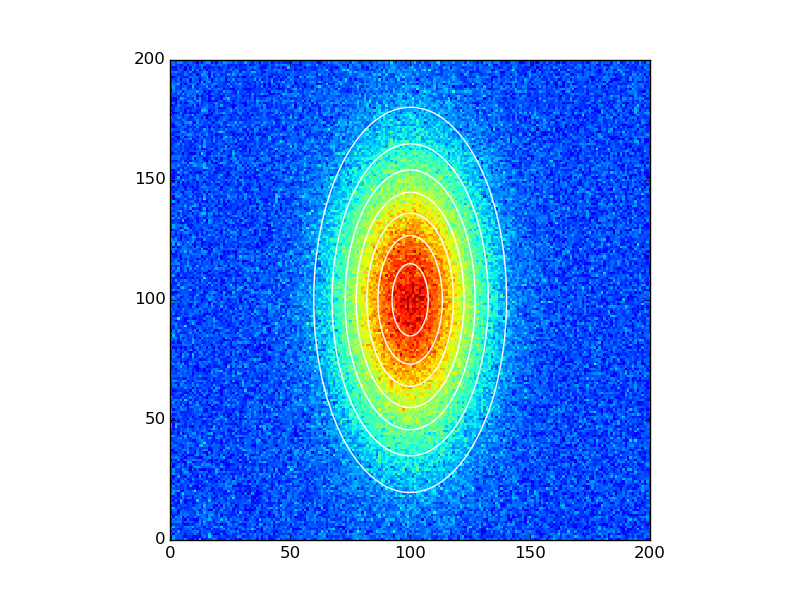
And plot the results:
data_fitted = twoD_Gaussian((x, y), *popt)

fig, ax = plt.subplots(1, 1)
ax.hold(True)
ax.imshow(data_noisy.reshape(201, 201), cmap=plt.cm.jet, origin='bottom',
    extent=(x.min(), x.max(), y.min(), y.max()))
ax.contour(x, y, data_fitted.reshape(201, 201), 8, colors='w')
plt.show()
Method 2
To expand on Dietrich’s answer a bit, I got the following error when running the suggested solution with Python 3.4 (on Ubuntu 14.04):
def twoD_Gaussian((x, y), amplitude, xo, yo, sigma_x, sigma_y, theta, offset):
                  ^
SyntaxError: invalid syntax
Running 2to3 suggested the following simple fix:
def twoD_Gaussian(xdata_tuple, amplitude, xo, yo, sigma_x, sigma_y, theta, offset):
    (x, y) = xdata_tuple
    xo = float(xo)
    yo = float(yo)
    a = (np.cos(theta)**2)/(2*sigma_x**2) + (np.sin(theta)**2)/(2*sigma_y**2)
    b = -(np.sin(2*theta))/(4*sigma_x**2) + (np.sin(2*theta))/(4*sigma_y**2)
    c = (np.sin(theta)**2)/(2*sigma_x**2) + (np.cos(theta)**2)/(2*sigma_y**2)
    g = offset + amplitude*np.exp( - (a*((x-xo)**2) + 2*b*(x-xo)*(y-yo)
                        + c*((y-yo)**2)))
    return g.ravel()
The reason for this is that automatic tuple unpacking when it is passed to a function as a parameter has been removed as of Python 3. For more information see here: PEP 3113
Method 3
curve_fit() wants to the dimension of xdata to be (2,n*m) and not (2,n,m). ydata should have shape (n*m) not (n,m) respectively. So you use ravel() to flatten your 2D arrays:
xdata = np.vstack((xx.ravel(),yy.ravel()))
ydata = data_noisy.ravel()
popt, pcov = opt.curve_fit(twoD_Gaussian, xdata, ydata, p0=initial_guess)
By the way: I’m not sure if the parametrization with the trigonometric terms is the best one. E.g., taking the one described here might be a bit more robust under numerical aspects and large deviations.
All methods was sourced from stackoverflow.com or stackexchange.com, is licensed under cc by-sa 2.5, cc by-sa 3.0 and cc by-sa 4.0