For example, given the list ['one', 'two', 'one'], the algorithm should return True, whereas given ['one', 'two', 'three'] it should return False.
Answers:
Thank you for visiting the Q&A section on Magenaut. Please note that all the answers may not help you solve the issue immediately. So please treat them as advisements. If you found the post helpful (or not), leave a comment & I’ll get back to you as soon as possible.
Method 1
Use set() to remove duplicates if all values are hashable:
>>> your_list = ['one', 'two', 'one']
>>> len(your_list) != len(set(your_list))
True
Method 2
Recommended for short lists only:
any(thelist.count(x) > 1 for x in thelist)
Do not use on a long list — it can take time proportional to the square of the number of items in the list!
For longer lists with hashable items (strings, numbers, &c):
def anydup(thelist):
  seen = set()
  for x in thelist:
    if x in seen: return True
    seen.add(x)
  return False
If your items are not hashable (sublists, dicts, etc) it gets hairier, though it may still be possible to get O(N logN) if they’re at least comparable. But you need to know or test the characteristics of the items (hashable or not, comparable or not) to get the best performance you can — O(N) for hashables, O(N log N) for non-hashable comparables, otherwise it’s down to O(N squared) and there’s nothing one can do about it:-(.
Method 3
I thought it would be useful to compare the timings of the different solutions presented here. For this I used my own library simple_benchmark:
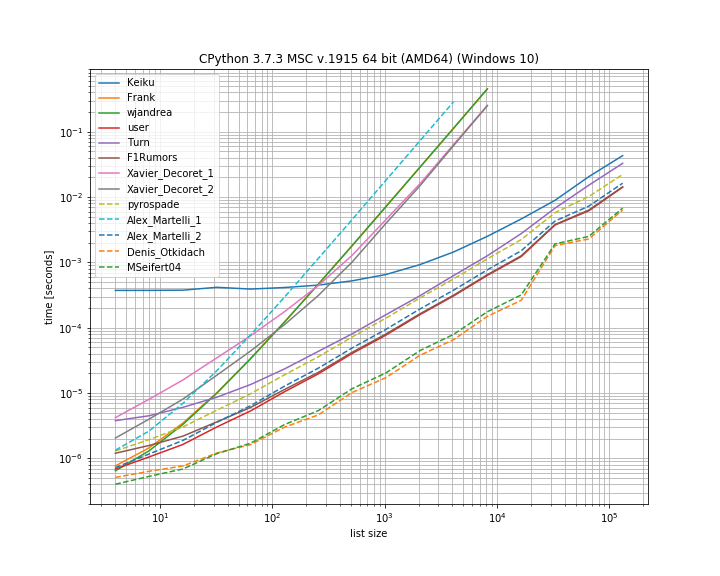
So indeed for this case the solution from Denis Otkidach is fastest.
Some of the approaches also exhibit a much steeper curve, these are the approaches that scale quadratic with the number of elements (Alex Martellis first solution, wjandrea and both of Xavier Decorets solutions). Also important to mention is that the pandas solution from Keiku has a very big constant factor. But for larger lists it almost catches up with the other solutions.
And in case the duplicate is at the first position. This is useful to see which solutions are short-circuiting:
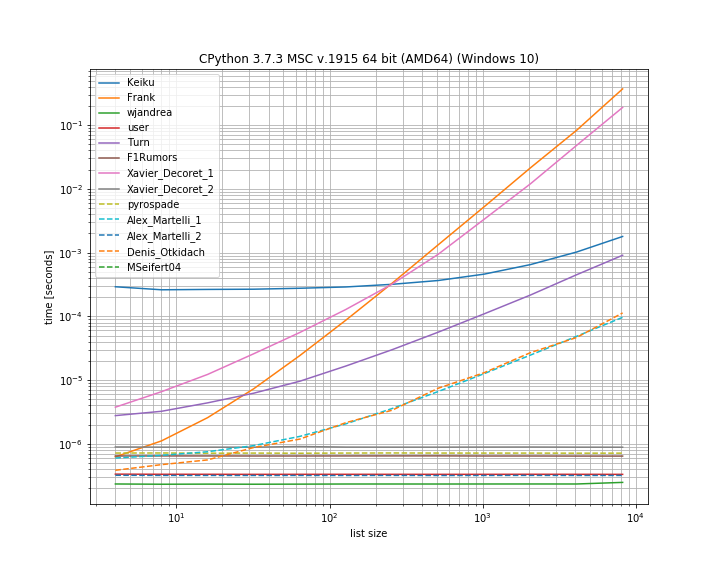
Here several approaches don’t short-circuit: Kaiku, Frank, Xavier_Decoret (first solution), Turn, Alex Martelli (first solution) and the approach presented by Denis Otkidach (which was fastest in the no-duplicate case).
I included a function from my own library here: iteration_utilities.all_distinct which can compete with the fastest solution in the no-duplicates case and performs in constant-time for the duplicate-at-begin case (although not as fastest).
The code for the benchmark:
from collections import Counter
from functools import reduce

import pandas as pd
from simple_benchmark import BenchmarkBuilder
from iteration_utilities import all_distinct

b = BenchmarkBuilder()

@b.add_function()
def Keiku(l):
    return pd.Series(l).duplicated().sum() > 0

@b.add_function()
def Frank(num_list):
    unique = []
    dupes = []
    for i in num_list:
        if i not in unique:
            unique.append(i)
        else:
            dupes.append(i)
    if len(dupes) != 0:
        return False
    else:
        return True

@b.add_function()
def wjandrea(iterable):
    seen = []
    for x in iterable:
        if x in seen:
            return True
        seen.append(x)
    return False

@b.add_function()
def user(iterable):
    clean_elements_set = set()
    clean_elements_set_add = clean_elements_set.add

    for possible_duplicate_element in iterable:

        if possible_duplicate_element in clean_elements_set:
            return True

        else:
            clean_elements_set_add( possible_duplicate_element )

    return False

@b.add_function()
def Turn(l):
    return Counter(l).most_common()[0][1] > 1

def getDupes(l):
    seen = set()
    seen_add = seen.add
    for x in l:
        if x in seen or seen_add(x):
            yield x

@b.add_function()
def F1Rumors(l):
    try:
        if next(getDupes(l)): return True    # Found a dupe
    except StopIteration:
        pass
    return False

def decompose(a_list):
    return reduce(
        lambda u, o : (u[0].union([o]), u[1].union(u[0].intersection([o]))),
        a_list,
        (set(), set()))

@b.add_function()
def Xavier_Decoret_1(l):
    return not decompose(l)[1]

@b.add_function()
def Xavier_Decoret_2(l):
    try:
        def func(s, o):
            if o in s:
                raise Exception
            return s.union([o])
        reduce(func, l, set())
        return True
    except:
        return False

@b.add_function()
def pyrospade(xs):
    s = set()
    return any(x in s or s.add(x) for x in xs)

@b.add_function()
def Alex_Martelli_1(thelist):
    return any(thelist.count(x) > 1 for x in thelist)

@b.add_function()
def Alex_Martelli_2(thelist):
    seen = set()
    for x in thelist:
        if x in seen: return True
        seen.add(x)
    return False

@b.add_function()
def Denis_Otkidach(your_list):
    return len(your_list) != len(set(your_list))

@b.add_function()
def MSeifert04(l):
    return not all_distinct(l)
And for the arguments:
# No duplicate run
@b.add_arguments('list size')
def arguments():
    for exp in range(2, 14):
        size = 2**exp
        yield size, list(range(size))

# Duplicate at beginning run
@b.add_arguments('list size')
def arguments():
    for exp in range(2, 14):
        size = 2**exp
        yield size, [0, *list(range(size)]

# Running and plotting
r = b.run()
r.plot()
Method 4
This is old, but the answers here led me to a slightly different solution. If you are up for abusing comprehensions, you can get short-circuiting this way.
xs = [1, 2, 1]
s = set()
any(x in s or s.add(x) for x in xs)
# You can use a similar approach to actually retrieve the duplicates.
s = set()
duplicates = set(x for x in xs if x in s or s.add(x))
Method 5
If you are fond of functional programming style, here is a useful function, self-documented and tested code using doctest.
def decompose(a_list):
    """Turns a list into a set of all elements and a set of duplicated elements.

    Returns a pair of sets. The first one contains elements
    that are found at least once in the list. The second one
    contains elements that appear more than once.

    >>> decompose([1,2,3,5,3,2,6])
    (set([1, 2, 3, 5, 6]), set([2, 3]))
    """
    return reduce(
        lambda (u, d), o : (u.union([o]), d.union(u.intersection([o]))),
        a_list,
        (set(), set()))

if __name__ == "__main__":
    import doctest
    doctest.testmod()
From there you can test unicity by checking whether the second element of the returned pair is empty:
def is_set(l):
    """Test if there is no duplicate element in l.

    >>> is_set([1,2,3])
    True
    >>> is_set([1,2,1])
    False
    >>> is_set([])
    True
    """
    return not decompose(l)[1]
Note that this is not efficient since you are explicitly constructing the decomposition. But along the line of using reduce, you can come up to something equivalent (but slightly less efficient) to answer 5:
def is_set(l):
    try:
        def func(s, o):
            if o in s:
                raise Exception
            return s.union([o])
        reduce(func, l, set())
        return True
    except:
        return False
Method 6
I recently answered a related question to establish all the duplicates in a list, using a generator. It has the advantage that if used just to establish ‘if there is a duplicate’ then you just need to get the first item and the rest can be ignored, which is the ultimate shortcut.
This is an interesting set based approach I adapted straight from moooeeeep:
def getDupes(l):
    seen = set()
    seen_add = seen.add
    for x in l:
        if x in seen or seen_add(x):
            yield x
Accordingly, a full list of dupes would be list(getDupes(etc)). To simply test “if” there is a dupe, it should be wrapped as follows:
def hasDupes(l):
    try:
        if getDupes(l).next(): return True    # Found a dupe
    except StopIteration:
        pass
    return False
This scales well and provides consistent operating times wherever the dupe is in the list — I tested with lists of up to 1m entries. If you know something about the data, specifically, that dupes are likely to show up in the first half, or other things that let you skew your requirements, like needing to get the actual dupes, then there are a couple of really alternative dupe locators that might outperform. The two I recommend are…
Simple dict based approach, very readable:
def getDupes(c):
    d = {}
    for i in c:
        if i in d:
            if d[i]:
                yield i
                d[i] = False
        else:
            d[i] = True
Leverage itertools (essentially an ifilter/izip/tee) on the sorted list, very efficient if you are getting all the dupes though not as quick to get just the first:
def getDupes(c):
    a, b = itertools.tee(sorted(c))
    next(b, None)
    r = None
    for k, g in itertools.ifilter(lambda x: x[0]==x[1], itertools.izip(a, b)):
        if k != r:
            yield k
            r = k
These were the top performers from the approaches I tried for the full dupe list, with the first dupe occurring anywhere in a 1m element list from the start to the middle. It was surprising how little overhead the sort step added. Your mileage may vary, but here are my specific timed results:
Finding FIRST duplicate, single dupe places "n" elements in to 1m element array

Test set len change :        50 -  . . . . .  -- 0.002
Test in dict        :        50 -  . . . . .  -- 0.002
Test in set         :        50 -  . . . . .  -- 0.002
Test sort/adjacent  :        50 -  . . . . .  -- 0.023
Test sort/groupby   :        50 -  . . . . .  -- 0.026
Test sort/zip       :        50 -  . . . . .  -- 1.102
Test sort/izip      :        50 -  . . . . .  -- 0.035
Test sort/tee/izip  :        50 -  . . . . .  -- 0.024
Test moooeeeep      :        50 -  . . . . .  -- 0.001 *
Test iter*/sorted   :        50 -  . . . . .  -- 0.027

Test set len change :      5000 -  . . . . .  -- 0.017
Test in dict        :      5000 -  . . . . .  -- 0.003 *
Test in set         :      5000 -  . . . . .  -- 0.004
Test sort/adjacent  :      5000 -  . . . . .  -- 0.031
Test sort/groupby   :      5000 -  . . . . .  -- 0.035
Test sort/zip       :      5000 -  . . . . .  -- 1.080
Test sort/izip      :      5000 -  . . . . .  -- 0.043
Test sort/tee/izip  :      5000 -  . . . . .  -- 0.031
Test moooeeeep      :      5000 -  . . . . .  -- 0.003 *
Test iter*/sorted   :      5000 -  . . . . .  -- 0.031

Test set len change :     50000 -  . . . . .  -- 0.035
Test in dict        :     50000 -  . . . . .  -- 0.023
Test in set         :     50000 -  . . . . .  -- 0.023
Test sort/adjacent  :     50000 -  . . . . .  -- 0.036
Test sort/groupby   :     50000 -  . . . . .  -- 0.134
Test sort/zip       :     50000 -  . . . . .  -- 1.121
Test sort/izip      :     50000 -  . . . . .  -- 0.054
Test sort/tee/izip  :     50000 -  . . . . .  -- 0.045
Test moooeeeep      :     50000 -  . . . . .  -- 0.019 *
Test iter*/sorted   :     50000 -  . . . . .  -- 0.055

Test set len change :    500000 -  . . . . .  -- 0.249
Test in dict        :    500000 -  . . . . .  -- 0.145
Test in set         :    500000 -  . . . . .  -- 0.165
Test sort/adjacent  :    500000 -  . . . . .  -- 0.139
Test sort/groupby   :    500000 -  . . . . .  -- 1.138
Test sort/zip       :    500000 -  . . . . .  -- 1.159
Test sort/izip      :    500000 -  . . . . .  -- 0.126
Test sort/tee/izip  :    500000 -  . . . . .  -- 0.120 *
Test moooeeeep      :    500000 -  . . . . .  -- 0.131
Test iter*/sorted   :    500000 -  . . . . .  -- 0.157
Method 7
Another way of doing this succinctly is with Counter.
To just determine if there are any duplicates in the original list:
from collections import Counter

def has_dupes(l):
    # second element of the tuple has number of repetitions
    return Counter(l).most_common()[0][1] > 1
Or to get a list of items that have duplicates:
def get_dupes(l):
    return [k for k, v in Counter(l).items() if v > 1]
Method 8
my_list = ['one', 'two', 'one']

duplicates = []

for value in my_list:
  if my_list.count(value) > 1:
    if value not in duplicates:
      duplicates.append(value)

print(duplicates) //["one"]
Method 9
I found this to do the best performance because it short-circuit the operation when the first duplicated it found, then this algorithm has time and space complexity O(n) where n is the list’s length:
def has_duplicated_elements(iterable):
    """ Given an `iterable`, return True if there are duplicated entries. """
    clean_elements_set = set()
    clean_elements_set_add = clean_elements_set.add

    for possible_duplicate_element in iterable:

        if possible_duplicate_element in clean_elements_set:
            return True

        else:
            clean_elements_set_add( possible_duplicate_element )

    return False
Method 10
If the list contains unhashable items, you can use Alex Martelli’s solution but with a list instead of a set, though it’s slower for larger inputs: O(N^2).
def has_duplicates(iterable):
    seen = []
    for x in iterable:
        if x in seen:
            return True
        seen.append(x)
    return False
Method 11
I dont really know what set does behind the scenes, so I just like to keep it simple.
def dupes(num_list):
    unique = []
    dupes = []
    for i in num_list:
        if i not in unique:
            unique.append(i)
        else:
            dupes.append(i)
    if len(dupes) != 0:
        return False
    else:
        return True
Method 12
A more simple solution is as follows. Just check True/False with pandas .duplicated() method and then take sum. Please also see pandas.Series.duplicated — pandas 0.24.1 documentation
import pandas as pd

def has_duplicated(l):
    return pd.Series(l).duplicated().sum() > 0

print(has_duplicated(['one', 'two', 'one']))
# True
print(has_duplicated(['one', 'two', 'three']))
# False
Method 13
I used pyrospade’s approach, for its simplicity, and modified that slightly on a short list made from the case-insensitive Windows registry.
If the raw PATH value string is split into individual paths all ‘null’ paths (empty or whitespace-only strings) can be removed by using:
PATH_nonulls = [s for s in PATH if s.strip()]

def HasDupes(aseq) :
    s = set()
    return any(((x.lower() in s) or s.add(x.lower())) for x in aseq)

def GetDupes(aseq) :
    s = set()
    return set(x for x in aseq if ((x.lower() in s) or s.add(x.lower())))

def DelDupes(aseq) :
    seen = set()
    return [x for x in aseq if (x.lower() not in seen) and (not seen.add(x.lower()))]
The original PATH has both ‘null’ entries and duplicates for testing purposes:
<div class="su-list" style="margin-left:0px"></div>  Root paths in HKLMSYSTEMCurrentControlSetControlSession ManagerEnvironment:PATH<div class="su-list" style="margin-left:0px"></div>  Root paths in HKLMSYSTEMCurrentControlSetControlSession ManagerEnvironment
  1  C:Python37
  2
  3
  4  C:Python37Scripts
  5  c:python37
  6  C:Program FilesImageMagick-7.0.8-Q8
  7  C:Program Files (x86)popplerbin
  8  D:DATASounds
  9  C:Program Files (x86)GnuWin32bin
 10  C:Program Files (x86)InteliCLS Client
 11  C:Program FilesInteliCLS Client
 12  D:DATACCMDFF
 13  D:DATACCMD
 14  D:DATAUTIL
 15  C:
 16  D:DATAUHELP
 17  %SystemRoot%system32
 18
 19
 20  D:DATACCMDFF%SystemRoot%
 21  D:DATASounds
 22  %SystemRoot%System32Wbem
 23  D:DATACCMDFF
 24
 25
 26  c:
 27  %SYSTEMROOT%System32WindowsPowerShellv1.0
 28
Null paths have been removed, but still has duplicates, e.g., (1, 3) and (13, 20):
    <div class="su-list" style="margin-left:0px"></div>  Null paths removed from HKLMSYSTEMCurrentControlSetControlSession ManagerEnvironment:PATH
  1  C:Python37
  2  C:Python37Scripts
  3  c:python37
  4  C:Program FilesImageMagick-7.0.8-Q8
  5  C:Program Files (x86)popplerbin
  6  D:DATASounds
  7  C:Program Files (x86)GnuWin32bin
  8  C:Program Files (x86)InteliCLS Client
  9  C:Program FilesInteliCLS Client
 10  D:DATACCMDFF
 11  D:DATACCMD
 12  D:DATAUTIL
 13  C:
 14  D:DATAUHELP
 15  %SystemRoot%system32
 16  D:DATACCMDFF%SystemRoot%
 17  D:DATASounds
 18  %SystemRoot%System32Wbem
 19  D:DATACCMDFF
 20  c:
 21  %SYSTEMROOT%System32WindowsPowerShellv1.0
And finally, the dupes have been removed:
<div class="su-list" style="margin-left:0px"></div>  Massaged path list from in HKLMSYSTEMCurrentControlSetControlSession ManagerEnvironment:PATH
  1  C:Python37
  2  C:Python37Scripts
  3  C:Program FilesImageMagick-7.0.8-Q8
  4  C:Program Files (x86)popplerbin
  5  D:DATASounds
  6  C:Program Files (x86)GnuWin32bin
  7  C:Program Files (x86)InteliCLS Client
  8  C:Program FilesInteliCLS Client
  9  D:DATACCMDFF
 10  D:DATACCMD
 11  D:DATAUTIL
 12  C:
 13  D:DATAUHELP
 14  %SystemRoot%system32
 15  D:DATACCMDFF%SystemRoot%
 16  %SystemRoot%System32Wbem
 17  %SYSTEMROOT%System32WindowsPowerShellv1.0
Method 14
def check_duplicates(my_list):
    seen = {}
    for item in my_list:
        if seen.get(item):
            return True
        seen[item] = True
    return False
Method 15
Another solution is to use slicing, which will also work with strings and other enumerable things.
def has_duplicates(x):
    for idx, item in enumerate(x):
        if item in x[(idx + 1):]:
            return True
    return False


>>> has_duplicates(["a", "b", "c"])
False
>>> has_duplicates(["a", "b", "b", "c"])
True
>>> has_duplicates("abc")
False
>>> has_duplicates("abbc")
True
All methods was sourced from stackoverflow.com or stackexchange.com, is licensed under cc by-sa 2.5, cc by-sa 3.0 and cc by-sa 4.0