I have a variable, x, and I want to know whether it is pointing to a function or not.
I had hoped I could do something like:
>>> isinstance(x, function)
But that gives me:
Traceback (most recent call last):
  File "<stdin>", line 1, in ?
NameError: name 'function' is not defined
The reason I picked that is because
>>> type(x)
<type 'function'>
Answers:
Thank you for visiting the Q&A section on Magenaut. Please note that all the answers may not help you solve the issue immediately. So please treat them as advisements. If you found the post helpful (or not), leave a comment & I’ll get back to you as soon as possible.
Method 1
If this is for Python 2.x or for Python 3.2+, you can use callable(). It used to be deprecated, but is now undeprecated, so you can use it again. You can read the discussion here: http://bugs.python.org/issue10518. You can do this with:
callable(obj)
If this is for Python 3.x but before 3.2, check if the object has a __call__ attribute. You can do this with:
hasattr(obj, '__call__')
The oft-suggested types.FunctionTypes or inspect.isfunction approach (both do the exact same thing) comes with a number of caveats. It returns False for non-Python functions. Most builtin functions, for example, are implemented in C and not Python, so they return False:
>>> isinstance(open, types.FunctionType)
False
>>> callable(open)
True
so types.FunctionType might give you surprising results. The proper way to check properties of duck-typed objects is to ask them if they quack, not to see if they fit in a duck-sized container.
Method 2
Builtin types that don’t have constructors in the built-in namespace (e.g. functions, generators, methods) are in the types module. You can use types.FunctionType in an isinstance call:
>>> import types
>>> types.FunctionType
<class 'function'>

>>> def f(): pass

>>> isinstance(f, types.FunctionType)
True
>>> isinstance(lambda x : None, types.FunctionType)
True
Note that this uses a very specific notion of “function” that is usually not what you need. For example, it rejects zip (technically a class):
>>> type(zip), isinstance(zip, types.FunctionType)
(<class 'type'>, False)
open (built-in functions have a different type):
>>> type(open), isinstance(open, types.FunctionType)
(<class 'builtin_function_or_method'>, False)
and random.shuffle (technically a method of a hidden random.Random instance):
>>> type(random.shuffle), isinstance(random.shuffle, types.FunctionType)
(<class 'method'>, False)
If you’re doing something specific to types.FunctionType instances, like decompiling their bytecode or inspecting closure variables, use types.FunctionType, but if you just need an object to be callable like a function, use callable.
Method 3
Since Python 2.1 you can import isfunction from the inspect module.
>>> from inspect import isfunction
>>> def f(): pass
>>> isfunction(f)
True
>>> isfunction(lambda x: x)
True
Method 4
The accepted answer was at the time it was offered thought to be correct. As it
turns out, there is no substitute for callable(), which is back in Python
3.2: Specifically, callable() checks the tp_call field of the object being
tested. There is no plain Python equivalent. Most of the suggested tests are
correct most of the time:
>>> class Spam(object):
...     def __call__(self):
...         return 'OK'
>>> can_o_spam = Spam()


>>> can_o_spam()
'OK'
>>> callable(can_o_spam)
True
>>> hasattr(can_o_spam, '__call__')
True
>>> import collections
>>> isinstance(can_o_spam, collections.Callable)
True
We can throw a monkey-wrench into this by removing the __call__ from the
class. And just to keep things extra exciting, add a fake __call__ to the instance!
>>> del Spam.__call__
>>> can_o_spam.__call__ = lambda *args: 'OK?'
Notice this really isn’t callable:
>>> can_o_spam()
Traceback (most recent call last):
  ...
TypeError: 'Spam' object is not callable
callable() returns the correct result:
>>> callable(can_o_spam)
False
But hasattr is wrong:
>>> hasattr(can_o_spam, '__call__')
True
can_o_spam does have that attribute after all; it’s just not used when calling
the instance.
Even more subtle, isinstance() also gets this wrong:
>>> isinstance(can_o_spam, collections.Callable)
True
Because we used this check earlier and later deleted the method, abc.ABCMeta
caches the result. Arguably this is a bug in abc.ABCMeta. That said,
there’s really no possible way it could produce a more accurate result than
the result than by using callable() itself, since the typeobject->tp_call
slot method is not accessible in any other way.
Just use callable()
Method 5
The following should return a boolean:
callable(x)
Method 6
Python’s 2to3 tool (http://docs.python.org/dev/library/2to3.html) suggests:
import collections
isinstance(obj, collections.Callable)
It seems this was chosen instead of the hasattr(x, '__call__') method because of http://bugs.python.org/issue7006.
Method 7
callable(x) will return true if the object passed can be called in Python, but the function does not exist in Python 3.0, and properly speaking will not distinguish between:
class A(object):
    def __call__(self):
        return 'Foo'

def B():
    return 'Bar'

a = A()
b = B

print type(a), callable(a)
print type(b), callable(b)
You’ll get <class 'A'> True and <type function> True as output.
isinstance works perfectly well to determine if something is a function (try isinstance(b, types.FunctionType)); if you’re really interested in knowing if something can be called, you can either use hasattr(b, '__call__') or just try it.
test_as_func = True
try:
    b()
except TypeError:
    test_as_func = False
except:
    pass
This, of course, won’t tell you whether it’s callable but throws a TypeError when it executes, or isn’t callable in the first place. That may not matter to you.
Method 8
Result
| callable(x) | hasattr(x, ‘__call__’) | inspect.isfunction(x) | inspect.ismethod(x) | inspect.isgeneratorfunction(x) | inspect.iscoroutinefunction(x) | inspect.isasyncgenfunction(x) | isinstance(x, typing.Callable) | isinstance(x, types.BuiltinFunctionType) | isinstance(x, types.BuiltinMethodType) | isinstance(x, types.FunctionType) | isinstance(x, types.MethodType) | isinstance(x, types.LambdaType) | isinstance(x, functools.partial) | |
|---|---|---|---|---|---|---|---|---|---|---|---|---|---|---|
| √ | √ | × | × | × | × | × | √ | √ | √ | × | × | × | × | |
| func | √ | √ | √ | × | × | × | × | √ | × | × | √ | × | √ | × |
| functools.partial | √ | √ | × | × | × | × | × | √ | × | × | × | × | × | √ |
| <lambda> | √ | √ | √ | × | × | × | × | √ | × | × | √ | × | √ | × |
| generator | √ | √ | √ | × | √ | × | × | √ | × | × | √ | × | √ | × |
| async_func | √ | √ | √ | × | × | √ | × | √ | × | × | √ | × | √ | × |
| async_generator | √ | √ | √ | × | × | × | √ | √ | × | × | √ | × | √ | × |
| A | √ | √ | × | × | × | × | × | √ | × | × | × | × | × | × |
| func1 | √ | √ | √ | × | × | × | × | √ | × | × | √ | × | √ | × |
| func2 | √ | √ | × | √ | × | × | × | √ | × | × | × | √ | × | × |
| func3 | √ | √ | √ | × | × | × | × | √ | × | × | √ | × | √ | × |
import types
import inspect
import functools
import typing


def judge(x):
    name = x.__name__ if hasattr(x, '__name__') else 'functools.partial'
    print(name)
    print('ttype({})={}'.format(name, type(x)))
    print('tcallable({})={}'.format(name, callable(x)))
    print('thasattr({}, '__call__')={}'.format(name, hasattr(x, '__call__')))
    print()
    print('tinspect.isfunction({})={}'.format(name, inspect.isfunction(x)))
    print('tinspect.ismethod({})={}'.format(name, inspect.ismethod(x)))
    print('tinspect.isgeneratorfunction({})={}'.format(name, inspect.isgeneratorfunction(x)))
    print('tinspect.iscoroutinefunction({})={}'.format(name, inspect.iscoroutinefunction(x)))
    print('tinspect.isasyncgenfunction({})={}'.format(name, inspect.isasyncgenfunction(x)))
    print()
    print('tisinstance({}, typing.Callable)={}'.format(name, isinstance(x, typing.Callable)))
    print('tisinstance({}, types.BuiltinFunctionType)={}'.format(name, isinstance(x, types.BuiltinFunctionType)))
    print('tisinstance({}, types.BuiltinMethodType)={}'.format(name, isinstance(x, types.BuiltinMethodType)))
    print('tisinstance({}, types.FunctionType)={}'.format(name, isinstance(x, types.FunctionType)))
    print('tisinstance({}, types.MethodType)={}'.format(name, isinstance(x, types.MethodType)))
    print('tisinstance({}, types.LambdaType)={}'.format(name, isinstance(x, types.LambdaType)))
    print('tisinstance({}, functools.partial)={}'.format(name, isinstance(x, functools.partial)))


def func(a, b):
    pass


partial = functools.partial(func, a=1)

_lambda = lambda _: _


def generator():
    yield 1
    yield 2


async def async_func():
    pass


async def async_generator():
    yield 1


class A:
    def __call__(self, a, b):
        pass

    def func1(self, a, b):
        pass

    @classmethod
    def func2(cls, a, b):
        pass

    @staticmethod
    def func3(a, b):
        pass


for func in [print,
             func,
             partial,
             _lambda,
             generator,
             async_func,
             async_generator,
             A,
             A.func1,
             A.func2,
             A.func3]:
    judge(func)
Time
Pick the three most common methods:
| time/s | |
|---|---|
| callable(x) | 0.86 |
| hasattr(x, ‘__call__’) | 1.36 |
| isinstance(x, typing.Callable) | 12.19 |
import typing
from timeit import timeit


def x():
    pass


def f1():
    return callable(x)


def f2():
    return hasattr(x, '__call__')


def f3():
    return isinstance(x, typing.Callable)


print(timeit(f1, number=10000000))
print(timeit(f2, number=10000000))
print(timeit(f3, number=10000000))
# 0.8643081
# 1.3563508
# 12.193492500000001
Method 9
If you want to detect everything that syntactically looks like a function: a function, method, built-in fun/meth, lambda … but exclude callable objects (objects with __call__ method defined), then try this one:
import types
isinstance(x, (types.FunctionType, types.BuiltinFunctionType, types.MethodType, types.BuiltinMethodType, types.UnboundMethodType))
I compared this with the code of is*() checks in inspect module and the expression above is much more complete, especially if your goal is filtering out any functions or detecting regular properties of an object.
Method 10
Try using callable(x).
Method 11
If you have learned C++, you must be familiar with function object or functor, means any object that can be called as if it is a function.
In C++, an ordinary function is a function object, and so is a function pointer; more generally, so is an object of a class that defines operator(). In C++11 and greater, the lambda expression is the functor too.
Similarity, in Python, those functors are all callable. An ordinary function can be callable, a lambda expression can be callable, a functional.partial can be callable, the instances of class with a __call__() method can be callable.
Ok, go back to question : I have a variable, x, and I want to know whether it is pointing to a function or not.
If you want to judge weather the object acts like a function, then the
callablemethod suggested by@John Feminellais ok.If you want to
judge whether a object is just an ordinary function or not( not a callable class instance, or a lambda expression), then thextypes.XXXsuggested by@Ryanis a better choice.
Then I do an experiment using those code:
#!/usr/bin/python3
# 2017.12.10 14:25:01 CST
# 2017.12.10 15:54:19 CST

import functools
import types
import pprint
Define a class and an ordinary function.
class A():
    def __call__(self, a,b):
        print(a,b)
    def func1(self, a, b):
        print("[classfunction]:", a, b)
    @classmethod
    def func2(cls, a,b):
        print("[classmethod]:", a, b)
    @staticmethod
    def func3(a,b):
        print("[staticmethod]:", a, b)

def func(a,b):
    print("[function]", a,b)
Define the functors:
#(1.1) built-in function
builtins_func = open
#(1.2) ordinary function
ordinary_func = func
#(1.3) lambda expression
lambda_func  = lambda a : func(a,4)
#(1.4) functools.partial
partial_func = functools.partial(func, b=4)

#(2.1) callable class instance
class_callable_instance = A()
#(2.2) ordinary class function
class_ordinary_func = A.func1
#(2.3) bound class method
class_bound_method = A.func2
#(2.4) static class method
class_static_func = A.func3
Define the functors’ list and the types’ list:
## list of functors
xfuncs = [builtins_func, ordinary_func, lambda_func, partial_func, class_callable_instance, class_ordinary_func, class_bound_method, class_static_func]
## list of type
xtypes = [types.BuiltinFunctionType, types.FunctionType, types.MethodType, types.LambdaType, functools.partial]
Judge wether the functor is callable. As you can see, they all are callable.
res = [callable(xfunc)  for xfunc in xfuncs]
print("functors callable:")
print(res)

"""
functors callable:
[True, True, True, True, True, True, True, True]
"""
Judge the functor’s type( types.XXX). Then the types of functors are not all the same.
res = [[isinstance(xfunc, xtype) for xtype in xtypes] for xfunc in xfuncs]

## output the result
print("functors' types")
for (row, xfunc) in zip(res, xfuncs):
    print(row, xfunc)

"""
functors' types
[True, False, False, False, False] <built-in function open>
[False, True, False, True, False] <function func at 0x7f1b5203e048>
[False, True, False, True, False] <function <lambda> at 0x7f1b5081fd08>
[False, False, False, False, True] functools.partial(<function func at 0x7f1b5203e048>, b=4)
[False, False, False, False, False] <__main__.A object at 0x7f1b50870cc0>
[False, True, False, True, False] <function A.func1 at 0x7f1b5081fb70>
[False, False, True, False, False] <bound method A.func2 of <class '__main__.A'>>
[False, True, False, True, False] <function A.func3 at 0x7f1b5081fc80>
"""
I draw a table of callable functor’s types using the data.
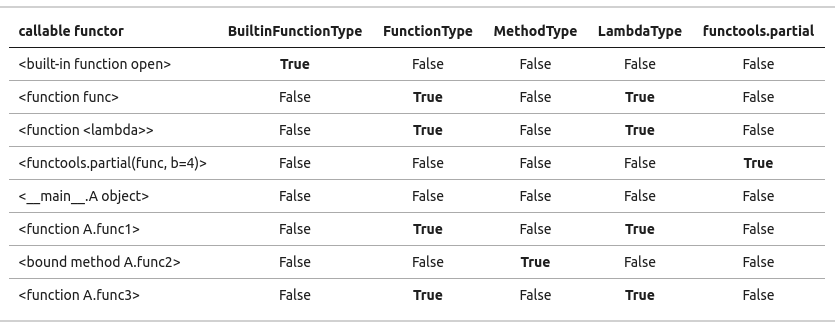
Then you can choose the functors’ types that suitable.
such as:
def func(a,b):
    print("[function]", a,b)

>>> callable(func)
True
>>> isinstance(func,  types.FunctionType)
True
>>> isinstance(func, (types.BuiltinFunctionType, types.FunctionType, functools.partial))
True
>>>
>>> isinstance(func, (types.MethodType, functools.partial))
False
Method 12
Here’s a couple of other ways:
def isFunction1(f) :
    return type(f) == type(lambda x: x);

def isFunction2(f) :
    return 'function' in str(type(f));
Here’s how I came up with the second:
>>> type(lambda x: x);
<type 'function'>
>>> str(type(lambda x: x));
"<type 'function'>"
# Look Maa, function! ... I ACTUALLY told my mom about this!
Method 13
As the accepted answer, John Feminella stated that:
The proper way to check properties of duck-typed objects is to ask them if they quack, not to see if they fit in a duck-sized container. The “compare it directly” approach will give the wrong answer for many functions, like builtins.
Even though, there’re two libs to distinguish functions strictly, I draw an exhaustive comparable table:
8.9. types — Dynamic type creation and names for built-in types — Python 3.7.0 documentation
30.13. inspect — Inspect live objects — Python 3.7.0 documentation
#import inspect             #import types
['isabstract',
 'isasyncgen',              'AsyncGeneratorType',
 'isasyncgenfunction',
 'isawaitable',
 'isbuiltin',               'BuiltinFunctionType',
                            'BuiltinMethodType',
 'isclass',
 'iscode',                  'CodeType',
 'iscoroutine',             'CoroutineType',
 'iscoroutinefunction',
 'isdatadescriptor',
 'isframe',                 'FrameType',
 'isfunction',              'FunctionType',
                            'LambdaType',
                            'MethodType',
 'isgenerator',             'GeneratorType',
 'isgeneratorfunction',
 'ismethod',
 'ismethoddescriptor',
 'ismodule',                'ModuleType',
 'isroutine',
 'istraceback',             'TracebackType'
                            'MappingProxyType',
]
The “duck typing” is a preferred solution for general purpose:
def detect_function(obj):
    return hasattr(obj,"__call__")

In [26]: detect_function(detect_function)
Out[26]: True
In [27]: callable(detect_function)
Out[27]: True
As for the builtins function
In [43]: callable(hasattr)
Out[43]: True
When go one more step to check if builtin function or user-defined funtion
#check inspect.isfunction and type.FunctionType
In [46]: inspect.isfunction(detect_function)
Out[46]: True
In [47]: inspect.isfunction(hasattr)
Out[47]: False
In [48]: isinstance(detect_function, types.FunctionType)
Out[48]: True
In [49]: isinstance(getattr, types.FunctionType)
Out[49]: False
#so they both just applied to judge the user-definded
Determine if builtin function
In [50]: isinstance(getattr, types.BuiltinFunctionType)
Out[50]: True
In [51]: isinstance(detect_function, types.BuiltinFunctionType)
Out[51]: False
Summary
Employ callable to duck type checking a function,
Use types.BuiltinFunctionType if you have further specified demand.
Method 14
A function is just a class with a __call__ method, so you can do
hasattr(obj, '__call__')
For example:
>>> hasattr(x, '__call__')
True

>>> x = 2
>>> hasattr(x, '__call__')
False
That is the “best” way of doing it, but depending on why you need to know if it’s callable or note, you could just put it in a try/execpt block:
try:
    x()
except TypeError:
    print "was not callable"
It’s arguable if try/except is more Python’y than doing if hasattr(x, '__call__'): x().. I would say hasattr is more accurate, since you wont accidently catch the wrong TypeError, for example:
>>> def x():
...     raise TypeError
...
>>> hasattr(x, '__call__')
True # Correct
>>> try:
...     x()
... except TypeError:
...     print "x was not callable"
...
x was not callable # Wrong!
Method 15
Instead of checking for '__call__' (which is not exclusive to functions), you can check whether a user-defined function has attributes func_name, func_doc, etc. This does not work for methods.
>>> def x(): pass
...
>>> hasattr(x, 'func_name')
True
Another way of checking is using the isfunction() method from the inspect module.
>>> import inspect
>>> inspect.isfunction(x)
True
To check if an object is a method, use inspect.ismethod()
Method 16
Since classes also have __call__ method, I recommend another solution:
class A(object):
    def __init__(self):
        pass
    def __call__(self):
        print 'I am a Class'

MyClass = A()

def foo():
    pass

print hasattr(foo.__class__, 'func_name') # Returns True
print hasattr(A.__class__, 'func_name')   # Returns False as expected

print hasattr(foo, '__call__') # Returns True
print hasattr(A, '__call__')   # (!) Returns True while it is not a function
Method 17
Note that Python classes are also callable.
To get functions (and by functions we mean standard functions and lambdas) use:
import types

def is_func(obj):
    return isinstance(obj, (types.FunctionType, types.LambdaType))


def f(x):
    return x


assert is_func(f)
assert is_func(lambda x: x)
Method 18
An Exact Function Checker
callable is a very good solution. However, I wanted to treat this the opposite way of John Feminella. Instead of treating it like this saying:
The proper way to check properties of duck-typed objects is to ask them if they quack, not to see if they fit in a duck-sized container. The “compare it directly” approach will give the wrong answer for many functions, like builtins.
We’ll treat it like this:
The proper way to check if something is a duck is not to see if it can quack, but rather to see if it truly is a duck through several filters, instead of just checking if it seems like a duck from the surface.
How Would We Implement It
The ‘types’ module has plenty of classes to detect functions, the most useful being types.FunctionType, but there are also plenty of others, like a method type, a built in type, and a lambda type. We also will consider a ‘functools.partial’ object as being a function.
The simple way we check if it is a function is by using an isinstance condition on all of these types. Previously, I wanted to make a base class which inherits from all of the above, but I am unable to do that, as Python does not allow us to inherit from some of the above classes.
Here’s a table of what classes can classify what functions:
Above function table by kinght-金
The Code Which Does It
Now, this is the code which does all of the work we described from above.
from types import BuiltinFunctionType, BuiltinMethodType,  FunctionType, MethodType, LambdaType
from functools import partial

def is_function(obj):
  return isinstance(obj, (BuiltinFunctionType, BuiltinMethodType,  FunctionType, MethodType, LambdaType, partial))

#-------------------------------------------------

def my_func():
  pass

def add_both(x, y):
  return x + y

class a:
  def b(self):
    pass

check = [

is_function(lambda x: x + x),
is_function(my_func),
is_function(a.b),
is_function(partial),
is_function(partial(add_both, 2))

]

print(check)
>>> [True, True, True, False, True]
The one false was is_function(partial), because that’s a class, not a function, and this is exactly functions, not classes. Here is a preview for you to try out the code from.
Conclusion
callable(obj) is the preferred method to check if an object is a function if you want to go by duck-typing over absolutes.
Our custom is_function(obj), maybe with some edits is the preferred method to check if an object is a function if you don’t any count callable class instance as a function, but only functions defined built-in, or with lambda, def, or partial.
And I think that wraps it all up. Have a good day!
Method 19
Whatever function is a class so you can take the name of the class of instance x and compare:
if(x.__class__.__name__ == 'function'):
     print "it's a function"
Method 20
The solutions using hasattr(obj, '__call__') and callable(.) mentioned in some of the answers have a main drawback: both also return True for classes and instances of classes with a __call__() method. Eg.
>>> import collections
>>> Test = collections.namedtuple('Test', [])
>>> callable(Test)
True
>>> hasattr(Test, '__call__')
True
One proper way of checking if an object is a user-defined function (and nothing but a that) is to use isfunction(.):
>>> import inspect
>>> inspect.isfunction(Test)
False
>>> def t(): pass
>>> inspect.isfunction(t)
True
If you need to check for other types, have a look at inspect — Inspect live objects.
Method 21
In Python3 I came up with type (f) == type (lambda x:x) which yields True if f is a function and False if it is not. But I think I prefer isinstance (f, types.FunctionType), which feels less ad hoc. I wanted to do type (f) is function, but that doesn’t work.
Method 22
You could try this:
if obj.__class__.__name__ in ['function', 'builtin_function_or_method']:
    print('probably a function')
or even something more bizarre:
if "function" in lower(obj.__class__.__name__):
    print('probably a function')
Method 23
combining @Sumukh Barve, @Katsu and @tinnick ‘s answers, and if your motive is just to grab the list of builtin functions available for your disposal in the console, these two options work:
[i for i, j in __builtin__.__dict__.items() if j.__class__.__name__ in ['function', 'builtin_function_or_method']][i for i, j in __builtin__.__dict__.items() if str(j)[:18] == '<built-in function']
Method 24
Following previous replies, I came up with this:
from pprint import pprint

def print_callables_of(obj):
    li = []
    for name in dir(obj):
        attr = getattr(obj, name)
        if hasattr(attr, '__call__'):
            li.append(name)
    pprint(li)
Method 25
If the code will go on to perform the call if the value is callable, just perform the call and catch TypeError.
def myfunc(x):
  try:
    x()
  except TypeError:
    raise Exception("Not callable")
Method 26
The following is a “repr way” to check it. Also it works with lambda.
def a():pass
type(a) #<class 'function'>
str(type(a))=="<class 'function'>" #True

b = lambda x:x*2
str(type(b))=="<class 'function'>" #True
Method 27
You can DIY a short function to check if the input is not string and cast the input to string will return matched name define:
def isFunction(o):return not isinstance(o,str) and str(o)[:3]=='<fu';
I think that this code is already compatible cross all python version.
Or if something change, you may add extra convert to lower case and check for content length. The format string casted of function I saw is “<function “+name+” at 0xFFFFFFFF>”
Method 28
This works for me:
str(type(a))=="<class 'function'>"
All methods was sourced from stackoverflow.com or stackexchange.com, is licensed under cc by-sa 2.5, cc by-sa 3.0 and cc by-sa 4.0