I’m new to pandas and trying to figure out how to add multiple columns to pandas simultaneously. Any help here is appreciated. Ideally I would like to do this in one step rather than multiple repeated steps…
import pandas as pd

df = {'col_1': [0, 1, 2, 3],
        'col_2': [4, 5, 6, 7]}
df = pd.DataFrame(df)

df[[ 'column_new_1', 'column_new_2','column_new_3']] = [np.nan, 'dogs',3]  #thought this would work here...
Answers:
Thank you for visiting the Q&A section on Magenaut. Please note that all the answers may not help you solve the issue immediately. So please treat them as advisements. If you found the post helpful (or not), leave a comment & I’ll get back to you as soon as possible.
Method 1
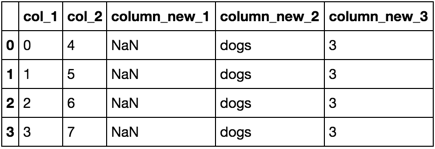
I would have expected your syntax to work too. The problem arises because when you create new columns with the column-list syntax (df[[new1, new2]] = ...), pandas requires that the right hand side be a DataFrame (note that it doesn’t actually matter if the columns of the DataFrame have the same names as the columns you are creating).
Your syntax works fine for assigning scalar values to existing columns, and pandas is also happy to assign scalar values to a new column using the single-column syntax (df[new1] = ...). So the solution is either to convert this into several single-column assignments, or create a suitable DataFrame for the right-hand side.
Here are several approaches that will work:
import pandas as pd
import numpy as np

df = pd.DataFrame({
    'col_1': [0, 1, 2, 3],
    'col_2': [4, 5, 6, 7]
})
Then one of the following:
1) Three assignments in one, using list unpacking:
df['column_new_1'], df['column_new_2'], df['column_new_3'] = [np.nan, 'dogs', 3]
2) DataFrame conveniently expands a single row to match the index, so you can do this:
df[['column_new_1', 'column_new_2', 'column_new_3']] = pd.DataFrame([[np.nan, 'dogs', 3]], index=df.index)
3) Make a temporary data frame with new columns, then combine with the original data frame later:
df = pd.concat(
    [
        df,
        pd.DataFrame(
            [[np.nan, 'dogs', 3]],
            index=df.index,
            columns=['column_new_1', 'column_new_2', 'column_new_3']
        )
    ], axis=1
)
4) Similar to the previous, but using join instead of concat (may be less efficient):
df = df.join(pd.DataFrame(
    [[np.nan, 'dogs', 3]],
    index=df.index,
    columns=['column_new_1', 'column_new_2', 'column_new_3']
))
5) Using a dict is a more “natural” way to create the new data frame than the previous two, but the new columns will be sorted alphabetically (at least before Python 3.6 or 3.7):
df = df.join(pd.DataFrame(
    {
        'column_new_1': np.nan,
        'column_new_2': 'dogs',
        'column_new_3': 3
    }, index=df.index
))
6) Use .assign() with multiple column arguments.
I like this variant on @zero’s answer a lot, but like the previous one, the new columns will always be sorted alphabetically, at least with early versions of Python:
df = df.assign(column_new_1=np.nan, column_new_2='dogs', column_new_3=3)
7) This is interesting (based on https://stackoverflow.com/a/44951376/3830997), but I don’t know when it would be worth the trouble:
new_cols = ['column_new_1', 'column_new_2', 'column_new_3']
new_vals = [np.nan, 'dogs', 3]
df = df.reindex(columns=df.columns.tolist() + new_cols)   # add empty cols
df[new_cols] = new_vals  # multi-column assignment works for existing cols
8) In the end it’s hard to beat three separate assignments:
df['column_new_1'] = np.nan
df['column_new_2'] = 'dogs'
df['column_new_3'] = 3
Note: many of these options have already been covered in other answers: Add multiple columns to DataFrame and set them equal to an existing column, Is it possible to add several columns at once to a pandas DataFrame?, Add multiple empty columns to pandas DataFrame
Method 2
You could use assign with a dict of column names and values.
In [1069]: df.assign(**{'col_new_1': np.nan, 'col2_new_2': 'dogs', 'col3_new_3': 3})
Out[1069]:
   col_1  col_2 col2_new_2  col3_new_3  col_new_1
0      0      4       dogs           3        NaN
1      1      5       dogs           3        NaN
2      2      6       dogs           3        NaN
3      3      7       dogs           3        NaN
Method 3
With the use of concat:
In [128]: df
Out[128]:
   col_1  col_2
0      0      4
1      1      5
2      2      6
3      3      7

In [129]: pd.concat([df, pd.DataFrame(columns = [ 'column_new_1', 'column_new_2','column_new_3'])])
Out[129]:
   col_1  col_2 column_new_1 column_new_2 column_new_3
0    0.0    4.0          NaN          NaN          NaN
1    1.0    5.0          NaN          NaN          NaN
2    2.0    6.0          NaN          NaN          NaN
3    3.0    7.0          NaN          NaN          NaN
Not very sure of what you wanted to do with [np.nan, 'dogs',3]. Maybe now set them as default values?
In [142]: df1 = pd.concat([df, pd.DataFrame(columns = [ 'column_new_1', 'column_new_2','column_new_3'])])
In [143]: df1[[ 'column_new_1', 'column_new_2','column_new_3']] = [np.nan, 'dogs', 3]

In [144]: df1
Out[144]:
   col_1  col_2  column_new_1 column_new_2  column_new_3
0    0.0    4.0           NaN         dogs             3
1    1.0    5.0           NaN         dogs             3
2    2.0    6.0           NaN         dogs             3
3    3.0    7.0           NaN         dogs             3
Method 4
use of list comprehension, pd.DataFrame and pd.concat
pd.concat(
    [
        df,
        pd.DataFrame(
            [[np.nan, 'dogs', 3] for _ in range(df.shape[0])],
            df.index, ['column_new_1', 'column_new_2','column_new_3']
        )
    ], axis=1)
Method 5
if adding a lot of missing columns (a, b, c ,….) with the same value, here 0, i did this:
    new_cols = ["a", "b", "c" ]
    df[new_cols] = pd.DataFrame([[0] * len(new_cols)], index=df.index)
It’s based on the second variant of the accepted answer.
Method 6
Just want to point out that option2 in @Matthias Fripp’s answer
(2) I wouldn’t necessarily expect DataFrame to work this way, but it does
df[[‘column_new_1’, ‘column_new_2’, ‘column_new_3’]] = pd.DataFrame([[np.nan, ‘dogs’, 3]], index=df.index)
is already documented in pandas’ own documentation
http://pandas.pydata.org/pandas-docs/stable/indexing.html#basics
You can pass a list of columns to [] to select columns in that order.
If a column is not contained in the DataFrame, an exception will be raised.
Multiple columns can also be set in this manner.
You may find this useful for applying a transform (in-place) to a subset of the columns.
Method 7
Dictionary mapping with .assign():
This is the most readable and dynamic way to assign new column(s) with value(s) when working with many of them.
import pandas as pd
import numpy as np

new_cols = ["column_new_1", "column_new_2", "column_new_3"]
new_vals = [np.nan, "dogs", 3]
# Map new columns as keys and new values as values
col_val_mapping = dict(zip(new_cols, new_vals))
# Unpack new column/new value pairs and assign them to the data frame
df = df.assign(**col_val_mapping)
If you’re just trying to initialize the new column values to be empty as you either don’t know what the values are going to be or you have many new columns.
import pandas as pd
import numpy as np

new_cols = ["column_new_1", "column_new_2", "column_new_3"]
new_vals = [None for item in new_cols]
# Map new columns as keys and new values as values
col_val_mapping = dict(zip(new_cols, new_vals))
# Unpack new column/new value pairs and assign them to the data frame
df = df.assign(**col_val_mapping)
Method 8
If you just want to add empty new columns, reindex will do the job
df
   col_1  col_2
0      0      4
1      1      5
2      2      6
3      3      7

df.reindex(list(df)+['column_new_1', 'column_new_2','column_new_3'], axis=1)
   col_1  col_2  column_new_1  column_new_2  column_new_3
0      0      4           NaN           NaN           NaN
1      1      5           NaN           NaN           NaN
2      2      6           NaN           NaN           NaN
3      3      7           NaN           NaN           NaN
full code example
import numpy as np
import pandas as pd

df = {'col_1': [0, 1, 2, 3],
        'col_2': [4, 5, 6, 7]}
df = pd.DataFrame(df)
print('df',df, sep='n')
print()
df=df.reindex(list(df)+['column_new_1', 'column_new_2','column_new_3'], axis=1)
print('''df.reindex(list(df)+['column_new_1', 'column_new_2','column_new_3'], axis=1)''',df, sep='n')
otherwise go for zeros answer with assign
Method 9
I am not comfortable using “Index” and so on…could come up as below
df.columns
Index(['A123', 'B123'], dtype='object')

df=pd.concat([df,pd.DataFrame(columns=list('CDE'))])

df.rename(columns={
    'C':'C123',
    'D':'D123',
    'E':'E123'
},inplace=True)


df.columns
Index(['A123', 'B123', 'C123', 'D123', 'E123'], dtype='object')
Method 10
You could instantiate the values from a dictionary if you wanted different values for each column & you don’t mind making a dictionary on the line before.
>>> import pandas as pd
>>> import numpy as np
>>> df = pd.DataFrame({
  'col_1': [0, 1, 2, 3],
  'col_2': [4, 5, 6, 7]
})
>>> df
   col_1  col_2
0      0      4
1      1      5
2      2      6
3      3      7
>>> cols = {
  'column_new_1':np.nan,
  'column_new_2':'dogs',
  'column_new_3': 3
}
>>> df[list(cols)] = pd.DataFrame(data={k:[v]*len(df) for k,v in cols.items()})
>>> df
   col_1  col_2  column_new_1 column_new_2  column_new_3
0      0      4           NaN         dogs             3
1      1      5           NaN         dogs             3
2      2      6           NaN         dogs             3
3      3      7           NaN         dogs             3
Not necessarily better than the accepted answer, but it’s another approach not yet listed.
Method 11
import pandas as pd
df = pd.DataFrame({
 'col_1': [0, 1, 2, 3],
 'col_2': [4, 5, 6, 7]
 })
df['col_3'],  df['col_4'] =  [df.col_1]*2

>> df
col_1   col_2   col_3   col_4
0      4       0       0
1      5       1       1
2      6       2       2
3      7       3       3
All methods was sourced from stackoverflow.com or stackexchange.com, is licensed under cc by-sa 2.5, cc by-sa 3.0 and cc by-sa 4.0