I tried to create this code to input an m by n matrix. I intended to input [[1,2,3],[4,5,6]] but the code yields [[4,5,6],[4,5,6]. Same things happen when I input other m by n matrix, the code yields an m by n matrix whose rows are identical.
Perhaps you can help me to find what is wrong with my code.
m = int(input('number of rows, m = '))
n = int(input('number of columns, n = '))
matrix = []; columns = []
# initialize the number of rows
for i in range(0,m):
  matrix += [0]
# initialize the number of columns
for j in range (0,n):
  columns += [0]
# initialize the matrix
for i in range (0,m):
  matrix[i] = columns
for i in range (0,m):
  for j in range (0,n):
    print ('entry in row: ',i+1,' column: ',j+1)
    matrix[i][j] = int(input())
print (matrix)
Answers:
Thank you for visiting the Q&A section on Magenaut. Please note that all the answers may not help you solve the issue immediately. So please treat them as advisements. If you found the post helpful (or not), leave a comment & I’ll get back to you as soon as possible.
Method 1
The problem is on the initialization step.
for i in range (0,m):
  matrix[i] = columns
This code actually makes every row of your matrix refer to the same columns object. If any item in any column changes – every other column will change:
>>> for i in range (0,m):
...     matrix[i] = columns
...
>>> matrix
[[0, 0, 0], [0, 0, 0]]
>>> matrix[1][1] = 2
>>> matrix
[[0, 2, 0], [0, 2, 0]]
You can initialize your matrix in a nested loop, like this:
matrix = []
for i in range(0,m):
    matrix.append([])
    for j in range(0,n):
        matrix[i].append(0)
or, in a one-liner by using list comprehension:
matrix = [[0 for j in range(n)] for i in range(m)]
or:
matrix = [x[:] for x in [[0]*n]*m]
See also:
Hope that helps.
Method 2
you can accept a 2D list in python this way …
simply
arr2d = [[j for j in input().strip()] for i in range(n)]
# n is no of rows
for characters
n = int(input().strip())
m = int(input().strip())
a = [[0]*n for _ in range(m)]
for i in range(n):
    a[i] = list(input().strip())
print(a)
or
n = int(input().strip())
n = int(input().strip())
a = []
for i in range(n):
    a[i].append(list(input().strip()))
print(a)
for numbers
n = int(input().strip())
m = int(input().strip())
a = [[0]*n for _ in range(m)]
for i in range(n):
    a[i] = [int(j) for j in input().strip().split(" ")]
print(a)
where n is no of elements in columns while m is no of elements in a row.
In pythonic way, this will create a list of list
Method 3
If the input is formatted like this,
1 2 3
4 5 6
7 8 9
a one liner can be used
mat = [list(map(int,input().split())) for i in range(row)]
explanation with example:
input()takes a string as input. “1 2 3”split()splits the string by whitespaces and returns a
list of strings. [“1”, “2”, “3”]list(map(int, ...))transforms/maps the list of strings into a list of ints. [1, 2, 3]- All these steps are done row times and these lists are stored in another list.
[[1, 2, 3], [4, 5, 6], [7, 8, 9]], row = 3
Method 4
If you want to take n lines of input where each line contains m space separated integers like:
1 2 3
4 5 6
7 8 9
Then you can use:
a=[] // declaration
for i in range(0,n):   //where n is the no. of lines you want
 a.append([int(j) for j in input().split()])  // for taking m space separated integers as input
Then print whatever you want like for the above input:
print(a[1][1])
O/P would be 5 for 0 based indexing
Method 5
Apart from the accepted answer, you can also initialise your rows in the following manner –
matrix[i] = [0]*n
Therefore, the following piece of code will work –
m = int(input('number of rows, m = '))
n = int(input('number of columns, n = '))
matrix = []
# initialize the number of rows
for i in range(0,m):
    matrix += [0]
# initialize the matrix
for i in range (0,m):
    matrix[i] = [0]*n
for i in range (0,m):
    for j in range (0,n):
        print ('entry in row: ',i+1,' column: ',j+1)
        matrix[i][j] = int(input())
print (matrix)
Method 6
This code takes number of row and column from user then takes elements and displays as a matrix.
m = int(input('number of rows, m : '))
n = int(input('number of columns, n : '))
a=[]
for i in range(1,m+1):
  b = []
  print("{0} Row".format(i))
  for j in range(1,n+1):
    b.append(int(input("{0} Column: " .format(j))))
  a.append(b)
print(a)
Method 7
If your matrix is given in row manner like below, where size is s*s here s=5
5

31 100 65 12 18 10 13 47 157 6 100 113 174 11 33 88 124 41 20 140 99 32 111 41 20
then you can use this
s=int(input())
b=list(map(int,input().split()))
arr=[[b[j+s*i] for j in range(s)]for i in range(s)]
your matrix will be ‘arr’
Method 8
m,n=map(int,input().split()) # m – number of rows; n – number of columns;
matrix = [[int(j) for j in input().split()[:n]] for i in range(m)]
for i in matrix:print(i)
Method 9
no_of_rows = 3  # For n by n, and even works for n by m but just give no of rows
matrix = [[int(j) for j in input().split()] for i in range(n)]
print(matrix)
Method 10
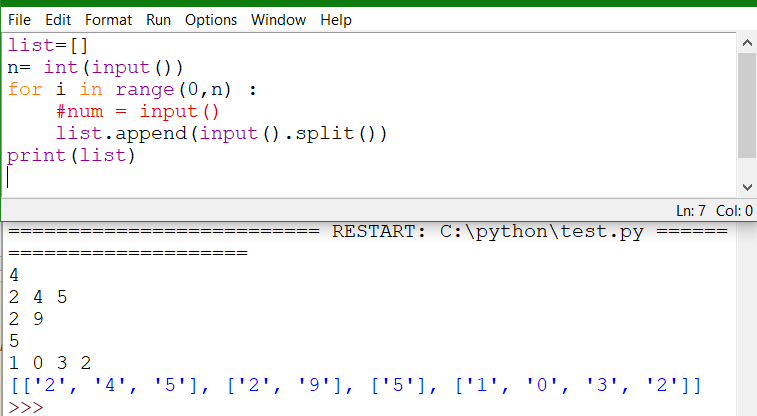
You can make any dimension of list
list=[]
n= int(input())
for i in range(0,n) :
    #num = input()
    list.append(input().split())
print(list)
output:
Method 11
Creating matrix with prepopulated numbers can be done with list comprehension. It may be hard to read but it gets job done:
rows = int(input('Number of rows: '))
cols = int(input('Number of columns: '))
matrix = [[i + cols * j for i in range(1, cols + 1)] for j in range(rows)]
with 2 rows and 3 columns matrix will be [[1, 2, 3], [4, 5, 6]], with 3 rows and 2 columns matrix will be [[1, 2], [3, 4], [5, 6]] etc.
Method 12
a = []
b = []

m=input("enter no of rows: ")
n=input("enter no of coloumns: ")

for i in range(n):
     a = []
     for j in range(m):
         a.append(input())
     b.append(a)
Input : 1 2 3 4 5 6 7 8 9
Output : [ [‘1’, ‘2’, ‘3’], [‘4’, ‘5’, ‘6’], [‘7’, ‘8’, ‘9’] ]
Method 13
row=list(map(int,input().split())) #input no. of row and column
b=[]
for i in range(0,row[0]):
    print('value of i: ',i)
    a=list(map(int,input().split()))
    print(a)
    b.append(a)
print(b)
print(row)
Output:
2 3

value of i:0
1 2 4 5
[1, 2, 4, 5]
value of i:  1
2 4 5 6
[2, 4, 5, 6]
[[1, 2, 4, 5], [2, 4, 5, 6]]
[2, 3]
Note: this code in case of control.it only control no. Of rows but we can enter any number of column we want i.e row[0]=2 so be careful. This is not the code where you can control no of columns.
Method 14
a,b=[],[]
n=int(input("Provide me size of squre matrix row==column : "))
for i in range(n):
   for j in range(n):
      b.append(int(input()))
    a.append(b)
    print("Here your {} column {}".format(i+1,a))
    b=[]
for m in range(n):
    print(a[m])
works perfectly
Method 15
rows, columns = list(map(int,input().split())) #input no. of row and column
b=[]
for i in range(rows):
    a=list(map(int,input().split()))
    b.append(a)
print(b)
input
2 3
1 2 3
4 5 6
output
[[1, 2, 3], [4, 5, 6]]
Method 16
I used numpy library and it works fine for me. Its just a single line and easy to understand.
The input needs to be in a single size separated by space and the reshape converts the list into shape you want. Here (2,2) resizes the list of 4 elements into 2*2 matrix.
Be careful in giving equal number of elements in the input corresponding to the dimension of the matrix.
import numpy as np
a=np.array(list(map(int,input().strip().split(' ')))).reshape(2,2)

print(a)
Input
array([[1, 2],
       [3, 4]])
Output
All methods was sourced from stackoverflow.com or stackexchange.com, is licensed under cc by-sa 2.5, cc by-sa 3.0 and cc by-sa 4.0