I would like to break down a pandas column consisting of a list of elements into as many columns as there are unique elements i.e. one-hot-encode them (with value 1 representing a given element existing in a row and 0 in the case of absence).
For example, taking dataframe df
Col1   Col2         Col3
 C      33     [Apple, Orange, Banana]
 A      2.5    [Apple, Grape]
 B      42     [Banana]
I would like to convert this to:
df
Col1   Col2   Apple   Orange   Banana   Grape
 C      33     1        1        1       0
 A      2.5    1        0        0       1
 B      42     0        0        1       0
How can I use pandas/sklearn to achieve this?
Answers:
Thank you for visiting the Q&A section on Magenaut. Please note that all the answers may not help you solve the issue immediately. So please treat them as advisements. If you found the post helpful (or not), leave a comment & I’ll get back to you as soon as possible.
Method 1
We can also use sklearn.preprocessing.MultiLabelBinarizer:
Often we want to use sparse DataFrame for the real world data in order to save a lot of RAM.
Sparse solution (for Pandas v0.25.0+)
from sklearn.preprocessing import MultiLabelBinarizer

mlb = MultiLabelBinarizer(sparse_output=True)

df = df.join(
            pd.DataFrame.sparse.from_spmatrix(
                mlb.fit_transform(df.pop('Col3')),
                index=df.index,
                columns=mlb.classes_))
result:
In [38]: df
Out[38]:
  Col1  Col2  Apple  Banana  Grape  Orange
0    C  33.0      1       1      0       1
1    A   2.5      1       0      1       0
2    B  42.0      0       1      0       0

In [39]: df.dtypes
Out[39]:
Col1                object
Col2               float64
Apple     Sparse[int32, 0]
Banana    Sparse[int32, 0]
Grape     Sparse[int32, 0]
Orange    Sparse[int32, 0]
dtype: object

In [40]: df.memory_usage()
Out[40]:
Index     128
Col1       24
Col2       24
Apple      16    #  <--- NOTE!
Banana     16    #  <--- NOTE!
Grape       8    #  <--- NOTE!
Orange      8    #  <--- NOTE!
dtype: int64
Dense solution
mlb = MultiLabelBinarizer()
df = df.join(pd.DataFrame(mlb.fit_transform(df.pop('Col3')),
                          columns=mlb.classes_,
                          index=df.index))
Result:
In [77]: df
Out[77]:
  Col1  Col2  Apple  Banana  Grape  Orange
0    C  33.0      1       1      0       1
1    A   2.5      1       0      1       0
2    B  42.0      0       1      0       0
Method 2
Option 1
Short Answer
pir_slow
df.drop('Col3', 1).join(df.Col3.str.join('|').str.get_dummies())

  Col1  Col2  Apple  Banana  Grape  Orange
0    C  33.0      1       1      0       1
1    A   2.5      1       0      1       0
2    B  42.0      0       1      0       0
Option 2
Fast Answer
pir_fast
v = df.Col3.values
l = [len(x) for x in v.tolist()]
f, u = pd.factorize(np.concatenate(v))
n, m = len(v), u.size
i = np.arange(n).repeat(l)

dummies = pd.DataFrame(
    np.bincount(i * m + f, minlength=n * m).reshape(n, m),
    df.index, u
)

df.drop('Col3', 1).join(dummies)

  Col1  Col2  Apple  Orange  Banana  Grape
0    C  33.0      1       1       1      0
1    A   2.5      1       0       0      1
2    B  42.0      0       0       1      0
Option 3
pir_alt1
df.drop('Col3', 1).join(
    pd.get_dummies(
        pd.DataFrame(df.Col3.tolist()).stack()
    ).astype(int).sum(level=0)
)

  Col1  Col2  Apple  Orange  Banana  Grape
0    C  33.0      1       1       1      0
1    A   2.5      1       0       0      1
2    B  42.0      0       0       1      0
Timing Results
Code Below
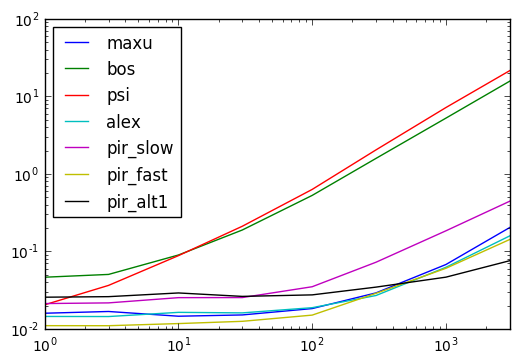
def maxu(df):
    mlb = MultiLabelBinarizer()
    d = pd.DataFrame(
        mlb.fit_transform(df.Col3.values)
        , df.index, mlb.classes_
    )
    return df.drop('Col3', 1).join(d)


def bos(df):
    return df.drop('Col3', 1).assign(**pd.get_dummies(df.Col3.apply(lambda x:pd.Series(x)).stack().reset_index(level=1,drop=True)).sum(level=0))

def psi(df):
    return pd.concat([
        df.drop("Col3", 1),
        df.Col3.apply(lambda x: pd.Series(1, x)).fillna(0)
    ], axis=1)

def alex(df):
    return df[['Col1', 'Col2']].assign(**{fruit: [1 if fruit in cell else 0 for cell in df.Col3]
                                       for fruit in set(fruit for fruits in df.Col3
                                                        for fruit in fruits)})

def pir_slow(df):
    return df.drop('Col3', 1).join(df.Col3.str.join('|').str.get_dummies())

def pir_alt1(df):
    return df.drop('Col3', 1).join(pd.get_dummies(pd.DataFrame(df.Col3.tolist()).stack()).astype(int).sum(level=0))

def pir_fast(df):
    v = df.Col3.values
    l = [len(x) for x in v.tolist()]
    f, u = pd.factorize(np.concatenate(v))
    n, m = len(v), u.size
    i = np.arange(n).repeat(l)

    dummies = pd.DataFrame(
        np.bincount(i * m + f, minlength=n * m).reshape(n, m),
        df.index, u
    )

    return df.drop('Col3', 1).join(dummies)

results = pd.DataFrame(
    index=(1, 3, 10, 30, 100, 300, 1000, 3000),
    columns='maxu bos psi alex pir_slow pir_fast pir_alt1'.split()
)

for i in results.index:
    d = pd.concat([df] * i, ignore_index=True)
    for j in results.columns:
        stmt = '{}(d)'.format(j)
        setp = 'from __main__ import d, {}'.format(j)
        results.set_value(i, j, timeit(stmt, setp, number=10))
Method 3
You can use the functions explode (new in version 0.25.0.) and crosstab:
s = df['Col3'].explode()
df[['Col1', 'Col2']].join(pd.crosstab(s.index, s))
or in Python 3.7+:
df[['col1', 'col2']].join(pd.crosstab((s:=df['col3'].explode()).index, s))
Output:
  Col1  Col2  Apple  Banana  Grape  Orange
0    C  33.0      1       1      0       1
1    A   2.5      1       0      1       0
2    B  42.0      0       1      0       0
Method 4
Use get_dummies:
df_out = df.assign(**pd.get_dummies(df.Col3.apply(lambda x:pd.Series(x)).stack().reset_index(level=1,drop=True)).sum(level=0))
Output:
  Col1  Col2                     Col3  Apple  Banana  Grape  Orange
0    C  33.0  [Apple, Orange, Banana]      1       1      0       1
1    A   2.5           [Apple, Grape]      1       0      1       0
2    B  42.0                 [Banana]      0       1      0       0
Cleanup column:
df_out.drop('Col3',axis=1)
Output:
  Col1  Col2  Apple  Banana  Grape  Orange
0    C  33.0      1       1      0       1
1    A   2.5      1       0      1       0
2    B  42.0      0       1      0       0
Method 5
You can loop through Col3 with apply and convert each element into a Series with the list as the index which become the header in the result data frame:
pd.concat([
        df.drop("Col3", 1),
        df.Col3.apply(lambda x: pd.Series(1, x)).fillna(0)
    ], axis=1)

#Col1   Col2    Apple   Banana  Grape   Orange
#0  C   33.0      1.0      1.0    0.0     1.0
#1  A    2.5      1.0      0.0    1.0     0.0
#2  B   42.0      0.0      1.0    0.0     0.0
Method 6
You can get all unique fruits in Col3 using set comprehension as follows:
set(fruit for fruits in df.Col3 for fruit in fruits)
Using a dictionary comprehension, you can then go through each unique fruit and see if it is in the column.
>>> df[['Col1', 'Col2']].assign(**{fruit: [1 if fruit in cell else 0 for cell in df.Col3]
                                   for fruit in set(fruit for fruits in df.Col3
                                                    for fruit in fruits)})
  Col1  Col2  Apple  Banana  Grape  Orange
0    C  33.0      1       1      0       1
1    A   2.5      1       0      1       0
2    B  42.0      0       1      0       0
Timings
dfs = pd.concat([df] * 1000)  # Use 3,000 rows in the dataframe.

# Solution 1 by @Alexander (me)
%%timeit -n 1000
dfs[['Col1', 'Col2']].assign(**{fruit: [1 if fruit in cell else 0 for cell in dfs.Col3]
                                for fruit in set(fruit for fruits in dfs.Col3 for fruit in fruits)})
# 10 loops, best of 3: 4.57 ms per loop

# Solution 2 by @Psidom
%%timeit -n 1000
pd.concat([
        dfs.drop("Col3", 1),
        dfs.Col3.apply(lambda x: pd.Series(1, x)).fillna(0)
    ], axis=1)
# 10 loops, best of 3: 748 ms per loop

# Solution 3 by @MaxU
from sklearn.preprocessing import MultiLabelBinarizer
mlb = MultiLabelBinarizer()

%%timeit -n 10
dfs.join(pd.DataFrame(mlb.fit_transform(dfs.Col3),
                          columns=mlb.classes_,
                          index=dfs.index))
# 10 loops, best of 3: 283 ms per loop

# Solution 4 by @ScottBoston
%%timeit -n 10
df_out = dfs.assign(**pd.get_dummies(dfs.Col3.apply(lambda x:pd.Series(x)).stack().reset_index(level=1,drop=True)).sum(level=0))
# 10 loops, best of 3: 512 ms per loop

But...
>>> print(df_out.head())
  Col1  Col2                     Col3  Apple  Banana  Grape  Orange
0    C  33.0  [Apple, Orange, Banana]   1000    1000      0    1000
1    A   2.5           [Apple, Grape]   1000       0   1000       0
2    B  42.0                 [Banana]      0    1000      0       0
0    C  33.0  [Apple, Orange, Banana]   1000    1000      0    1000
1    A   2.5           [Apple, Grape]   1000       0   1000       0
All methods was sourced from stackoverflow.com or stackexchange.com, is licensed under cc by-sa 2.5, cc by-sa 3.0 and cc by-sa 4.0