Given a mean and a variance is there a simple function call which will plot a normal distribution?
Answers:
Thank you for visiting the Q&A section on Magenaut. Please note that all the answers may not help you solve the issue immediately. So please treat them as advisements. If you found the post helpful (or not), leave a comment & I’ll get back to you as soon as possible.
Method 1
import matplotlib.pyplot as plt
import numpy as np
import scipy.stats as stats
import math

mu = 0
variance = 1
sigma = math.sqrt(variance)
x = np.linspace(mu - 3*sigma, mu + 3*sigma, 100)
plt.plot(x, stats.norm.pdf(x, mu, sigma))
plt.show()
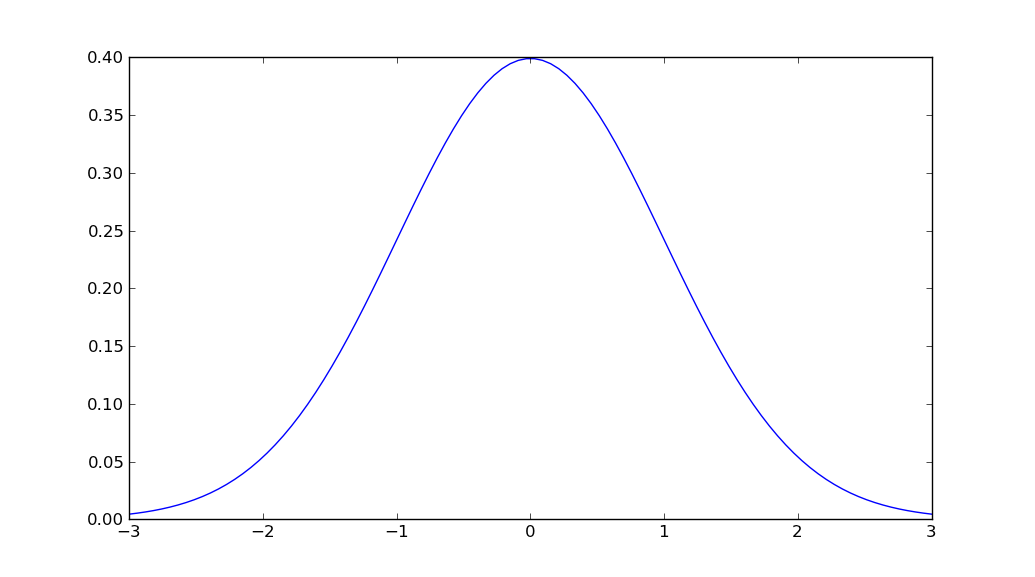
Method 2
I don’t think there is a function that does all that in a single call. However you can find the Gaussian probability density function in scipy.stats.
So the simplest way I could come up with is:
import numpy as np
import matplotlib.pyplot as plt
from scipy.stats import norm

# Plot between -10 and 10 with .001 steps.
x_axis = np.arange(-10, 10, 0.001)
# Mean = 0, SD = 2.
plt.plot(x_axis, norm.pdf(x_axis,0,2))
plt.show()
Sources:
- http://www.johndcook.com/distributions_scipy.html
- http://docs.scipy.org/doc/scipy/reference/stats.html
- http://telliott99.blogspot.com/2010/02/plotting-normal-distribution-with.html
Method 3
Use seaborn instead
i am using distplot of seaborn with mean=5 std=3 of 1000 values
value = np.random.normal(loc=5,scale=3,size=1000)
sns.distplot(value)
You will get a normal distribution curve
Method 4
If you prefer to use a step by step approach you could consider a solution like follows
import numpy as np
import matplotlib.pyplot as plt

mean = 0; std = 1; variance = np.square(std)
x = np.arange(-5,5,.01)
f = np.exp(-np.square(x-mean)/2*variance)/(np.sqrt(2*np.pi*variance))

plt.plot(x,f)
plt.ylabel('gaussian distribution')
plt.show()
Method 5
Unutbu answer is correct.
But because our mean can be more or less than zero I would still like to change this :
x = np.linspace(-3 * sigma, 3 * sigma, 100)
to this :
x = np.linspace(-3 * sigma + mean, 3 * sigma + mean, 100)
Method 6
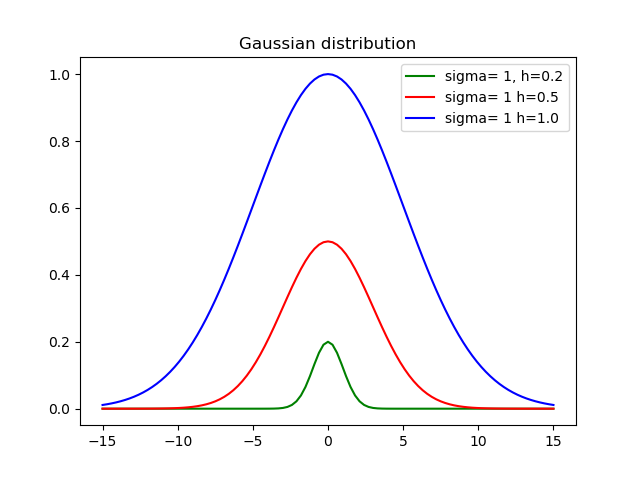
I believe that is important to set the height, so created this function:
def my_gauss(x, sigma=1, h=1, mid=0):
    from math import exp, pow
    variance = pow(sigma, 2)
    return h * exp(-pow(x-mid, 2)/(2*variance))
Where sigma is the standard deviation, h is the height and mid is the mean.
Here is the result using different heights and deviations:
Method 7
I have just come back to this and I had to install scipy as matplotlib.mlab gave me the error message MatplotlibDeprecationWarning: scipy.stats.norm.pdf when trying example above. So the sample is now:
%matplotlib inline
import math
import matplotlib.pyplot as plt
import numpy as np
import scipy.stats


mu = 0
variance = 1
sigma = math.sqrt(variance)
x = np.linspace(mu - 3*sigma, mu + 3*sigma, 100)
plt.plot(x, scipy.stats.norm.pdf(x, mu, sigma))

plt.show()
Method 8
you can get cdf easily. so pdf via cdf
    import numpy as np
    import matplotlib.pyplot as plt
    import scipy.interpolate
    import scipy.stats

    def setGridLine(ax):
        #http://jonathansoma.com/lede/data-studio/matplotlib/adding-grid-lines-to-a-matplotlib-chart/
        ax.set_axisbelow(True)
        ax.minorticks_on()
        ax.grid(which='major', linestyle='-', linewidth=0.5, color='grey')
        ax.grid(which='minor', linestyle=':', linewidth=0.5, color='#a6a6a6')
        ax.tick_params(which='both', # Options for both major and minor ticks
                        top=False, # turn off top ticks
                        left=False, # turn off left ticks
                        right=False,  # turn off right ticks
                        bottom=False) # turn off bottom ticks

    data1 = np.random.normal(0,1,1000000)
    x=np.sort(data1)
    y=np.arange(x.shape[0])/(x.shape[0]+1)

    f2 = scipy.interpolate.interp1d(x, y,kind='linear')
    x2 = np.linspace(x[0],x[-1],1001)
    y2 = f2(x2)

    y2b = np.diff(y2)/np.diff(x2)
    x2b=(x2[1:]+x2[:-1])/2.

    f3 = scipy.interpolate.interp1d(x, y,kind='cubic')
    x3 = np.linspace(x[0],x[-1],1001)
    y3 = f3(x3)

    y3b = np.diff(y3)/np.diff(x3)
    x3b=(x3[1:]+x3[:-1])/2.

    bins=np.arange(-4,4,0.1)
    bins_centers=0.5*(bins[1:]+bins[:-1])
    cdf = scipy.stats.norm.cdf(bins_centers)
    pdf = scipy.stats.norm.pdf(bins_centers)

    plt.rcParams["font.size"] = 18
    fig, ax = plt.subplots(3,1,figsize=(10,16))
    ax[0].set_title("cdf")
    ax[0].plot(x,y,label="data")
    ax[0].plot(x2,y2,label="linear")
    ax[0].plot(x3,y3,label="cubic")
    ax[0].plot(bins_centers,cdf,label="ans")

    ax[1].set_title("pdf:linear")
    ax[1].plot(x2b,y2b,label="linear")
    ax[1].plot(bins_centers,pdf,label="ans")

    ax[2].set_title("pdf:cubic")
    ax[2].plot(x3b,y3b,label="cubic")
    ax[2].plot(bins_centers,pdf,label="ans")

    for idx in range(3):
        ax[idx].legend()
        setGridLine(ax[idx])

    plt.show()
    plt.clf()
    plt.close()
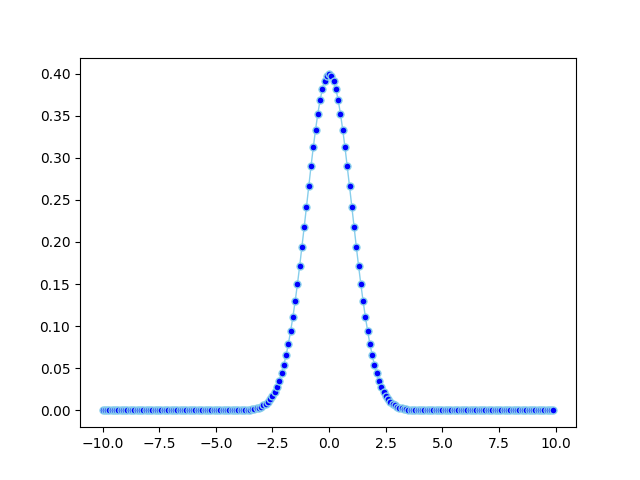
Method 9
import math
import matplotlib.pyplot as plt
import numpy
import pandas as pd


def normal_pdf(x, mu=0, sigma=1):
    sqrt_two_pi = math.sqrt(math.pi * 2)
    return math.exp(-(x - mu) ** 2 / 2 / sigma ** 2) / (sqrt_two_pi * sigma)


df = pd.DataFrame({'x1': numpy.arange(-10, 10, 0.1), 'y1': map(normal_pdf, numpy.arange(-10, 10, 0.1))})

plt.plot('x1', 'y1', data=df, marker='o', markerfacecolor='blue', markersize=5, color='skyblue', linewidth=1)
plt.show()
Method 10
For me, this worked pretty well if you are trying to plot a particular pdf
theta1 = {
            "a": 0.5,
            "cov" : 1,
            "mean" : 0
        }
x = np.linspace(start = 0, stop = 1000, num = 1000)
pdf = stats.norm.pdf(x, theta1['mean'], theta1['cov']) + theta2['a']
sns.lineplot(x,pdf)
All methods was sourced from stackoverflow.com or stackexchange.com, is licensed under cc by-sa 2.5, cc by-sa 3.0 and cc by-sa 4.0