I want to repeat elements of an array along axis 0 and axis 1 for M and N times respectively:
import numpy as np

a = np.arange(12).reshape(3, 4)
b = a.repeat(2, 0).repeat(2, 1)
print(b)

[[ 0  0  1  1  2  2  3  3]
 [ 0  0  1  1  2  2  3  3]
 [ 4  4  5  5  6  6  7  7]
 [ 4  4  5  5  6  6  7  7]
 [ 8  8  9  9 10 10 11 11]
 [ 8  8  9  9 10 10 11 11]]
This works, but I want to know are there better methods without create a temporary array.
Answers:
Thank you for visiting the Q&A section on Magenaut. Please note that all the answers may not help you solve the issue immediately. So please treat them as advisements. If you found the post helpful (or not), leave a comment & I’ll get back to you as soon as possible.
Method 1
You could use the Kronecker product, see numpy.kron:
>>> a = np.arange(12).reshape(3,4)
>>> print(np.kron(a, np.ones((2,2), dtype=a.dtype)))
[[ 0  0  1  1  2  2  3  3]
 [ 0  0  1  1  2  2  3  3]
 [ 4  4  5  5  6  6  7  7]
 [ 4  4  5  5  6  6  7  7]
 [ 8  8  9  9 10 10 11 11]
 [ 8  8  9  9 10 10 11 11]]
Your original method is OK too, though!
Method 2
You can make use of np.broadcast_to here:
def broadcast_tile(a, h, w):
    x, y = a.shape
    m, n = x * h, y * w
    return np.broadcast_to(
        a.reshape(x, 1, y, 1), (x, h, y, w)
    ).reshape(m, n)

broadcast_tile(a, 2, 2)
array([[ 0,  0,  1,  1,  2,  2,  3,  3],
       [ 0,  0,  1,  1,  2,  2,  3,  3],
       [ 4,  4,  5,  5,  6,  6,  7,  7],
       [ 4,  4,  5,  5,  6,  6,  7,  7],
       [ 8,  8,  9,  9, 10, 10, 11, 11],
       [ 8,  8,  9,  9, 10, 10, 11, 11]])
Performance
Functions
def chris(a, h, w):
    x, y = a.shape
    m, n = x * h, y * w
    return np.broadcast_to(
        a.reshape(x, 1, y, 1), (x, h, y, w)
    ).reshape(m, n)

def alex_riley(a, b0, b1):
    r, c = a.shape
    rs, cs = a.strides
    x = np.lib.stride_tricks.as_strided(a, (r, b0, c, b1), (rs, 0, cs, 0))
    return x.reshape(r*b0, c*b1)

def paul_panzer(a, b0, b1):
    r, c = a.shape
    out = np.empty((r, b0, c, b1), a.dtype)
    out[...] = a[:, None, :, None]
    return out.reshape(r*b0, c*b1)

def wim(a, h, w):
    return np.kron(a, np.ones((h,w), dtype=a.dtype))
Setup
import numpy as np
import pandas as pd
from timeit import timeit

res = pd.DataFrame(
       index=['chris', 'alex_riley', 'paul_panzer', 'wim'],
       columns=[5, 10, 20, 50, 100, 500, 1000],
       dtype=float
)

a = np.arange(100).reshape((10,10))

for f in res.index:
    for c in res.columns:
        h = w = c
        stmt = '{}(a, h, w)'.format(f)
        setp = 'from __main__ import h, w, a, {}'.format(f)
        res.at[f, c] = timeit(stmt, setp, number=50)
Output
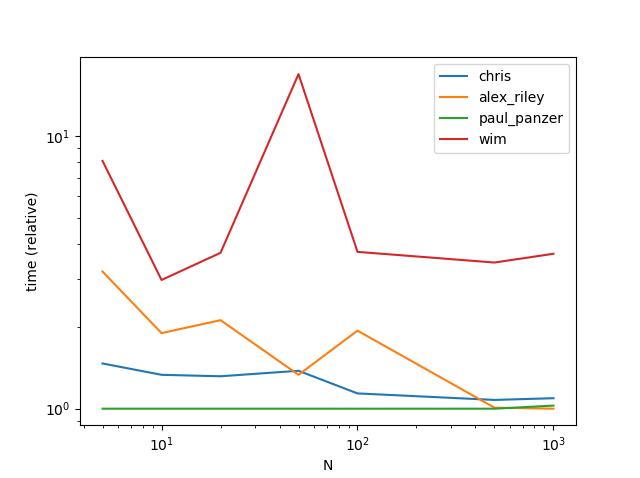
Method 3
Since the result cannot be implemented as a view, as_strided offers no benefits over simple preallocation and broadcasting. Because of its overhead as_strided seems in fact a bit slower (I did no proper benchmarking, though).
The as_strided code is taken from @AlexRiley’s post.
from numpy.lib.stride_tricks import as_strided
import numpy as np

def tile_array(a, b0, b1):
    r, c = a.shape                                    # number of rows/columns
    rs, cs = a.strides                                # row/column strides
    x = as_strided(a, (r, b0, c, b1), (rs, 0, cs, 0)) # view a as larger 4D array
    return x.reshape(r*b0, c*b1)                      # create new 2D array

def tile_array_pp(a, b0, b1):
    r, c = a.shape
    out = np.empty((r, b0, c, b1), a.dtype)
    out[...] = a[:, None, :, None]
    return out.reshape(r*b0, c*b1)

a = np.arange(9).reshape(3, 3)

kwds = {'globals': {'f_ar': tile_array, 'f_pp': tile_array_pp, 'a': a},
        'number': 1000}

from timeit import timeit

print('as_strided', timeit('f_ar(a, 100, 100)', **kwds))
print('broadcast ', timeit('f_pp(a, 100, 100)', **kwds))
Sample run:
as_strided 0.048387714981799945
broadcast  0.04324757700669579
Method 4
Another solution is to use as_strided. kron is much slower then using repeat twice. I have found that as_strided is much faster than a double repeat in many cases (small arrays [<250×250] with only a doubling in each dimension as_strided was slower). The as_strided trick is as follows:
a = arange(1000000).reshape((1000, 1000)) # dummy data

from numpy.lib.stride_tricks import as_strided
N, M = 4,3 # number of time to replicate each point in each dimension
H, W = a.shape
b = as_strided(a, (H, N, W, M), (a.strides[0], 0, a.strides[1], 0)).reshape((H*N, W*M))
This works by using 0-length strides which causes numpy to read the same value multiple times (until it gets to the next dimension). The final reshape does copy the data, but only once unlike using a double repeat which will copy the data twice.
Method 5
Errata: I’m only taking 2x upsampling into account.
TL;DR It turns out that after the OpenCV version,
np.repeat(np.repeat(a, 2, axis=1), 2, axis=0)
is the fastest. So the answer is – there’s no faster ways in numpy today,
but you can get a slight improvement by changing the order of axes.
And if you don’t mind OpenCV –
cv.resize(a, None, fx=2, fy=2, interpolation=cv.INTER_NEAREST)
Here is the test.
import timeit
import numpy as np
import cv2 as cv
test = np.zeros((16, 16, 3), dtype=np.float32)

def measure(f):
    t = timeit.timeit("f(test)", number=1000, globals={"test": test, "f": f})
    print("%s - %f"%(f.__name__, t))
    return f, t

def fastest(c):
    print(c.__name__)
    winner, t = min((measure(getattr(c, ve)) for ve in dir(c) if ve.startswith("alg_")), key=lambda x: x[1])
    print("%s winner: %s - %f"%(c.__name__, winner.__name__, t))
    return winner

@fastest
class nn:
    def alg_01(a):
        return np.repeat(np.repeat(a, 2, axis=0), 2, axis=1)
    def alg_02(a):
        return np.repeat(np.repeat(a, 2, axis=1), 2, axis=0)
    def alg_03(a):
        b = a[:, None, :, None]
        b = np.concatenate((b, b), axis=1)
        b = np.concatenate((b, b), axis=3)
        return b.reshape(a.shape[0]<<1, a.shape[1]<<1, *a.shape[2:])
    def alg_04(a):
        b = a[:, None, :, None]
        b = np.concatenate((b, b), axis=3)
        b = np.concatenate((b, b), axis=1)
        return b.reshape(a.shape[0]<<1, a.shape[1]<<1, *a.shape[2:])
    def alg_05(a):
        return (a[:, None, :, None]*np.ones((1, 2, 1, 2)+((1,)*len(a.shape[2:])), dtype=np.float32)).reshape(a.shape[0]<<1, a.shape[1]<<1, *a.shape[2:])
    def alg_06(a):
        return cv.resize(a, None, fx=2, fy=2, interpolation=cv.INTER_NEAREST)
    def alg_07(a):
        return a[:, None, :, None][:, (0, 0)][:, :, :, (0, 0)].reshape(a.shape[0]<<1, a.shape[1]<<1, *a.shape[2:])
    def alg_08(a):
        return a[:, None, :, None][:, :, :, (0, 0)][:, (0, 0)].reshape(a.shape[0]<<1, a.shape[1]<<1, *a.shape[2:])
    def alg_09(a):
        return np.kron(a, np.ones((2, 2), dtype=np.float32))
    def alg_10(a):
        return np.broadcast_to(a[:, None, :, None], (a.shape[0], 2, a.shape[1], 2)+a.shape[2:]).reshape(a.shape[0]<<1, a.shape[1]<<1, *a.shape[2:])
    def alg_11(a):
        ret = np.empty((a.shape[0], 2, a.shape[1], 2, *a.shape[2:]), dtype=np.float32)
        ret[...] = a[:, None, :, None]
        ret.resize((a.shape[0]<<1, a.shape[1]<<1, *a.shape[2:]), refcheck=False)
        return ret
The result is:
nn
alg_01 - 0.040967
alg_02 - 0.033744
alg_03 - 0.057969
alg_04 - 0.048739
alg_05 - 0.076595
alg_06 - 0.078638
alg_07 - 0.084692
alg_08 - 0.084539
alg_09 - 0.344339
alg_10 - 0.078707
alg_11 - 0.049424
nn winner: alg_02 - 0.033744
All methods was sourced from stackoverflow.com or stackexchange.com, is licensed under cc by-sa 2.5, cc by-sa 3.0 and cc by-sa 4.0