I’m trying to multiply each of the terms in a 2D array by the corresponding terms in a 1D array. This is very easy if I want to multiply every column by the 1D array, as shown in the numpy.multiply function. But I want to do the opposite, multiply each term in the row.
In other words I want to multiply:
[1,2,3]   [0]
[4,5,6] * [1]
[7,8,9]   [2]
and get
[0,0,0]
[4,5,6]
[14,16,18]
but instead I get
[0,2,6]
[0,5,12]
[0,8,18]
Does anyone know if there’s an elegant way to do that with numpy?
Thanks a lot,
Alex
Answers:
Thank you for visiting the Q&A section on Magenaut. Please note that all the answers may not help you solve the issue immediately. So please treat them as advisements. If you found the post helpful (or not), leave a comment & I’ll get back to you as soon as possible.
Method 1
Normal multiplication like you showed:
>>> import numpy as np
>>> m = np.array([[1,2,3],[4,5,6],[7,8,9]])
>>> c = np.array([0,1,2])
>>> m * c
array([[ 0,  2,  6],
       [ 0,  5, 12],
       [ 0,  8, 18]])
If you add an axis, it will multiply the way you want:
>>> m * c[:, np.newaxis]
array([[ 0,  0,  0],
       [ 4,  5,  6],
       [14, 16, 18]])
You could also transpose twice:
>>> (m.T * c).T
array([[ 0,  0,  0],
       [ 4,  5,  6],
       [14, 16, 18]])
Method 2
I’ve compared the different options for speed and found that – much to my surprise – all options (except diag) are equally fast. I personally use
A * b[:, None]
(or (A.T * b).T) because it’s short.
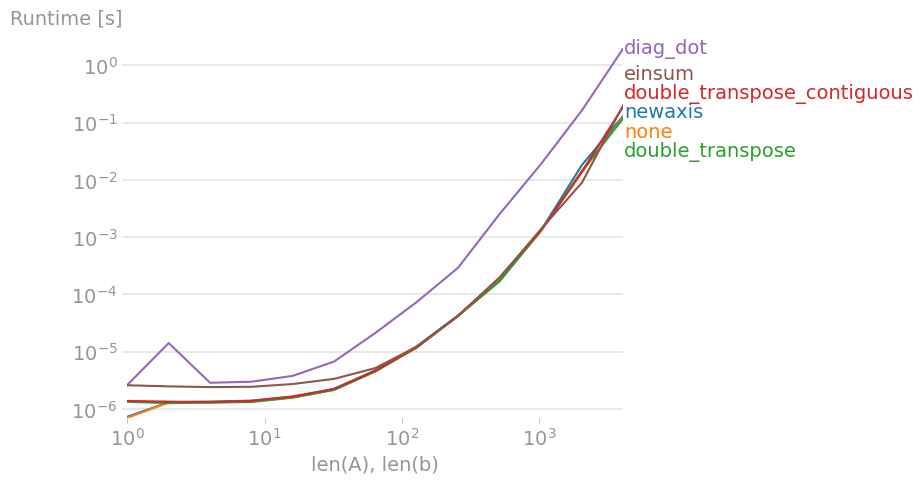
Code to reproduce the plot:
import numpy
import perfplot


def newaxis(data):
    A, b = data
    return A * b[:, numpy.newaxis]


def none(data):
    A, b = data
    return A * b[:, None]


def double_transpose(data):
    A, b = data
    return (A.T * b).T


def double_transpose_contiguous(data):
    A, b = data
    return numpy.ascontiguousarray((A.T * b).T)


def diag_dot(data):
    A, b = data
    return numpy.dot(numpy.diag(b), A)


def einsum(data):
    A, b = data
    return numpy.einsum("ij,i->ij", A, b)


perfplot.save(
    "p.png",
    setup=lambda n: (numpy.random.rand(n, n), numpy.random.rand(n)),
    kernels=[
        newaxis,
        none,
        double_transpose,
        double_transpose_contiguous,
        diag_dot,
        einsum,
    ],
    n_range=[2 ** k for k in range(13)],
    xlabel="len(A), len(b)",
)
Method 3
You could also use matrix multiplication (aka dot product):
a = [[1,2,3],[4,5,6],[7,8,9]]
b = [0,1,2]
c = numpy.diag(b)

numpy.dot(c,a)
Which is more elegant is probably a matter of taste.
Method 4
Yet another trick (as of v1.6)
A=np.arange(1,10).reshape(3,3)
b=np.arange(3)

np.einsum('ij,i->ij',A,b)
I’m proficient with the numpy broadcasting (newaxis), but I’m still finding my way around this new einsum tool. So I had play around a bit to find this solution.
Timings (using Ipython timeit):
einsum: 4.9 micro
transpose: 8.1 micro
newaxis: 8.35 micro
dot-diag: 10.5 micro
Incidentally, changing a i to j, np.einsum('ij,j->ij',A,b), produces the matrix that Alex does not want. And np.einsum('ji,j->ji',A,b) does, in effect, the double transpose.
Method 5
For those lost souls on google, using numpy.expand_dims then numpy.repeat will work, and will also work in higher dimensional cases (i.e. multiplying a shape (10, 12, 3) by a (10, 12)).
>>> import numpy
>>> a = numpy.array([[1,2,3],[4,5,6],[7,8,9]])
>>> b = numpy.array([0,1,2])
>>> b0 = numpy.expand_dims(b, axis = 0)
>>> b0 = numpy.repeat(b0, a.shape[0], axis = 0)
>>> b1 = numpy.expand_dims(b, axis = 1)
>>> b1 = numpy.repeat(b1, a.shape[1], axis = 1)
>>> a*b0
array([[ 0,  2,  6],
   [ 0,  5, 12],
   [ 0,  8, 18]])
>>> a*b1
array([[ 0,  0,  0],
   [ 4,  5,  6],
   [14, 16, 18]])
Method 6
Why don’t you just do
>>> m = np.array([[1,2,3],[4,5,6],[7,8,9]])
>>> c = np.array([0,1,2])
>>> (m.T * c).T
??
All methods was sourced from stackoverflow.com or stackexchange.com, is licensed under cc by-sa 2.5, cc by-sa 3.0 and cc by-sa 4.0