I have an n-by-m Pandas DataFrame df defined as follows. (I know this is not the best way to do it. It makes sense for what I’m trying to do in my actual code, but that would be TMI for this post so just take my word that this approach works in my particular scenario.)
>>> df = DataFrame(columns=['col1'])
>>> df.append(Series([None]), ignore_index=True)
>>> df
Empty DataFrame
Columns: [col1]
Index: []
I stored lists in the cells of this DataFrame as follows.
>>> df['column1'][0] = [1.23, 2.34]
>>> df
     col1
0  [1, 2]
For some reason, the DataFrame stored this list as a string instead of a list.
>>> df['column1'][0]
'[1.23, 2.34]'
I have 2 questions for you.
- Why does the DataFrame store a list as a string and is there a way around this behavior?
- If not, then is there a Pythonic way to convert this string into a list?
Update
The DataFrame I was using had been saved and loaded from a CSV format. This format, rather than the DataFrame itself, converted the list from a string to a literal.
Answers:
Thank you for visiting the Q&A section on Magenaut. Please note that all the answers may not help you solve the issue immediately. So please treat them as advisements. If you found the post helpful (or not), leave a comment & I’ll get back to you as soon as possible.
Method 1
As you pointed out, this can commonly happen when saving and loading pandas DataFrames as .csv files, which is a text format.
In your case this happened because list objects have a string representation, allowing them to be stored as .csv files. Loading the .csv will then yield that string representation.
If you want to store the actual objects, you should use DataFrame.to_pickle() (note: objects must be picklable!).
To answer your second question, you can convert it back with ast.literal_eval:
>>> from ast import literal_eval
>>> literal_eval('[1.23, 2.34]')
[1.23, 2.34]
Method 2
You can directly use pandas –
import pandas as pd
df = pd.read_csv(DF_NAME, converters={'COLUMN_NAME': pd.eval})
This will read that column as a it’s corresponding dtype in python instead of a string.
UPDATE:
As rightfully pointed out by @ctwardy in comments. It is wiser to use pd.eval instead of eval to avoid unintended regex related consequences. Details – https://realpython.com/python-eval-function/#minimizing-the-security-issues-of-eval
Method 3
- Use
ast.literal_evalto safely evaluate a string containing a Python literal or container datatype.- It’s part of the standard library
-
Using python’s eval() vs. ast.literal_eval()? explains why
literal_evalis safer than usingeval. -
Examples:
literal_eval("[1.23, 2.34]")worksliteral_eval("['KB4523205','KB4519569','KB4503308']")works- Other answers mention
pd.eval, but its usage is limited; it results inValueError: NumExpr 2 does not support Unicode as a dtype.for this simple example.
- Other answers mention
literal_eval("[KB4523205, KB4519569, KB4503308]")doesn’t work (no quotes around thestrvalues)- See pandas – convert string into list of strings for dealing with this representation.
- Convert the column when reading the file, by using the
convertersparameter ofpandas.read_csv.
data in test.csv
col1
"[1.23, 2.34]"
"['KB4523205','KB4519569','KB4503308']"
Convert the column when creating the csv
from ast import literal_eval
import pandas as pd

# convert the column during import
df = pd.read_csv('test.csv', converters={'col1': literal_eval})

# display(df)
                                col1
0                       [1.23, 2.34]
1  [KB4523205, KB4519569, KB4503308]

# check type
print(type(df.iloc[0, 0]))
list

print(type(df.iloc[1, 0]))
list
Convert the column of an existing dataframe
df.col1 = df.col1.apply(literal_eval)
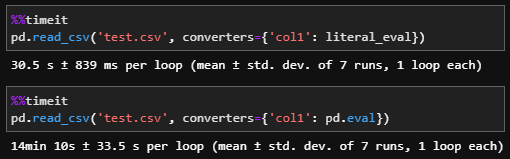
%%timeit
pd.evalis 28 times slower thanliteral_eval- Given
test.csvwith 2,820,511 rows of"[1.23, 2.34]"
Method 4
I just came across this problem and there is a very simple solution (pandas.eval()). I’m using pandas 0.20.0.
# SETUP
import pandas as pd
import io

csv = io.StringIO(u'''
id  list
A1  [1,2]
A2  [3,4]
A3  [5,6]
''')

df = pd.read_csv(csv, delim_whitespace = True)

# TYPE CHECK <type 'str'>
print type(df.at[0, 'list'])

# MAIN CONVERSION
df['list'] = pd.eval(df['list'])

# TYPE CHECK <type 'list'>
print type(df.at[0, 'list'])
Method 5
1) There is a way around this behavior. Use loc helps here.
>>> import pandas as pd

>>> df = pd.DataFrame(columns=['column1'])
>>> df = df.append(pd.Series(data = {'column1':[None]}), ignore_index = True)

   column1
0  [None]

>>> # Add list to index 0 in column1
>>> df.loc[0,'column1'] = [1.23, 2.34]
>>> print(df.loc[0, 'column1'])
[1.23, 2.34]
2) Pythonic way to convert this string into a list. (This is probably what you want as the DataFrame you are using had been been saved and loaded from a CSV format, there are a couple solutions for this). This is an addition on pshep123’s answer.
from ast import literal_eval
import pandas as pd

csv = io.StringIO(u'''
id  list
A1  [1,2]
A2  [3,4]
A3  [5,6]
''')
df = pd.read_csv(csv, delim_whitespace = True)

# Output is a string
df.loc[0, 'list']
'[1,2]'

# Convert entire column to a list
df.loc[:,'list'] = df.loc[:,'list'].apply(lambda x: literal_eval(x))

# Output is a list
df.loc[0, 'list']
[1, 2]
Method 6
I had the same problem. When storing a dataframe list column to a CSV file using df.to_csv(), list columns are converted to a string e.g. “[42, 42, 42]” instead of [42, 42, 42]
Alex answer is correct and you can use literal_eval to convert the string back to a list. The problem with this approach is that you need to import an additional library and you need to apply or map the function to your dataframe. As easier way is to force Pandas to read the column as a Python object (dtype)
df["col1"].astype('O')
The O is used for Python objects including lists. More info here. Please note that this method fails if you parse empty list strings: “[]”
Alternatively you can also apply a function to your column (this one is for integers):
def stringToList(string):
    # input format : "[42, 42, 42]" , note the spaces after the commas, in this case I have a list of integers
    string = string[1:len(string)-1]
    try:
        if len(string) != 0:
            tempList = string.split(", ")
            newList = list(map(lambda x: int(x), tempList))
        else:
            newList = []
    except:
        newList = [-9999]
    return(newList)

df["col1"] = df["col1"].apply(lambda x: stringToList(x))
Method 7
for reference only… pandas don’t convert lists into string. ..
In [29]: data2 = [{'a': [1, 5], 'b': 2}, {'a': 5, 'b': 10, 'c': 20}]

In [30]: df = pd.DataFrame(data2)

In [31]: df
Out[31]:
        a   b   c
0  [1, 5]   2 NaN
1       5  10  20

In [32]: df['a'][0], type(df['a'][0])
Out[32]: ([1, 5], list)

In [33]: pd.__version__
Out[33]: '0.12.0'
Method 8
A simple hack I used is to call a lambda function that indexes out the first and last elements (the list brackets in str form) and calls the split method followed by another that replaces the list elements with ints.
df['column1'] = df['column1'].apply(lambda x:x[1:-1].split(',')).apply(lambda x:[int(i) for i in x])
Method 9
Adding onto Alex’s answer. Here is another version which can be used for converting individual items from string to list
import pandas as pd
from ast import literal_eval

df = pd.read_csv("some_csvfile.csv")

def item_gen(l):
    for i in l:
        yield(i)

for i in item_gen(df["some_column_with_list_item"]):
    print(literal_eval(i))
All methods was sourced from stackoverflow.com or stackexchange.com, is licensed under cc by-sa 2.5, cc by-sa 3.0 and cc by-sa 4.0