I’m dealing with pandas dataframe and have a frame like this:
Year Value
2012  10
2013  20
2013  25
2014  30
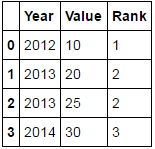
I want to make an equialent to DENSE_RANK () over (order by year) function. to make an additional column like this:
    Year Value Rank
    2012  10    1
    2013  20    2
    2013  25    2
    2014  30    3
How can it be done in pandas?
Thanks!
Answers:
Thank you for visiting the Q&A section on Magenaut. Please note that all the answers may not help you solve the issue immediately. So please treat them as advisements. If you found the post helpful (or not), leave a comment & I’ll get back to you as soon as possible.
Method 1
Use pd.Series.rank with method='dense'
df['Rank'] = df.Year.rank(method='dense').astype(int)

df
Method 2
The fastest solution is factorize:
df['Rank'] = pd.factorize(df.Year)[0] + 1
Timings:
#len(df)=40k
df = pd.concat([df]*10000).reset_index(drop=True)

In [13]: %timeit df['Rank'] = df.Year.rank(method='dense').astype(int)
1000 loops, best of 3: 1.55 ms per loop

In [14]: %timeit df['Rank1'] = df.Year.astype('category').cat.codes + 1
1000 loops, best of 3: 1.22 ms per loop

In [15]: %timeit df['Rank2'] = pd.factorize(df.Year)[0] + 1
1000 loops, best of 3: 737 µs per loop
Method 3
You can convert the year to categoricals and then take their codes (adding one because they are zero indexed and you wanted the initial value to start with one per your example).
df['Rank'] = df.Year.astype('category').cat.codes + 1

>>> df
   Year  Value  Rank
0  2012     10     1
1  2013     20     2
2  2013     25     2
3  2014     30     3
Method 4
Groupby.ngroup
Will sort keys by default so smaller years get labeled lower. Can set sort=False to rank groups based on order of occurrence.
df['Rank'] = df.groupby('Year', sort=True).ngroup()+1
np.unique
Also sorts, so use return_inverse to rank the smaller values lowest.
df['Rank'] = np.unique(df['Year'], return_inverse=True)[1]+1
All methods was sourced from stackoverflow.com or stackexchange.com, is licensed under cc by-sa 2.5, cc by-sa 3.0 and cc by-sa 4.0