I have two dataframes, both of which contain an irregularly spaced, millisecond resolution timestamp column. My goal here is to match up the rows so that for each matched row, 1) the first time stamp is always smaller or equal to the second timestamp, and 2) the matched timestamps are the closest for all pairs of timestamps satisfying 1).
Is there any way to do this with pandas.merge?
Answers:
Thank you for visiting the Q&A section on Magenaut. Please note that all the answers may not help you solve the issue immediately. So please treat them as advisements. If you found the post helpful (or not), leave a comment & I’ll get back to you as soon as possible.
Method 1
merge() can’t do this kind of join, but you can use searchsorted():
Create some random timestamps: t1, t2, there are in ascending order:
import pandas as pd
import numpy as np
np.random.seed(0)

base = np.array(["2013-01-01 00:00:00"], "datetime64[ns]")

a = (np.random.rand(30)*1000000*1000).astype(np.int64)*1000000
t1 = base + a
t1.sort()

b = (np.random.rand(10)*1000000*1000).astype(np.int64)*1000000
t2 = base + b
t2.sort()
call searchsorted() to find index in t1 for every value in t2:
idx = np.searchsorted(t1, t2) - 1
mask = idx >= 0

df = pd.DataFrame({"t1":t1[idx][mask], "t2":t2[mask]})
here is the output:
                         t1                         t2
0 2013-01-02 06:49:13.287000 2013-01-03 16:29:15.612000
1 2013-01-05 16:33:07.211000 2013-01-05 21:42:30.332000
2 2013-01-07 04:47:24.561000 2013-01-07 04:53:53.948000
3 2013-01-07 14:26:03.376000 2013-01-07 17:01:35.722000
4 2013-01-07 14:26:03.376000 2013-01-07 18:22:13.996000
5 2013-01-07 14:26:03.376000 2013-01-07 18:33:55.497000
6 2013-01-08 02:24:54.113000 2013-01-08 12:23:40.299000
7 2013-01-08 21:39:49.366000 2013-01-09 14:03:53.689000
8 2013-01-11 08:06:36.638000 2013-01-11 13:09:08.078000
To view this result by graph:
import pylab as pl
pl.figure(figsize=(18, 4))
pl.vlines(pd.Series(t1), 0, 1, colors="g", lw=1)
pl.vlines(df.t1, 0.3, 0.7, colors="r", lw=2)
pl.vlines(df.t2, 0.3, 0.7, colors="b", lw=2)
pl.margins(0.02)
output:
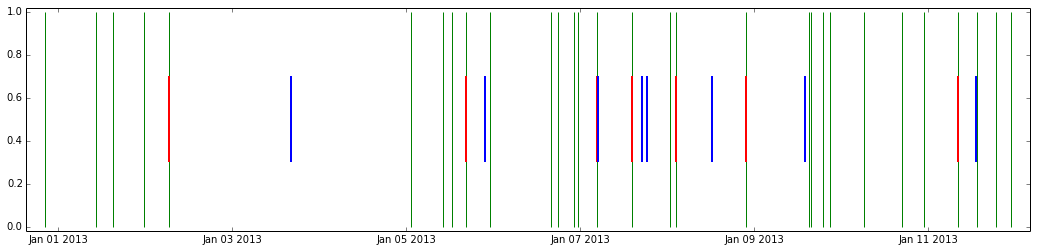
The green lines are t1, blue lines are t2, red lines are selected from t1 for every t2.
Method 2
Pandas now has the function merge_asof, doing exactly what was described in the accepted answer.
Method 3
I used a different way than HYRY:
- do a regular merge with outer join (how=’outer’);
- sort it by date;
- use fillna(method=’pad’) to take fill just the columns you need and ‘pad’ if you would like to take the previous filled row;
- drop all the rows you don’t need from the outer join.
All this can be written in few lines:
df=pd.merge(df0, df1, on='Date', how='outer')
df=df.sort(['Date'], ascending=[1])
headertofill=list(df1.columns.values)
df[headertofill]=df[headertofill].fillna(method='pad')
df=df[pd.isnull(df[var_from_df0_only])==False]
Method 4
Here is a simpler and more general method.
# data and signal are want we want to merge
keys = ['channel', 'timestamp']  # Could be simply ['timestamp']
index = data.loc[keys].set_index(keys).index  # Make index from columns to merge on
padded = signal.reindex(index, method='pad')  # Key step -- reindex with filling
joined = data.join(padded, on=keys)  # Join to data if needed
All methods was sourced from stackoverflow.com or stackexchange.com, is licensed under cc by-sa 2.5, cc by-sa 3.0 and cc by-sa 4.0