I have a simple problem in python and matplotlib.
I have 3 lists : x, y and rho with rho[i] a density at the point x[i], y[i].
All values of x and y are between -1. and 1. but they are not in a specific order.
How to make a contour plot (like with imshow) of the density rho (interpolated at the points x, y).
Thank you very much.
EDIT : I work with large arrays : x, y and rho have between 10,000 and 1,000,000 elements
Answers:
Thank you for visiting the Q&A section on Magenaut. Please note that all the answers may not help you solve the issue immediately. So please treat them as advisements. If you found the post helpful (or not), leave a comment & I’ll get back to you as soon as possible.
Method 1
You need to interpolate your rho values. There’s no one way to do this, and the “best” method depends entirely on the a-priori information you should be incorporating into the interpolation.
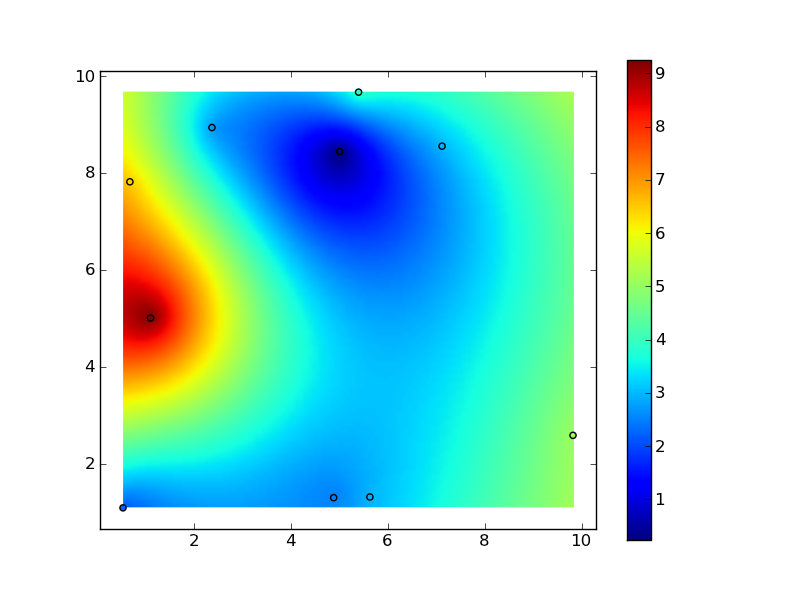
Before I go into a rant on “black-box” interpolation methods, though, a radial basis function (e.g. a “thin-plate-spline” is a particular type of radial basis function) is often a good choice. If you have millions of points, this implementation will be inefficient, but as a starting point:
import numpy as np
import matplotlib.pyplot as plt
import scipy.interpolate

# Generate data:
x, y, z = 10 * np.random.random((3,10))

# Set up a regular grid of interpolation points
xi, yi = np.linspace(x.min(), x.max(), 100), np.linspace(y.min(), y.max(), 100)
xi, yi = np.meshgrid(xi, yi)

# Interpolate
rbf = scipy.interpolate.Rbf(x, y, z, function='linear')
zi = rbf(xi, yi)

plt.imshow(zi, vmin=z.min(), vmax=z.max(), origin='lower',
           extent=[x.min(), x.max(), y.min(), y.max()])
plt.scatter(x, y, c=z)
plt.colorbar()
plt.show()
Method 2
You can use scipy’s griddata (requires Scipy >= 0.10), it’s a triangulation-based method.
import numpy as np
import matplotlib.pyplot as plt
import scipy.interpolate

# Generate data: for N=1e6, the triangulation hogs 1 GB of memory
N = 1000000
x, y = 10 * np.random.random((2, N))
rho = np.sin(3*x) + np.cos(7*y)**3

# Set up a regular grid of interpolation points
xi, yi = np.linspace(x.min(), x.max(), 300), np.linspace(y.min(), y.max(), 300)
xi, yi = np.meshgrid(xi, yi)

# Interpolate; there's also method='cubic' for 2-D data such as here
zi = scipy.interpolate.griddata((x, y), rho, (xi, yi), method='linear')

plt.imshow(zi, vmin=rho.min(), vmax=rho.max(), origin='lower',
           extent=[x.min(), x.max(), y.min(), y.max()])
plt.colorbar()
plt.show()
There’s also inverse distance weighed interpolation — similar to RBF, but should work better for large # of points: Inverse Distance Weighted (IDW) Interpolation with Python
All methods was sourced from stackoverflow.com or stackexchange.com, is licensed under cc by-sa 2.5, cc by-sa 3.0 and cc by-sa 4.0