Here is a very simplified example:
xvalues = [2,3,4,6]

for x in xvalues:
    plt.axvline(x,color='b',label='xvalues')

plt.legend()
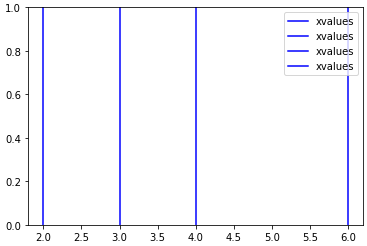
The legend will now show ‘xvalues’ as a blue line 4 times in the legend.
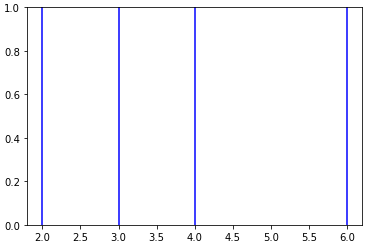
Is there a more elegant way of fixing this than the following?
for i,x in enumerate(xvalues):
    if not i:
        plt.axvline(x,color='b',label='xvalues')
    else:
        plt.axvline(x,color='b')
Answers:
Thank you for visiting the Q&A section on Magenaut. Please note that all the answers may not help you solve the issue immediately. So please treat them as advisements. If you found the post helpful (or not), leave a comment & I’ll get back to you as soon as possible.
Method 1
plt.legend takes as parameters
- A list of axis handles which are
Artistobjects - A list of labels which are strings
These parameters are both optional defaulting to plt.gca().get_legend_handles_labels().
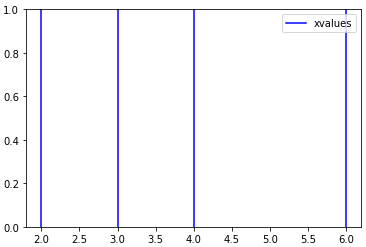
You can remove duplicate labels by putting them in a dictionary before calling legend. This is because dicts can’t have duplicate keys.
For example:
For Python versions < 3.7
from collections import OrderedDict
import matplotlib.pyplot as plt

handles, labels = plt.gca().get_legend_handles_labels()
by_label = OrderedDict(zip(labels, handles))
plt.legend(by_label.values(), by_label.keys())
For Python versions > 3.7
As of Python 3.7, dictionaries retain input order by default. Thus, there is no need for OrderedDict form the collections module.
import matplotlib.pyplot as plt

handles, labels = plt.gca().get_legend_handles_labels()
by_label = dict(zip(labels, handles))
plt.legend(by_label.values(), by_label.keys())
Docs for plt.legend
Method 2
handles, labels = ax.get_legend_handles_labels()
handle_list, label_list = [], []
for handle, label in zip(handles, labels):
    if label not in label_list:
        handle_list.append(handle)
        label_list.append(label)
plt.legend(handle_list, label_list)
Method 3
I don’t know if this can be considered “elegant”, but you can have your label a variable that gets set to "_nolegend_" after first usage:
my_label = "xvalues"
xvalues = [2,3,4,6]

for x in xvalues:
    plt.axvline(x, color='b', label=my_label)
    my_label = "_nolegend_"

plt.legend()
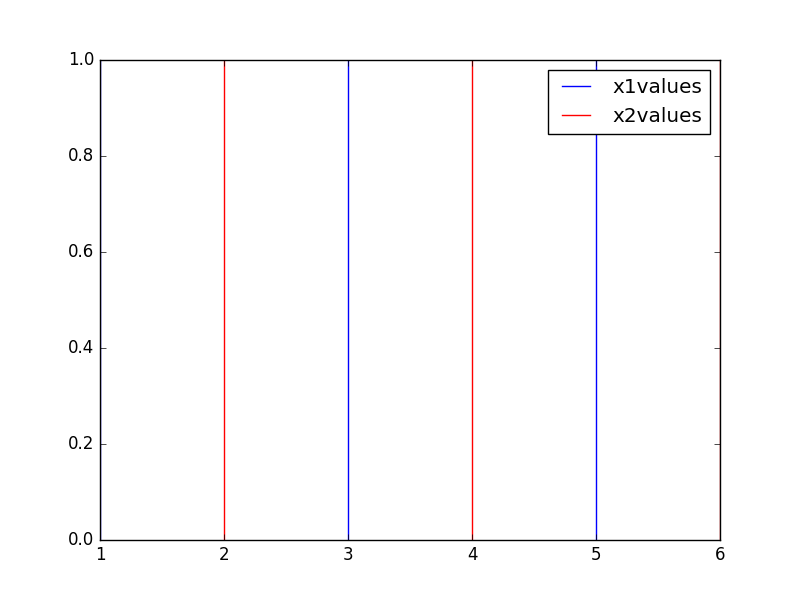
This can be generalized using a dictionary of labels if you have to put several labels:
my_labels = {"x1" : "x1values", "x2" : "x2values"}
x1values = [1, 3, 5]
x2values = [2, 4, 6]

for x in x1values:
    plt.axvline(x, color='b', label=my_labels["x1"])
    my_labels["x1"] = "_nolegend_"
for x in x2values:
    plt.axvline(x, color='r', label=my_labels["x2"])
    my_labels["x2"] = "_nolegend_"

plt.legend()
(Answer inspired by https://stackoverflow.com/a/19386045/1878788)
Method 4
Problem – 3D Array
import numpy as np
a = np.random.random((2, 100, 4))
b = np.random.random((2, 100, 4))
c = np.random.random((2, 100, 4))
Solution – dict uniqueness
For my case _nolegend_ (bli and DSM) would not work, nor would label if i==0. ecatmur‘s answer uses get_legend_handles_labels and reduces the legend down with collections.OrderedDict. Fons demonstrates this is possible without an import.
Inline with these answers, I suggest using dict for unique labels.
# Step-by-step
ax = plt.gca()                      # Get the axes you need
a = ax.get_legend_handles_labels()  # a = [(h1 ... h2) (l1 ... l2)]  non unique
b = {l:h for h,l in zip(*a)}        # b = {l1:h1, l2:h2}             unique
c = [*zip(*b.items())]              # c = [(l1 l2) (h1 h2)]
d = c[::-1]                         # d = [(h1 h2) (l1 l2)]
plt.legend(*d)
Or
plt.legend(*[*zip(*{l:h for h,l in zip(*ax.get_legend_handles_labels())}.items())][::-1])
Maybe less legible and memorable than Matthew Bourque‘s solution. Code golf welcome.
Example
import numpy as np
a = np.random.random((2, 100, 4))
b = np.random.random((2, 100, 4))

import matplotlib.pyplot as plt
fig, ax = plt.subplots(1)
ax.plot(*a, 'C0', label='a')
ax.plot(*b, 'C1', label='b')

ax.legend(*[*zip(*{l:h for h,l in zip(*ax.get_legend_handles_labels())}.items())][::-1])
# ax.legend()   # Old,  ^ New

plt.show()
Method 5
Based on answer https://stackoverflow.com/a/13589144/9132798 and https://stackoverflow.com/a/19386045/9132798
plt.gca().get_legend_handles_labels()[1] gives a list of names, it is possible to check if the label is already in the list while in the loop plotting (label= name[i] if name[i] not in plt.gca().get_legend_handles_labels()[1] else '').
For the given example this solution would look like:
import matplotlib.pyplot as plt

xvalues = [2,3,4,6]

for x in xvalues:
    plt.axvline(x,color='b',
    label= 'xvalues' if 'xvalues'
            not in plt.gca().get_legend_handles_labels()[1] else '')

plt.legend()
Which is much shorter than https://stackoverflow.com/a/13589144/9132798 and more flexible than https://stackoverflow.com/a/19386045/9132798 as it could be use for any kind of loop any plot function in the loop individually.
However, for many cycles it probably slower than https://stackoverflow.com/a/13589144/9132798.
Method 6
These code snippets didn’t work for me personally. I was plotting two different groups in two different colors. The legend would show two red markers and two blue markers, when I only wanted to see one per color. I’ll paste a simplified version of what did work for me:
Import statements
import matplotlib.pyplot as plt

from matplotlib.legend_handler import HandlerLine2D
Plot data
points_grp, = plt.plot(x[grp_idx], y[grp_idx], color=c.c[1], marker=m, ms=4, lw=0, label=leglab[1])
points_ctrl, = plt.plot(x[ctrl_idx], y[ctrl_idx], color=c.c[0], marker=m, ms=4, lw=0, label=leglab[0])
Add legend
points_dict = {points_grp: HandlerLine2D(numpoints=1),points_ctrl: HandlerLine2D(numpoints=1)}
leg = ax.legend(fontsize=12, loc='upper left', bbox_to_anchor=(1, 1.03),handler_map=points_dict)
All methods was sourced from stackoverflow.com or stackexchange.com, is licensed under cc by-sa 2.5, cc by-sa 3.0 and cc by-sa 4.0