I see more and more commands like this:
$ pip install "splinter[django]"
What do these square brackets do?
Answers:
Thank you for visiting the Q&A section on Magenaut. Please note that all the answers may not help you solve the issue immediately. So please treat them as advisements. If you found the post helpful (or not), leave a comment & I’ll get back to you as soon as possible.
Method 1
The syntax that you are using is:
pip install "project[extra]"
In your case, you are installing the splinter package which has the added support for django. The square brackets ([]) are not specific syntax, just convention. Really, you are installing the package named: "splinter[django]".
An explanation from @chetner:
The command
pip install splinter djangowould install two packages namedsplinteranddjango.splinter[django], on the other hand, installs a variant of thesplinterpackage which contains support fordjango. Note that it has nothing to do with thedjangopackage itself, but is just a string defined by thesplinterpackage for a particular feature set that gets enabled.
Method 2
Brackets [optional] in PIP signify optional dependencies
Just in case another developer comes along looking to implement this pattern in their own Python package deployment, here’s further explanation of the brackets [] in pip.
For Example: Apache Airflow
To install airflow from pip we use this command:
pip install 'apache-airflow'
You can install optional components of airflow with:
pip install 'apache-airflow[aws]'
#      [optional] -----------^
When we search pypi for apache-airflow note that the optional packages do not show up:
pip search 'apache-airflow'

apache-airflow (1.10.9)                            - Programmatically author, schedule and monitor data pipelines
pylint-airflow (0.1.0a1)                           - A Pylint plugin to lint Apache Airflow code.
swe-airflow-tools (0.0.3)                          - Tools for Apache Airflow Application
airflow (0.6)                                      - Placeholder for the old Airflow package
...
Implementation via setup.py
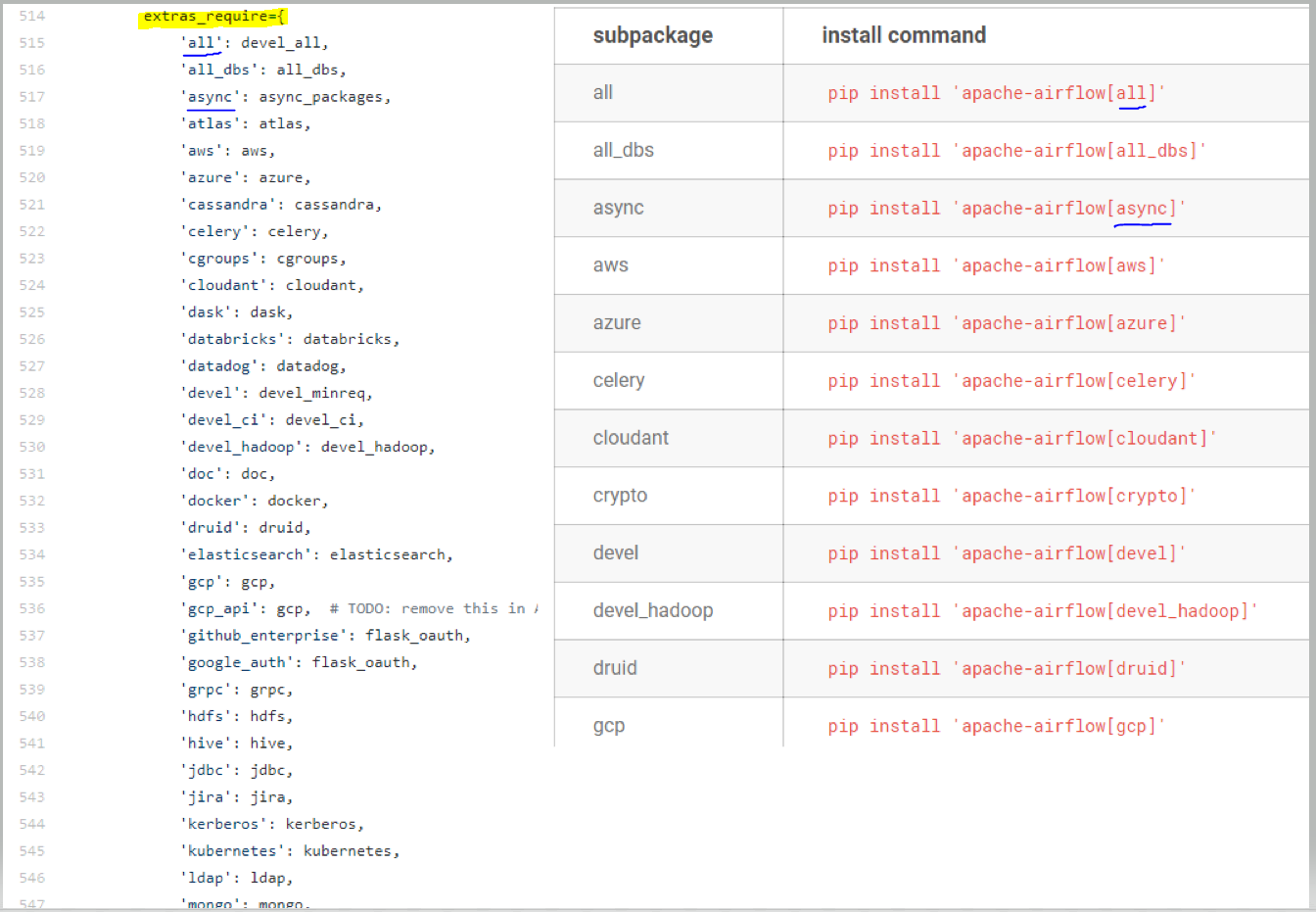
You can see how this was accomplished in the setup.py script
On the left in setup.py – extras_require is defined.
On the right are the correlated installation commands for these optional sub-packages.
Method 3
Pretty sure these are setuptools extras:
Sometimes a project has “recommended” dependencies, that are not required for all uses of the project. For example, a project might offer optional PDF output if ReportLab is installed, and reStructuredText support if docutils is installed. These optional features are called “extras” …
Method 4
Maybe worthwhile to know that this optional package syntax admits multiple extras (separated by comma within the brackets) as in:
python -m pip install SomePackage[PDF,EPUB] # multiple extras
As per the pip manual
Method 5
This is exactly the list from the setup.py file for the project in question:
"django": ["Django>=1.7.11;python_version<'3.0'", "Django>=2.0.6;python_version>'3.3'", "lxml>=2.3.6", "cssselect", "six"],
Method 6
TLDR
The square bracket contains the ‘extra’ option’s information defined in setup.py that pip will use to install additional dependencies.
pip install "splinter[django]"
To be specific, the above line will install first the ‘splinter’ package, then install the extra dependencies the ‘splinter’ project requires with the ‘django’ option specified in a setup.py of ‘splinter’ project.
Explanation
pip install "splinter[django]"

pip install "splinter" "Django>=2.0.6" "lxml>=4.2.4" "cssselect"
As of splinter==0.16.0, with python==3.9.2, the above two commands are equivalent.
Both pip install will result in the following packages given a clean virtual enviroment.
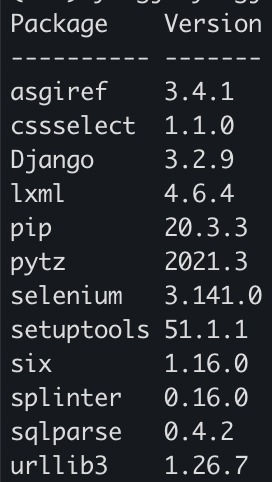
The reason why the two pip install commands achieve same is because this is literally what has been run in the background based on the setup.py of the splinter package
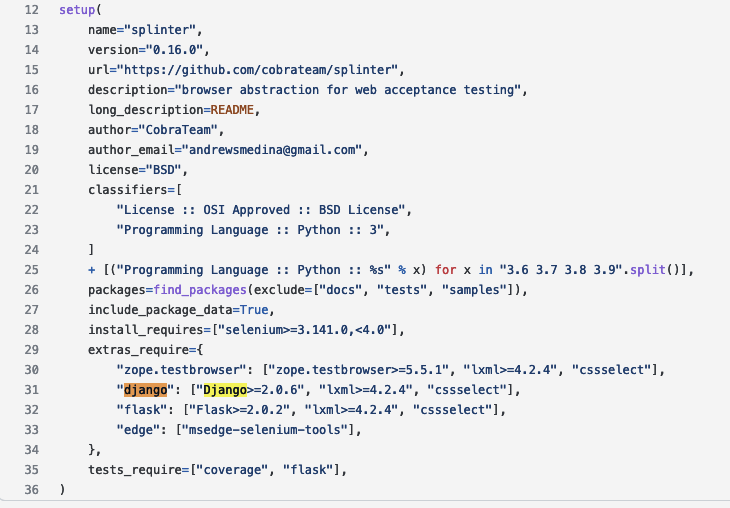
The ‘[django]’ is the ‘extra’ option for the ‘splinter’ package. Pip will look into the setup.py of splinter package, and find what needs to be installed with the ‘[django]’ option specified. In this case, it is these 3 packages: [“Django>=2.0.6”, “lxml>=4.2.4”, “cssselect”]
All methods was sourced from stackoverflow.com or stackexchange.com, is licensed under cc by-sa 2.5, cc by-sa 3.0 and cc by-sa 4.0