Suppose I do the following:
>>> l = [[]]*2
>>> l
[[], []]
>>> l[0].append(1)
>>> l
[[1], [1]]
Why does 1 get appended to both lists?
Answers:
Thank you for visiting the Q&A section on Magenaut. Please note that all the answers may not help you solve the issue immediately. So please treat them as advisements. If you found the post helpful (or not), leave a comment & I’ll get back to you as soon as possible.
Method 1
[[]]*2 is a list of two references to the same list. You are appending to it and then seeing it twice.
Method 2
Because there is really only one list. Consider this:
>>> l = [[]]
>>> l2 = l*2
>>> l2[0] is l[0]
True
>>> l2[1] is l[0]
True
*2 performed on a list does not copy the list but return a list of length 2 filled with the same reference.
What you probably wanted was this:
>>> l = [[] for _ in xrange(2)]
As @Asterisk mentions in a comment, the same behaviour is exposed by all common collections. As a rule of thumb it is therefore best to only use multiplication on immutable types with value-semantics.
Method 3
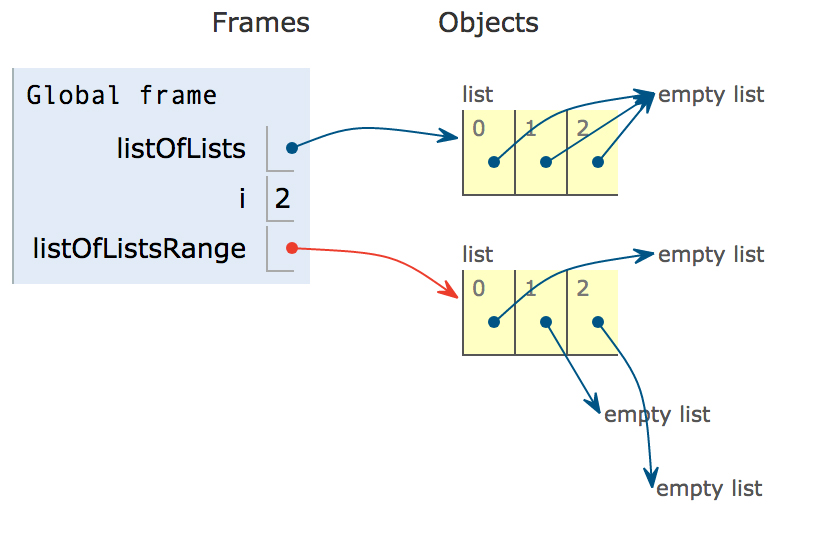
Showcasing the difference with memory layout:
listOfLists = [[]] * 3
listOfListsRange = [[] for i in range(0, 3)]
Method 4
Here’s how i initialize a list of lists. Rows vary slowest.
nrows = 3; ncols = 5

l_of_ls = [[0]*ncols for i in range(nrows )]

for rix, r in enumerate(l_of_ls):
    for cix, c in enumerate(r):
        print rix, cix, 'val = ',c
RESULT
0 0 val =  0
0 1 val =  0
0 2 val =  0
0 3 val =  0
0 4 val =  0
1 0 val =  0
1 1 val =  0
1 2 val =  0
1 3 val =  0
1 4 val =  0
2 0 val =  0
2 1 val =  0
2 2 val =  0
2 3 val =  0
2 4 val =  0
Also Worth Noting for Indexing Purposes
for rix in range(nrows):
    for cix in range(ncols):
        print l_of_ls[rix][cix],
    print
RESULT
0 0 0 0 0
0 0 0 0 0
0 0 0 0 0
All methods was sourced from stackoverflow.com or stackexchange.com, is licensed under cc by-sa 2.5, cc by-sa 3.0 and cc by-sa 4.0