I have 5 lists, all of the same length, and I’d like to write them to 5 columns in a CSV. So far, I can only write one to a column with this code:
with open('test.csv', 'wb') as f:
    writer = csv.writer(f)
    for val in test_list:
        writer.writerow([val])
If I add another for loop, it just writes that list to the same column. Anyone know a good way to get five separate columns?
Answers:
Thank you for visiting the Q&A section on Magenaut. Please note that all the answers may not help you solve the issue immediately. So please treat them as advisements. If you found the post helpful (or not), leave a comment & I’ll get back to you as soon as possible.
Method 1
Change them to rows:
rows = zip(list1, list2, list3, list4, list5)
Then just:
import csv

with open(newfilePath, "w") as f:
    writer = csv.writer(f)
    for row in rows:
        writer.writerow(row)
Method 2
The following code writes python lists into columns in csv
import csv
from itertools import zip_longest
list1 = ['a', 'b', 'c', 'd', 'e']
list2 = ['f', 'g', 'i', 'j']
d = [list1, list2]
export_data = zip_longest(*d, fillvalue = '')
with open('numbers.csv', 'w', encoding="ISO-8859-1", newline='') as myfile:
      wr = csv.writer(myfile)
      wr.writerow(("List1", "List2"))
      wr.writerows(export_data)
myfile.close()
The output looks like this
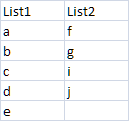
Method 3
You can use izip to combine your lists, and then iterate them
for val in itertools.izip(l1,l2,l3,l4,l5):
    writer.writerow(val)
Method 4
If you are happy to use a 3rd party library, you can do this with Pandas. The benefits include seamless access to specialized methods and row / column labeling:
import pandas as pd

list1 = [1, 2, 3]
list2 = [4, 5, 6]
list3 = [7, 8, 9]

df = pd.DataFrame(list(zip(*[list1, list2, list3]))).add_prefix('Col')

df.to_csv('file.csv', index=False)

print(df)

   Col0  Col1  Col2
0     1     4     7
1     2     5     8
2     3     6     9
Method 5
I didn’t want to import anything other than csv, and all my lists have the same number of items. The top answer here seems to make the lists into one row each, instead of one column each. Thus I took the answers here and came up with this:
import csv
list1 = ['a', 'b', 'c', 'd', 'e']
list2 = ['f', 'g', 'i', 'j','k']
with open('C:/test/numbers.csv', 'wb+') as myfile:
    wr = csv.writer(myfile)
    wr.writerow(("list1", "list2"))
    rcount = 0
    for row in list1:
        wr.writerow((list1[rcount], list2[rcount]))
        rcount = rcount + 1
    myfile.close()
Method 6
I just wanted to add to this one- because quite frankly, I banged my head against it for a while – and while very new to python – perhaps it will help someone else out.
 writer.writerow(("ColName1", "ColName2", "ColName"))
                 for i in range(len(first_col_list)):
                     writer.writerow((first_col_list[i], second_col_list[i], third_col_list[i]))
Method 7
import csv
dic = {firstcol,secondcol} #dictionary
csv = open('result.csv', "w")
for key in dic.keys():
    row ="n"+ str(key) + "," + str(dic[key])
    csv.write(row)
All methods was sourced from stackoverflow.com or stackexchange.com, is licensed under cc by-sa 2.5, cc by-sa 3.0 and cc by-sa 4.0