I’d like to implement a function in Bash which increases (and returns) a count with every call. Unfortunately this seems non-trivial since I’m invoking the function inside a subshell and it consequently cannot modify its parent shell’s variables.
Here’s my attempt:
PS_COUNT=0

ps_count_inc() {
    let PS_COUNT=PS_COUNT+1
    echo $PS_COUNT
}

ps_count_reset() {
    let PS_COUNT=0
}
This would be used as follows (and hence my need to invoke the functions from a subshell):
PS1='$(ps_count_reset)> '
PS2='$(ps_count_inc)   '
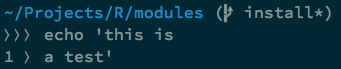
That way, I’d have a numbered multi-line prompt:
> echo 'this
1   is
2   a
3   test'
Cute. But due to the above mentioned limitation doesn’t work.
A non-working solution would be to write the count to a file instead of a variable. However, this would create a conflict between multiple, simultaneously running sessions. I could append the process ID of the shell to the file name, of course. But I’m hoping there’s a better solution which won’t clutter my system with lots of files.
Answers:
Thank you for visiting the Q&A section on Magenaut. Please note that all the answers may not help you solve the issue immediately. So please treat them as advisements. If you found the post helpful (or not), leave a comment & I’ll get back to you as soon as possible.
Method 1
To get the same output you note in your question, all that is needed is this:
PS1='${PS2c##*[$((PS2c=0))-9]}- > '
PS2='$((PS2c=PS2c+1)) > '
You need not contort. Those two lines will do it all in any shell that pretends to anything close to POSIX compatibility.
- > cat <<HD
1 >     line 1
2 >     line $((PS2c-1))
3 > HD
    line 1
    line 2
- > echo $PS2c
0
But I liked this. And I wanted to demonstrate the fundamentals of what makes this work a little better. So I edited this a little. I stuck it in /tmp for now but I think I’m going to keep it for myself, too. It’s here:
cat /tmp/prompt
PROMPT SCRIPT:
ps1() { IFS=/
    set -- ${PWD%"${last=${PWD##/*/}}"}
    printf "${1+%c/}" "<a href="https://getridbug.com/cdn-cgi/l/email-protection" class="__cf_email__" data-cfemail="547014">[email protected]</a>"
    printf "$last > "
}

PS1='$(ps1)${PS2c##*[$((PS2c=0))-9]}'
PS2='$((PS2c=PS2c+1)) > '
Note: having recently learned of yash, I built it yesterday. For whatever reason it doesn’t print the first byte of every argument with the %c string – though the docs were specific about wide-char extensions for that format and so it maybe related – but it does just fine with %.1s
That’s the whole thing. There are two main things going on up there. And this is what it looks like:
/u/s/m/man3 > cat <<HERE
1 >     line 1
2 >     line 2
3 >     line $((PS2c-1))
4 > HERE
    line 1
    line 2
    line 3
/u/s/m/man3 >
PARSING $PWD
Every time
$PS1is evaluated it parses and prints$PWDto add to the prompt. But I don’t like the whole$PWDcrowding my screen, so I want just the first letter of every breadcrumb in the current path down to the current directory, which I’d like to see in full. Like this:
/h/mikeserv > cd /etc
/etc > cd /usr/share/man/man3
/u/s/m/man3 > cd /
/ > cd ~
/h/mikeserv >
There are a few steps here:
IFS=/we’re going to have to split the current
$PWDand the most reliable way to do that is with$IFSsplit on/. No need to bother with it at all afterward – all splitting from here on out will be defined by the shell’s positional parameter[email protected]array in the next command like:
set -- ${PWD%"${last=${PWD##/*/}}"}So this one’s a little tricky, but the main thing is that we’re splitting
$PWDon/symbols. I also use parameter expansion to assign to$lasteverything after any value occurring between the left-most and right-most/slash. In this way I know that if I’m just at/and have only one/then$lastwill still equal the whole$PWDand$1will be empty. This matters. I also strip$lastfrom the tail end of$PWDbefore assigning it to[email protected].
printf "${1+%c/}" "[email protected]"So here – as long as
${1+is set}weprintfthe first%character of each our shell’s arguments – which we’ve just set to each directory in our current$PWD– less the top directory – split on/. So we’re essentially just printing the first character of every directory in$PWDbut the top one. It’s important though to realize this only happens if$1gets set at all, which will not happen at root/or at one removed from/such as in/etc.
printf "$last > "
$lastis the variable I just assigned to our top directory. So now this is our top directory. It prints whether or not the last statement did. And it takes a neat little>for good measure.
BUT WHAT ABOUT THE INCREMENT?
And then there’s the matter of the
$PS2conditional. I showed earlier how this can be done which you can still find below – this is fundamentally an issue of scope. But there’s a little more to it unless you want to start doing a bunch ofprintf backspaces and then trying to balance out their character count… ugh. So I do this:
PS1='$(ps1)${PS2c##*[$((PS2c=0))-9]}'Again,
${parameter##expansion}saves the day. It’s a little strange here though – we actually set the variable while we strip it of itself. We use its new value – set mid-strip – as the glob from which we strip. You see? We##*strip all from the head of our increment variable to the last character which can be anything from[$((PS2c=0))-9]. We’re guaranteed in this way not to output the value, and yet we still assign it. It’s pretty cool – I’ve never done that before. But POSIX also guarantees us that this is the most portable way this can be done.
And it’s thanks to POSIX-specified ${parameter} $((expansion)) that keeps these definitions in the current shell without requiring that we set them in a separate subshell, regardless of where we evaluate them. And this is why it works in dash and sh just as well as it does in bash and zsh. We use no shell/terminal dependent escapes and we let the variables test themselves. That’s what makes portable code quick.
The rest is fairly simple – just increment our counter for every time $PS2 is evaluated until $PS1 once again resets it. Like this:
PS2='$((PS2c=PS2c+1)) > '
So now I can:
DASH DEMO
ENV=/tmp/prompt dash -i

/h/mikeserv > cd /etc
/etc > cd /usr/share/man/man3
/u/s/m/man3 > cat <<HERE
1 >     line 1
2 >     line 2
3 >     line $((PS2c-1))
4 > HERE
    line 1
    line 2
    line 3
/u/s/m/man3 > printf 't%sn' "$PS1" "$PS2" "$PS2c"
    $(ps1)${PS2c##*[$((PS2c=0))-9]}
    $((PS2c=PS2c+1)) >
    0
/u/s/m/man3 > cd ~
/h/mikeserv >
SH DEMO
It works the same in bash or sh:
ENV=/tmp/prompt sh -i

/h/mikeserv > cat <<HEREDOC
1 >     $( echo $PS2c )
2 >     $( echo $PS1 )
3 >     $( echo $PS2 )
4 > HEREDOC
    4
    $(ps1)${PS2c##*[$((PS2c=0))-9]}
    $((PS2c=PS2c+1)) >
/h/mikeserv > echo $PS2c ; cd /
0
/ > cd /usr/share
/u/share > cd ~
/h/mikeserv > exit
As I said above, the primary problem is that you need to consider where you do your computation. You don’t get the state in the parent shell – so you don’t compute there. You get the state in the subshell – so that’s where you compute. But you do the definition in the parent shell.
ENV=/dev/fd/3 sh -i  3<<PROMPT
    ps1() { printf '$((PS2c=0)) > ' ; }
    ps2() { printf '$((PS2c=PS2c+1)) > ' ; }
    PS1=$(ps1)
    PS2=$(ps2)
PROMPT

0 > cat <<MULTI_LINE
1 > $(echo this will be line 1)
2 > $(echo and this line 2)
3 > $(echo here is line 3)
4 > MULTI_LINE
this will be line 1
and this line 2
here is line 3
0 >
Method 2
With this approach (function running in a subshell) you aren’t going to be able to update the master shell process’s state without going through contortions. Instead, arrange for the function to run in the master process.
The value of the PROMPT_COMMAND variable is interpereted as a command which is executed before printing the PS1 prompt.
For PS2, there’s nothing comparable. But you can use a trick instead: since all you want to do is an arithmetic operation, you can use arithmetic expansion, which doesn’t involve a subshell.
PROMPT_COMMAND='PS_COUNT=0'
PS2='$((++PS_COUNT))  '
The result of the arithmetic computation ends up in the prompt. If you want to hide it, you can pass it as an array subscript that doesn’t exist.
PS1='${nonexistent_array[$((PS_COUNT=0))]}$ '
Method 3
It’s a bit I/O-intensive, but you’ll need to use a temporary file to hold the value of the count.
ps_count_inc () {
   read ps_count < ~/.prompt_num
   echo $((++ps_count)) | tee ~/.prompt_num
}

ps_count_reset () {
   echo 0 > ~/.prompt_num
}
If you are concerned about needing a separate file per shell session (which seems like a minor concern; will you really be typing multi-line commands in two different shells at the same time?), you should use mktemp to create a new file for each use.
ps_count_reset () {
    rm -f "$prompt_count"
    prompt_count=$(mktemp)
    echo 0 > "$prompt_count"
}

ps_count_inc () {
    read ps_count < "$prompt_count"
    echo $((++ps_count)) | tee "$prompt_count"
}
Method 4
You can not use a shell variable this way and you already understand why. A subshell inherits variables exactly the same way a process inherits its environment: any changes made apply only to it and its children and not to any ancestor process.
As per other answers the easiest thing to do is stash that data in a file.
echo $count > file
count=$(<file)
Etc.
Method 5
For reference, here’s my solution using temporary files, which are unique per shell process, and deleted as soon as possible (to avoid clutter, as alluded to in the question):
# Yes, I actually need this to work across my systems. :-/
_mktemp() {
    local tmpfile="${TMPDIR-/tmp}/psfile-$$.XXX"
    local bin="$(command -v mktemp || echo echo)"
    local file="$($bin "$tmpfile")"
    rm -f "$file"
    echo "$file"
}

PS_COUNT_FILE="$(_mktemp)"

ps_count_inc() {
    local PS_COUNT
    if [[ -f "$PS_COUNT_FILE" ]]; then
        let PS_COUNT=$(<"$PS_COUNT_FILE")+1
    else
        PS_COUNT=1
    fi

    echo $PS_COUNT | tee "$PS_COUNT_FILE"
}

ps_count_reset() {
    rm -f "$PS_COUNT_FILE"
}
All methods was sourced from stackoverflow.com or stackexchange.com, is licensed under cc by-sa 2.5, cc by-sa 3.0 and cc by-sa 4.0