Does anyone know how I would go about detected what bit version Windows is under Python. I need to know this as a way of using the right folder for Program Files.
Many thanks
Answers:
Thank you for visiting the Q&A section on Magenaut. Please note that all the answers may not help you solve the issue immediately. So please treat them as advisements. If you found the post helpful (or not), leave a comment & I’ll get back to you as soon as possible.
Method 1
I think the best solution to the problem has been posted by Mark Ribau.
The best answer to the question for Python 2.7 and newer is:
def is_os_64bit():
    return platform.machine().endswith('64')
On windows the cross-platform-function platform.machine() internally uses the environmental variables used in Matthew Scoutens answer.
I found the following values:
- WinXP-32: x86
- Vista-32: x86
- Win7-64: AMD64
- Debian-32: i686
- Debian-64: x86_64
For Python 2.6 and older:
def is_windows_64bit():
    if 'PROCESSOR_ARCHITEW6432' in os.environ:
        return True
    return os.environ['PROCESSOR_ARCHITECTURE'].endswith('64')
To find the Python interpreter bit version I use:
def is_python_64bit():
    return (struct.calcsize("P") == 8)
Method 2
I guess you should look in os.environ['PROGRAMFILES'] for the program files folder.
Method 3
platform module — Access to underlying platform’s identifying data
>>> import platform
>>> platform.architecture()
('32bit', 'WindowsPE')
On 64-bit Windows, 32-bit Python returns:
('32bit', 'WindowsPE')
And that means that this answer, even though it has been accepted, is incorrect. Please see some of the answers below for options that may work for different situations.
Method 4
Came here searching for properly detecting if running on 64bit windows, compiling all the above into something more concise.
Below you will find a function to test if running on 64bit windows, a function to get the 32bit Program Files folder, and a function to get the 64bit Program Files folder; all regardless of running 32bit or 64bit python. When running 32bit python, most things report as if 32bit when running on 64bit, even os.environ['PROGRAMFILES'].
import os

def Is64Windows():
    return 'PROGRAMFILES(X86)' in os.environ

def GetProgramFiles32():
    if Is64Windows():
        return os.environ['PROGRAMFILES(X86)']
    else:
        return os.environ['PROGRAMFILES']

def GetProgramFiles64():
    if Is64Windows():
        return os.environ['PROGRAMW6432']
    else:
        return None
Note: Yes, this is a bit hackish. All other methods that “should just work”, do not work when running 32bit Python on 64bit Windows (at least for the various 2.x and 3.x versions I have tried).
Edits:
2011-09-07 – Added a note about why only this hackish method works properly.
Method 5
def os_platform():
    true_platform = os.environ['PROCESSOR_ARCHITECTURE']
    try:
            true_platform = os.environ["PROCESSOR_ARCHITEW6432"]
    except KeyError:
            pass
            #true_platform not assigned to if this does not exist
    return true_platform
http://blogs.msdn.com/b/david.wang/archive/2006/03/26/howto-detect-process-bitness.aspx
Method 6
Many of these proposed solutions, such as platform.architecture(), fail because their results depend on whether you are running 32-bit or 64-bit Python.
The only reliable method I have found is to check for the existence of os.environ[‘PROGRAMFILES(X86)’], which is unfortunately hackish.
Method 7
You should be using environment variables to access this. The program files directory is stored in the environment variable PROGRAMFILES on x86 Windows, the 32-bit program files is directory is stored in the PROGRAMFILES(X86) environment variable, these can be accessed by using os.environ('PROGRAMFILES').
Use sys.getwindowsversion() or the existence of PROGRAMFILES(X86) (if 'PROGRAMFILES(X86)' in os.environ) to determine what version of Windows you are using.
Method 8
Following this documentation, try this code:
is_64bits = sys.maxsize > 2**32
Method 9
Im aware that in comments of the question this method was already used.
This is the method the .net framework uses:
import ctypes

def is64_bit_os():
    """ Returns wethever system is a 64bit operating system"""
    is64bit = ctypes.c_bool()
    handle = ctypes.windll.kernel32.GetCurrentProcess() # should be -1, because the current process is currently defined as (HANDLE) -1
    success = ctypes.windll.kernel32.IsWow64Process(handle, ctypes.byref(is64bit)) #should return 1
    return (success and is64bit).value
print(is64_bit_os())
Method 10
I just found another way to do this, which may be useful in some situations.
import subprocess
import os

def os_arch():
    os_arch = '32-bit'
    if os.name == 'nt':
        output = subprocess.check_output(['wmic', 'os', 'get', 'OSArchitecture'])
        os_arch = output.split()[1]
    else:
        output = subprocess.check_output(['uname', '-m'])
        if 'x86_64' in output:
            os_arch = '64-bit'
        else:
            os_arch = '32-bit'
    return os_arch

print 'os_arch=%s' % os_arch()
I tested this code in the following environments:
- Ubuntu 16.04 + Python 2.7.12
- Mac OS Sierra + Python 2.7.11
- Windows 7 Pro 32-bit + Python 2.7.5 (32-bit)
- Windows 10 Home 64-bit + Python 2.7.13 (32-bit)
Method 11
The subject lines asks about detecting 64 or 32bit OS, while the body talks about determining the location of ProgramFiles. The latter has a couple of workable answers here. I’d like to add another solution generalized to handle StartMenu, Desktop, etc. as well as ProgramFiles: How to get path of Start Menu’s Programs directory?
Method 12
When you need to find out things about windows system, it is usually somewhere in the registry, according to MS documentation, you should look at (http://support.microsoft.com/kb/556009) this key value:
HKLMHARDWAREDESCRIPTIONSystemCentralProcessor
and if it is:
0x00000020 (32 in decimal)
It is a 32 bit machine.
Method 13
64-bit versions of Windows use something called registry redirection and reflection keys. There is a compatibility layer called WoW64 which enables compatibility of 32-bit applications. Starting from Windows 7 and Windows Server 2008 R2 WoW64 registry keys are not longer reflected but shared. You can read about it here:
registry-reflection: msdn.microsoft.com/en-us/library/aa384235(v=vs.85).aspx
affected-keys: msdn.microsoft.com/en-us/library/aa384253(v=vs.85).aspx
wikipedia: en.wikipedia.org/wiki/WoW64
All you need to do is detect existence of those keys. You can use _winreg for that. Use try: and try opening key, example:
try:
aReg = _winreg.OpenKey(_winreg.HKEY_LOCAL_MACHINE,"SOFTWARE\Wow6432Node\Microsoft\Windows\CurrentVersion\Run")
Method 14
 import _winreg
 def get_registry_value(key, subkey, value):
   key = getattr(_winreg, key)
   handle = _winreg.OpenKey(key, subkey )
   (value, type) = _winreg.QueryValueEx(handle, value)
   return value

 windowsbit=cputype = get_registry_value(
        "HKEY_LOCAL_MACHINE",
        "SYSTEM\CurrentControlSetControl\Session Manager\Environment",
        "PROCESSOR_ARCHITECTURE")
 print windowsbit
just run this code
if you are working on 64 bit windows machine this will print AMD64
or if you are working on 32 bit it will print AMD32
i hope this code can help to solve this problem fully
Method 15
This works for me in the Python versions I use: 2.7 and 2.5.4
    import win32com.client
    import _winreg

    shell = win32com.client.Dispatch('WScript.Shell')
    proc_arch = shell.ExpandEnvironmentStrings(r'%PROCESSOR_ARCHITECTURE%').lower()

    if proc_arch == 'x86':
        print "32 bit"
    elif proc_arch == 'amd64':
        print "64 bit"
    else:
        raise Exception("Unhandled arch: %s" % proc_arch)
Method 16
Just to update this old thread – it looks like the platform module reports the correct architecture now (at least, in Python 2.7.8):
c:python27python.exe -c "import platform; print platform.architecture(), platform.python_version()"
('32bit', 'WindowsPE') 2.7.6

c:homepython278-x64python.exe -c "import platform; print platform.architecture(), platform.python_version()"
('64bit', 'WindowsPE') 2.7.8
(sorry I don’t have the rep to comment on the first answer which still claims to be wrong 🙂
Method 17
import platform

platform.architecture()[0]
It will return ’32bit’ or ’64bit’ depending on system architecture.
Method 18
The solution posted by Alexander Brüsch is the correct solution, but it has a bug that only reveals itself on python3.x. He neglected to cast the returned value from GetCurrentProcess() to a HANDLE type. Passing a simple integer as the first parameter of IsWow64Process() returns 0 (which is an error flag from win32api). Also, Alexander incorrectly handles the return statement (success has no .value attribute).
For those who stumble on this thread, here is the corrected code:
import ctypes

def is64_bit_os():
    """Returns True if running 32-bit code on 64-bit operating system"""
    is64bit = ctypes.c_bool()
    handle = ctypes.wintypes.HANDLE(ctypes.windll.kernel32.GetCurrentProcess())
    success = ctypes.windll.kernel32.IsWow64Process(handle, ctypes.byref(is64bit))
    return success and is64bit.value
print(is64_bit_os())
Method 19
There is a function named machine in platform module. I installed both Python3.8 32-bit and 64-bit versions on the same 64-bit machine with 64-bit Windows 10 and here is what I found:
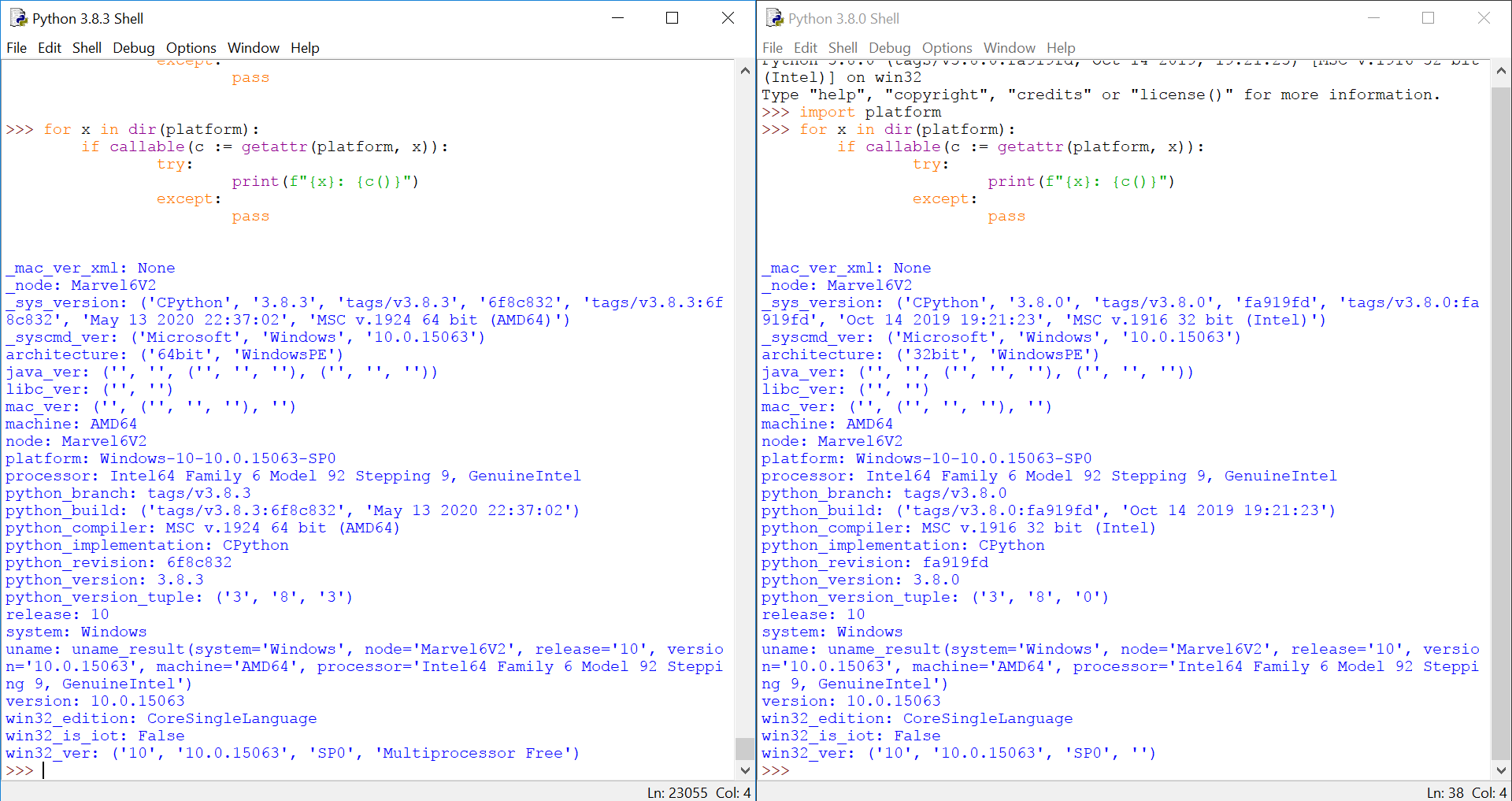
And it looks like platform.machine returns machine architecture without bothering what type of python is installed. so here is my
final compilation
import platform

def is_64bit():
    return platform.machine().endswith('64')
Method 20
Most of the answers here are incorrect :/
Here is a simple translation of the well known method used in CMD and this is how microsoft do it too.
import os
_os_bit=64
if os.environ.get('PROCESSOR_ARCHITECTURE').lower() == 'x86' and os.environ.get('PROCESSOR_ARCHITEW6432') is None: _os_bit=32

print(_os_bit)
but remember: Windows 10 on ARM includes an x86-on-ARM64 emulation, so the possible values for PROCESSOR_ARCHITECTURE are: AMD64 or IA64 or ARM64 or x86
Method 21
import struct

def is64Windows():
    return struct.calcsize('P') * 8 == 64
Method 22
There should be a directory under Windows 64bit, a Folder called WindowsWinSxS64 for 64 bit, under Windows 32bit, it’s WinSxS.
All methods was sourced from stackoverflow.com or stackexchange.com, is licensed under cc by-sa 2.5, cc by-sa 3.0 and cc by-sa 4.0