How do I display localhost traffic in Fiddler while debugging an ASP.NET application?
Answers:
Thank you for visiting the Q&A section on Magenaut. Please note that all the answers may not help you solve the issue immediately. So please treat them as advisements. If you found the post helpful (or not), leave a comment & I’ll get back to you as soon as possible.
Method 1
try using this:
http://ipv4.fiddler/folder
instead of
http://localhost/folder
this also works with ports
http://ipv4.fiddler:12345/folder
Here is link to fiddler documentation
http://docs.telerik.com/fiddler/Configure-Fiddler/Tasks/MonitorLocalTraffic
Method 2
To make Fiddler work on localhost with IIS Express you should use this form of URL
http://localhost.fiddler:50262/
This puts correct Host header value (localhost) which satisfies IIS Express.
Method 3
Start Fiddler.
Go to Tools–> Fiddler Options.
Choose Connections tab.
Check the ‘USe PAC Script’ option.
Now you will be able to monitor local traffic as well
Method 4
For an ASP.NET web site project:
1) Right-click the project and select Property Pages
2) Select Start Options
3) Under the Server section, click the “Use custom server” and edit the Base URL by replacing localhost with your computer’s name.
Method 5
Probably the easiest way to monitor traffic to localhost is to replace “localhost” with “localhost.” in the browser’s URL bar. E.g.
http://localhost./MyApp/default.aspx
Method 6
Using Fiddler v4:
- Check your IE proxy settings
IE->Tools->Internet Options->Connections->Lan Settings
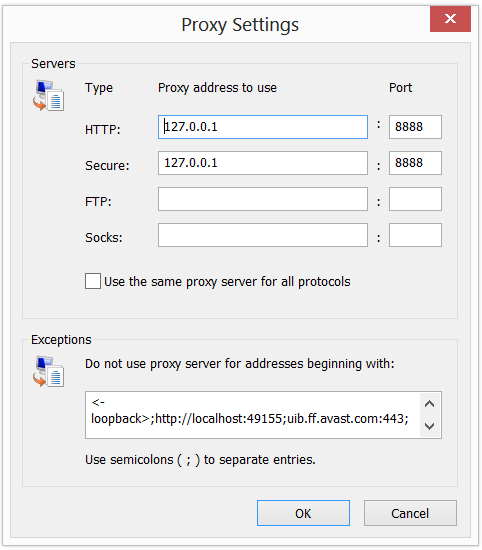
- Check your settings in Fiddler:
Fiddler -> Options-> Connections & Https
Check the Fiddler port, default is 8888
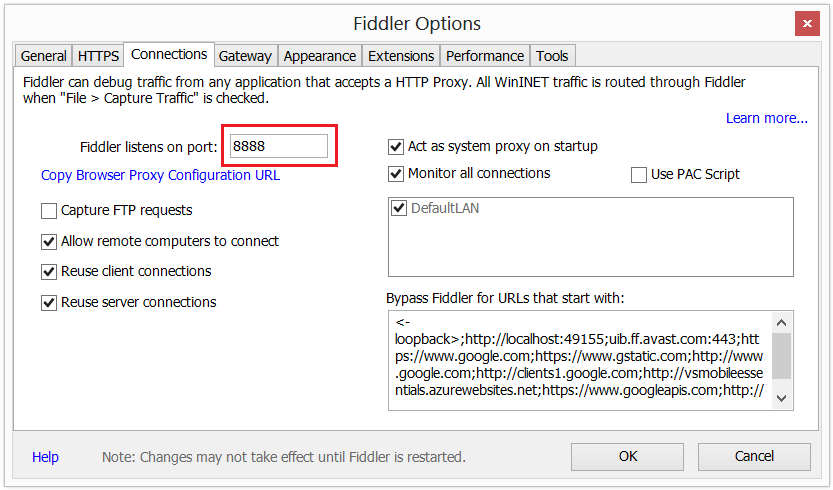
- In Fiddler-Menu:
File -> Capture Traffic is checked
The following solution worked for me, when using a
- HttpClient or
- WebClient
from inside an ASP.NET application.
Web.config
<system.net>
    <defaultProxy
                enabled = "true"
                useDefaultCredentials = "true">
      <proxy autoDetect="False" bypassonlocal="False" proxyaddress="http://127.0.0.1:8888" usesystemdefault="False" />
    </defaultProxy>
Code:
var resourceServerUri = new Uri("http://localhost.fiddler:YourAppServicePort");
var body = c.GetStringAsync(new Uri(resourceServerUri)).Result;
Check if your request actually reaches fiddler by customizing the Fiddler Rules script
Fiddler->Rules->Customize Rules
and hook into the OnBeforeRequest event:
static function OnBeforeRequest(oSession: Session) {

if (oSession.hostname.Contains("localhost:YourPortNumber")
{
 System.Windows.Forms.MessageBox.Show(oSession.hostname);
}
Or explicitly by setting a web proxy
WebClient wc = new WebClient();

WebProxy proxy = new WebProxy();
// try one of these URIs
proxy.Address = new Uri("http://127.0.0.1:8888");
proxy.Address = new Uri("http://hostname:8888");
proxy.Address = new Uri("http://localhost.fiddler");
proxy.Address = new Uri("http://ipv4.fiddler");
// https://en.wikipedia.org/wiki/IPv6
proxy.Address = new Uri("http://ipv6.fiddler");

proxy.BypassProxyOnLocal = false; wc.Proxy = proxy;
var b = wc.DownloadString(new Uri(YourResourceServerBaseAddress));
Method 7
Check out this link…the ‘workaround’ is hacky, but it does work:
Tip for using Fiddler on localhost
Method 8
You may use PC hostname instead of 127.0.0.1 or localhost
Method 9
Checking the “Use PAC Script” in Fiddler Options -> Connections worked for me when using IIS Express within a corporate intranet.
Method 10
Ensure that in your Fiddler Connections that localhost isn’t in the “IE should bypass Fiddler for URLs that start with:” box.
Method 11
You should uncheck the checkbox:
Bypass proxy server for local addresses
Located at proxy configuration of Internet Explorer.
Method 12
Try with http://127.0.0.1. <– note the . at the end
So you can still connect to Casini and debug easily (I’m currently debugging page on http://127.0.0.1.:1718/login/Default.aspx ).
Method 13
One of the possible solutions is remove the proxy settings in IE as follows.
IE->Tools->Internet Options->Connections->Lan Settings->
disable following
- Automatically detect settings
- Use automatic configuration script
Method 14
If trying to catpure HTTPS traffic on a local machine from BizTalk using Fiddler, try using the WCF Adapter Proxy settings. I used an address of: http://localhost:8888/
All methods was sourced from stackoverflow.com or stackexchange.com, is licensed under cc by-sa 2.5, cc by-sa 3.0 and cc by-sa 4.0