I’m trying to fit the distribution of some experimental values with a custom probability density function. Obviously, the integral of the resulting function should always be equal to 1, but the results of simple scipy.optimize.curve_fit(function, dataBincenters, dataCounts) never satisfy this condition.
What is the best way to solve this problem?
Answers:
Thank you for visiting the Q&A section on Magenaut. Please note that all the answers may not help you solve the issue immediately. So please treat them as advisements. If you found the post helpful (or not), leave a comment & I’ll get back to you as soon as possible.
Method 1
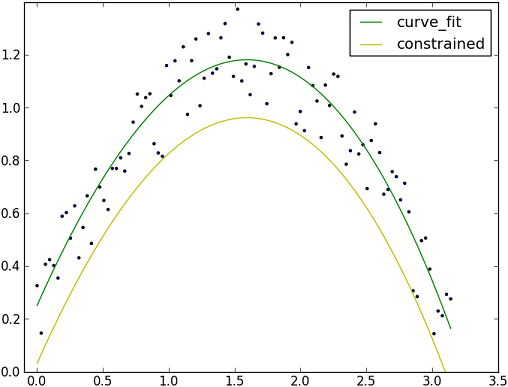
You can define your own residuals function, including a penalization parameter, like detailed in the code below, where it is known beforehand that the integral along the interval must be 2.. If you test without the penalization you will see that what your are getting is the conventional curve_fit:
import matplotlib.pyplot as plt
import scipy
from scipy.optimize import curve_fit, minimize, leastsq
from scipy.integrate import quad
from scipy import pi, sin
x = scipy.linspace(0, pi, 100)
y = scipy.sin(x) + (0. + scipy.rand(len(x))*0.4)
def func1(x, a0, a1, a2, a3):
    return a0 + a1*x + a2*x**2 + a3*x**3

# here you include the penalization factor
def residuals(p,x,y):
    integral = quad( func1, 0, pi, args=(p[0],p[1],p[2],p[3]))[0]
    penalization = abs(2.-integral)*10000
    return y - func1(x, p[0],p[1],p[2],p[3]) - penalization

popt1, pcov1 = curve_fit( func1, x, y )
popt2, pcov2 = leastsq(func=residuals, x0=(1.,1.,1.,1.), args=(x,y))
y_fit1 = func1(x, *popt1)
y_fit2 = func1(x, *popt2)
plt.scatter(x,y, marker='.')
plt.plot(x,y_fit1, color='g', label='curve_fit')
plt.plot(x,y_fit2, color='y', label='constrained')
plt.legend(); plt.xlim(-0.1,3.5); plt.ylim(0,1.4)
print 'Exact   integral:',quad(sin ,0,pi)[0]
print 'Approx integral1:',quad(func1,0,pi,args=(popt1[0],popt1[1],
                                                popt1[2],popt1[3]))[0]
print 'Approx integral2:',quad(func1,0,pi,args=(popt2[0],popt2[1],
                                                popt2[2],popt2[3]))[0]
plt.show()

#Exact   integral: 2.0
#Approx integral1: 2.60068579748
#Approx integral2: 2.00001911981
Other related questions:
Method 2
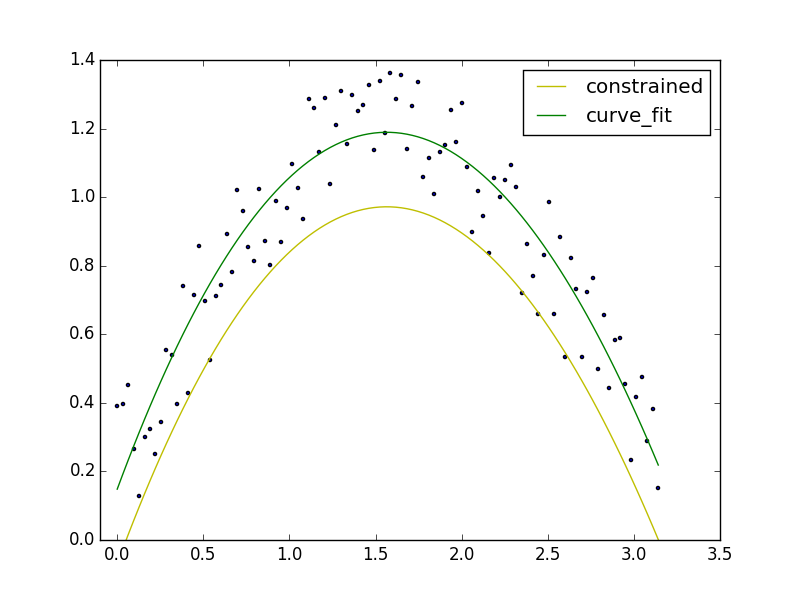
Here is an almost-identical snippet which makes only use of curve_fit.
import matplotlib.pyplot as plt
import numpy as np
import scipy.optimize as opt
import scipy.integrate as integr


x = np.linspace(0, np.pi, 100)
y = np.sin(x) + (0. + np.random.rand(len(x))*0.4)

def Func(x, a0, a1, a2, a3):
    return a0 + a1*x + a2*x**2 + a3*x**3

# modified function definition with Penalization
def FuncPen(x, a0, a1, a2, a3):
    integral = integr.quad( Func, 0, np.pi, args=(a0,a1,a2,a3))[0]
    penalization = abs(2.-integral)*10000
    return a0 + a1*x + a2*x**2 + a3*x**3 + penalization


popt1, pcov1 = opt.curve_fit( Func, x, y )
popt2, pcov2 = opt.curve_fit( FuncPen, x, y )

y_fit1 = Func(x, *popt1)
y_fit2 = Func(x, *popt2)

plt.scatter(x,y, marker='.')
plt.plot(x,y_fit2, color='y', label='constrained')
plt.plot(x,y_fit1, color='g', label='curve_fit')
plt.legend(); plt.xlim(-0.1,3.5); plt.ylim(0,1.4)
print 'Exact   integral:',integr.quad(np.sin ,0,np.pi)[0]
print 'Approx integral1:',integr.quad(Func,0,np.pi,args=(popt1[0],popt1[1],
                                                popt1[2],popt1[3]))[0]
print 'Approx integral2:',integr.quad(Func,0,np.pi,args=(popt2[0],popt2[1],
                                                popt2[2],popt2[3]))[0]
plt.show()

#Exact   integral: 2.0
#Approx integral1: 2.66485028754
#Approx integral2: 2.00002116217
Method 3
Following the example above here is more general way to add any constraints:
from scipy.optimize import minimize
from scipy.integrate import quad
import matplotlib.pyplot as plt
import numpy as np

x = np.linspace(0, np.pi, 100)
y = np.sin(x) + (0. + np.random.rand(len(x))*0.4)

def func_to_fit(x, params):
    return params[0] + params[1] * x + params[2] * x ** 2 + params[3] * x ** 3

def constr_fun(params):
    intgrl, _ = quad(func_to_fit, 0, np.pi, args=(params,))
    return intgrl - 2

def func_to_minimise(params, x, y):
    y_pred = func_to_fit(x, params)
    return np.sum((y_pred - y) ** 2)

# Do the parameter fitting
#without constraints
res1 = minimize(func_to_minimise, x0=np.random.rand(4), args=(x, y))
params1 = res1.x
# with constraints
cons = {'type': 'eq', 'fun': constr_fun}
res2 = minimize(func_to_minimise, x0=np.random.rand(4), args=(x, y), constraints=cons)
params2 = res2.x

y_fit1 = func_to_fit(x, params1)
y_fit2 = func_to_fit(x, params2)

plt.scatter(x,y, marker='.')
plt.plot(x, y_fit2, color='y', label='constrained')
plt.plot(x, y_fit1, color='g', label='curve_fit')
plt.legend(); plt.xlim(-0.1,3.5); plt.ylim(0,1.4)
plt.show()
print(f"Constrant violation: {constr_fun(params1)}")
Constraint violation: -2.9179325622408214e-10
Method 4
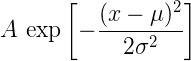
If you are able normalise your probability fitting function in advance then you can use this information to constrain your fit. A very simple example of this would be fitting a Gaussian to data. If one were to fit the following three-parameter (A, mu, sigma) Gaussian then it would be unnormalised in general:
however, if one instead enforces the normalisation condition on A:
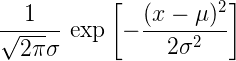
then the Gaussian is only two parameter and is automatically normalised.
Method 5
You could ensure that your fitted probability distribution is normalised via a numerical integration. For example, assuming that you have data x and y and that you have defined an unnormalised_function(x, a, b) with parameters a and b for your probability distribution, which is defined on the interval x1 to x2 (which could be infinite):
from scipy.optimize import curve_fit
from scipy.integrate import quad

# Define a numerically normalised function
def normalised_function(x, a, b):
    normalisation, _ = quad(lambda x: unnormalised_function(x, a, b), x1, x2)
    return unnormalised_function(x, a, b)/normalisation

# Do the parameter fitting
fitted_parameters, _ = curve_fit(normalised_function, x, y)
All methods was sourced from stackoverflow.com or stackexchange.com, is licensed under cc by-sa 2.5, cc by-sa 3.0 and cc by-sa 4.0