Were I root, I could simply create a dummy user/group, set file permissions accordingly and execute the process as that user. However I am not, so is there any way to achieve this without being root?
Answers:
Thank you for visiting the Q&A section on Magenaut. Please note that all the answers may not help you solve the issue immediately. So please treat them as advisements. If you found the post helpful (or not), leave a comment & I’ll get back to you as soon as possible.
Method 1
More similar Qs with more answers worth attention:
- https://stackoverflow.com/q/3859710/94687
- https://stackoverflow.com/q/4410447/94687
- https://stackoverflow.com/q/4249063/94687
- https://stackoverflow.com/q/1019707/94687
NOTE: Some of the answers there point to specific solutions not yet mentioned here.
Actually, there are quite a few jailing tools with different implementation, but many of them are either not secure by design (like fakeroot, LD_PRELOAD-based), or not complete (like fakeroot-ng, ptrace-based), or would require root (chroot, or plash mentioned at fakechroot warning label).
These are just examples; I thought of listing them all side-by-side, with indication of these 2 features (“can be trusted?”, “requires root to set up?”), perhaps at Operating-system-level virtualization Implementations.
In general, the answers there cover the full described range of possibilities and even more:
virtual machines/OS
kernel extension (like SELinux)
- (mentioned in comments here),
chroot
Chroot-based helpers (which however must be setUID root, because chroot requires root; or perhaps chroot could work in an isolated namespace–see below):
[to tell a little more about them!]
Known chroot-based isolation tools:
- hasher with its
hsh-runandhsh-shellcommands. (Hasher was designed for building software in a safe and repeatable manner.) - schroot mentioned in another answer
- …
ptrace
Another trustworthy isolation solution (besides a seccomp-based one) would be the complete syscall-interception through ptrace, as explained in the manpage for fakeroot-ng:
Unlike previous implementations, fakeroot-ng uses a
technology that leaves the
traced process no choice regarding whether it will use
fakeroot-ng’s “services” or
not. Compiling a program statically, directly calling the
kernel and manipulating
ones own address space are all techniques that can be trivially
used to bypass
LD_PRELOAD based control over a process, and do not apply to
fakeroot-ng. It is,
theoretically, possible to mold fakeroot-ng in such a way as to have
total control
over the traced process.While it is theoretically possible, it has not been done.
Fakeroot-ng does assume
certain “nicely behaved” assumptions about the process being
traced, and a process
that break those assumptions may be able to, if not totally escape
then at least
circumvent some of the “fake” environment imposed on it by
fakeroot-ng. As such,
you are strongly warned against using fakeroot-ng as a
security tool. Bug reports
that claim that a process can deliberatly (as opposed to inadvertly)
escape fake‐
root-ng’s control will either be closed as “not a bug” or marked as
low priority.It is possible that this policy be rethought in the future. For
the time being,
however, you have been warned.
Still, as you can read it, fakeroot-ng itself is not designed for this purpose.
(BTW, I wonder why they have chosen to use the seccomp-based approach for Chromium rather than a ptrace-based…)
Of the tools not mentioned above, I have noted Geordi for myself, because I liked that the controlling program is written in Haskell.
Known ptrace-based isolation tools:
- Geordi
- proot
fakeroot-ng- … (see also How to achieve the effect of chroot in userspace in Linux (without being root)?)
seccomp
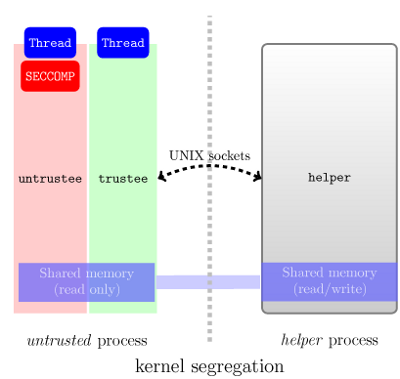
One known way to achieve isolation is through the seccomp sandboxing approach used in Google Chromium. But this approach supposes that you write a helper which would process some (the allowed ones) of the “intercepted” file access and other syscalls; and also, of course, make effort to “intercept” the syscalls and redirect them to the helper (perhaps, it would even mean such a thing as replacing the intercepted syscalls in the code of the controlled process; so, it doesn’t sound to be quite simple; if you are interested, you’d better read the details rather than just my answer).
More related info (from Wikipedia):
- http://en.wikipedia.org/wiki/Seccomp
- http://code.google.com/p/seccompsandbox/wiki/overview
- LWN article: Google’s Chromium sandbox, Jake Edge, August 2009
- seccomp-nurse, a sandboxing framework based on seccomp.
(The last item seems to be interesting if one is looking for a general seccomp-based solution outside of Chromium. There is also a blog post worth reading from the author of “seccomp-nurse”: SECCOMP as a Sandboxing solution ?.)
The illustration of this approach from the “seccomp-nurse” project:
A “flexible” seccomp possible in the future of Linux?
There used to appear in 2009 also suggestions to patch the Linux kernel so that there is more flexibility to the seccomp mode–so that “many of the acrobatics that we currently need could be avoided”. (“Acrobatics” refers to the complications of writing a helper that has to execute many possibly innocent syscalls on behalf of the jailed process and of substituting the possibly innocent syscalls in the jailed process.) An LWN article wrote to this point:
One suggestion that came out was to
add a new “mode” to seccomp. The API
was designed with the idea that
different applications might have
different security requirements; it
includes a “mode” value which
specifies the restrictions that should
be put in place. Only the original
mode has ever been implemented, but
others can certainly be added.
Creating a new mode which allowed the
initiating process to specify which
system calls would be allowed would
make the facility more useful for
situations like the Chrome sandbox.Adam Langley (also of Google) has
posted a patch which does just that.
The new “mode 2” implementation
accepts a bitmask describing which
system calls are accessible. If one of
those is prctl(), then the sandboxed
code can further restrict its own
system calls (but it cannot restore
access to system calls which have been
denied). All told, it looks like a
reasonable solution which could make
life easier for sandbox developers.That said, this code may never be
merged because the discussion has
since moved on to other possibilities.
This “flexible seccomp” would bring the possibilities of Linux closer to providing the desired feature in the OS, without the need to write helpers that complicated.
(A blog posting with basically the same content as this answer: http://geofft.mit.edu/blog/sipb/33.)
Isolating through namespaces (unshare-based solutions) — not mentioned here — e.g., unsharing mount-points (combined with FUSE?) could perhaps be a part of a working solution for you wanting to confine filesystem accesses of your untrusted processes.
More on namespaces, now, as their implementation has been completed (this isolation technique is also known under the nme “Linux Containers”, or “LXC”, isn’t it?..):
It’s even possible to create a new user namespace, so that “a process can have a normal unprivileged user ID outside a user namespace while at the same time having a user ID of 0 inside the namespace. This means that the process has full root privileges for operations inside the user namespace, but is unprivileged for operations outside the namespace”.
For real working commands to do this, see the answers at:
- Is there a linux vfs tool that allows bind a directory in different location (like mount –bind) in user space?
- Simulate chroot with unshare
and special user-space programming/compiling
But well, of course, the desired “jail” guarantees are implementable by programming in user-space (without additional support for this feature from the OS; maybe that’s why this feature hasn’t been included in the first place in the design of OSes); with more or less complications.
The mentioned ptrace– or seccomp-based sandboxing can be seen as some variants of implementing the guarantees by writing a sandbox-helper that would control your other processes, which would be treated as “black boxes”, arbitrary Unix programs.
Another approach could be to use programming techniques that can care about the effects that must be disallowed. (It must be you who writes the programs then; they are not black boxes anymore.) To mention one, using a pure programming language (which would force you to program without side-effects) like Haskell will simply make all the effects of the program explicit, so the programmer can easily make sure there will be no disallowed effects.
I guess, there are sandboxing facilities available for those programming in some other language, e.g., Java.
- Cf. “Sandboxed Haskell” project proposal.
- NaCl–not mentioned here–belongs to this group, doesn’t it?
Some pages accumulating info on this topic were also pointed at in the answers there:
Method 2
This is a fundamental limitation of the unix permission model: only root can delegate.
You don’t need to be root to run a virtual machine (not true of all VM technologies), but this is a heavyweight solution.
User-mode Linux is a relatively lightweight Linux-on-Linux virtualization solution. It’s not that easy to set up; you’ll need to populate a root partition (in a directory) with at least the minimum needed to boot (a few files in /etc, /sbin/init and its dependencies, a login program, a shell and utilities).
Method 3
I guess you can have some luck with LD_PRELOAD to intercept access to certain files, but this might be really tricky.
Method 4
Firejail is nice tool to jail any process, with or without root access with a lot of options and very flexible:
Method 5
From the complete list I would just add :
- fakeroot (from debian package maintener) : it aims at building package with “friendly” tools. This is not a complete isolation, but it helps building packages with different users and fake devices and other special pseudo-files.
- fakechroot (which uses fakeroot). This program has many bugs. For example, “/etc/hosts” is hardcoded in glibc : you cannot change it through this tool.
- qemu : you need to compile a linux kernel, but the result is very fast, and this is a “fake” (ie virtual) machine with real root privileges. You can build and mount any boot image.
All methods was sourced from stackoverflow.com or stackexchange.com, is licensed under cc by-sa 2.5, cc by-sa 3.0 and cc by-sa 4.0