I am trying to use IPython notebook on MacOS X with Python 2.7.2 and IPython 1.1.0.
I cannot get matplotlib graphics to show up inline.
import matplotlib
import numpy as np
import matplotlib.pyplot as plt
%matplotlib inline
I have also tried %pylab inline and the ipython command line arguments --pylab=inline but this makes no difference.
x = np.linspace(0, 3*np.pi, 500)
plt.plot(x, np.sin(x**2))
plt.title('A simple chirp')
plt.show()
Instead of inline graphics, I get this:
<matplotlib.figure.Figure at 0x110b9c450>
And matplotlib.get_backend() shows that I have the 'module://IPython.kernel.zmq.pylab.backend_inline' backend.
Answers:
Thank you for visiting the Q&A section on Magenaut. Please note that all the answers may not help you solve the issue immediately. So please treat them as advisements. If you found the post helpful (or not), leave a comment & I’ll get back to you as soon as possible.
Method 1
I used %matplotlib inline in the first cell of the notebook and it works. I think you should try:
%matplotlib inline

import matplotlib
import numpy as np
import matplotlib.pyplot as plt
You can also always start all your IPython kernels in inline mode by default by setting the following config options in your config files:
c.IPKernelApp.matplotlib=<CaselessStrEnum>
  Default: None
  Choices: ['auto', 'gtk', 'gtk3', 'inline', 'nbagg', 'notebook', 'osx', 'qt', 'qt4', 'qt5', 'tk', 'wx']
  Configure matplotlib for interactive use with the default matplotlib backend.
Method 2
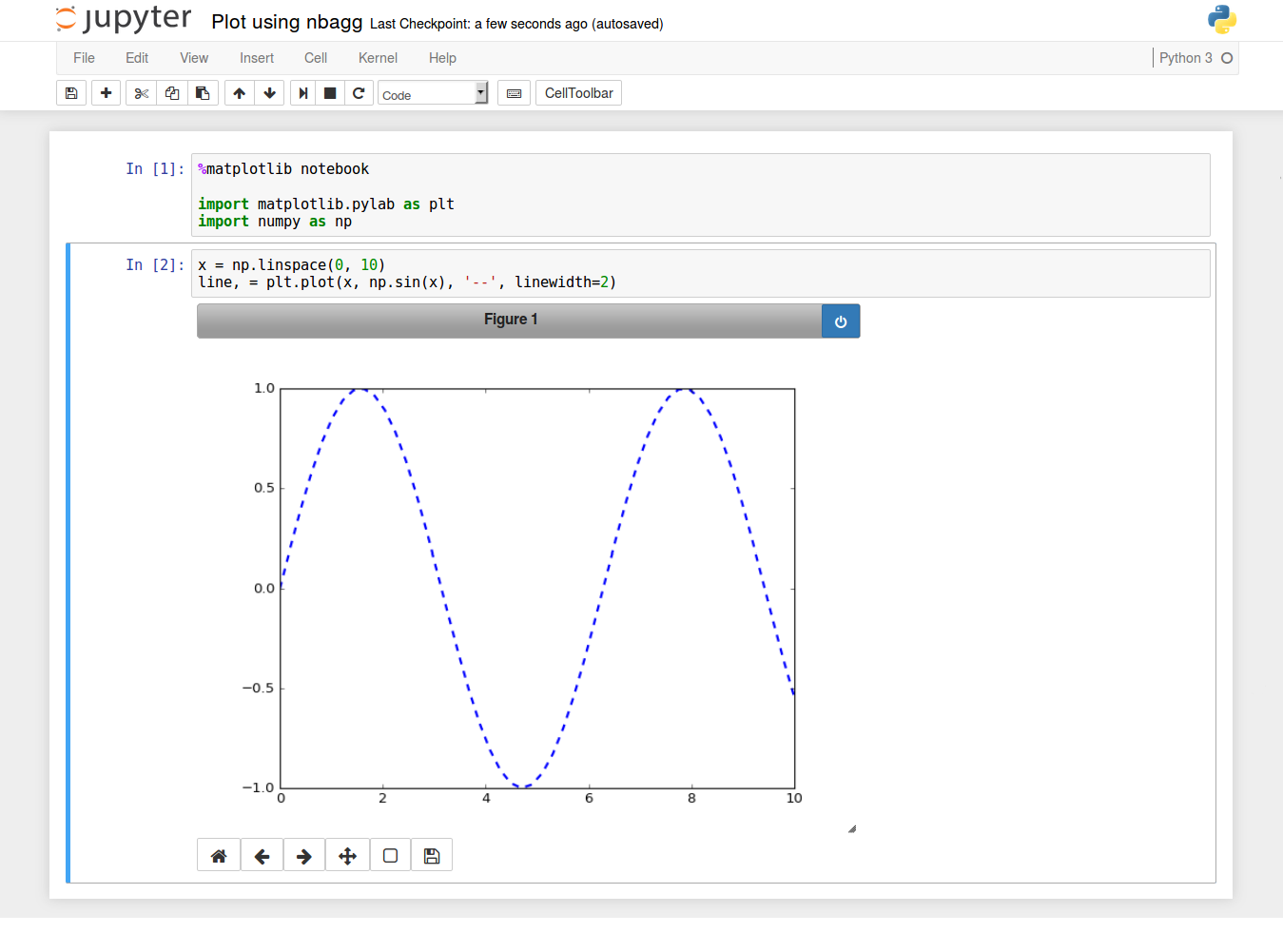
If your matplotlib version is above 1.4, it is also possible to use
IPython 3.x and above
%matplotlib notebook

import matplotlib.pyplot as plt
older versions
%matplotlib nbagg

import matplotlib.pyplot as plt
Both will activate the nbagg backend, which enables interactivity.
Method 3
Ctrl + Enter
%matplotlib inline
Magic Line 😀
See: Plotting with Matplotlib.
Method 4
Use the %pylab inline magic command.
Method 5
To make matplotlib inline by default in Jupyter (IPython 3):
-
Edit file
~/.ipython/profile_default/ipython_config.py -
Add line
c.InteractiveShellApp.matplotlib = 'inline'
Please note that adding this line to ipython_notebook_config.py would not work.
Otherwise it works well with Jupyter and IPython 3.1.0
Method 6
I have to agree with foobarbecue (I don’t have enough recs to be able to simply insert a comment under his post):
It’s now recommended that python notebook isn’t started wit the argument --pylab, and according to Fernando Perez (creator of ipythonnb) %matplotlib inline should be the initial notebook command.
Method 7
I found a workaround that is quite satisfactory. I installed Anaconda Python and this now works out of the box for me.
Method 8
I did the anaconda install but matplotlib is not plotting
It starts plotting when i did this
import matplotlib
import numpy as np
import matplotlib.pyplot as plt
%matplotlib inline
Method 9
I had the same problem when I was running the plotting commands in separate cells in Jupyter:
In [1]:  %matplotlib inline
         import matplotlib
         import matplotlib.pyplot as plt
         import numpy as np
In [2]:  x = np.array([1, 3, 4])
         y = np.array([1, 5, 3])
In [3]:  fig = plt.figure()
         <Figure size 432x288 with 0 Axes>                      #this might be the problem
In [4]:  ax = fig.add_subplot(1, 1, 1)
In [5]:  ax.scatter(x, y)
Out[5]:  <matplotlib.collections.PathCollection at 0x12341234>  # CAN'T SEE ANY PLOT :(
In [6]:  plt.show()                                             # STILL CAN'T SEE IT :(
The problem was solved by merging the plotting commands into a single cell:
In [1]:  %matplotlib inline
         import matplotlib
         import matplotlib.pyplot as plt
         import numpy as np
In [2]:  x = np.array([1, 3, 4])
         y = np.array([1, 5, 3])
In [3]:  fig = plt.figure()
         ax = fig.add_subplot(1, 1, 1)
         ax.scatter(x, y)
Out[3]:  <matplotlib.collections.PathCollection at 0x12341234>
         # AND HERE APPEARS THE PLOT AS DESIRED :)
Method 10
You can simulate this problem with a syntax mistake, however, %matplotlib inline won’t resolve the issue.
First an example of the right way to create a plot. Everything works as expected with the imports and magic that eNord9 supplied.
df_randNumbers1 = pd.DataFrame(np.random.randint(0,100,size=(100, 6)), columns=list('ABCDEF'))

df_randNumbers1.ix[:,["A","B"]].plot.kde()
However, by leaving the () off the end of the plot type you receive a somewhat ambiguous non-error.
Erronious code:
df_randNumbers1.ix[:,["A","B"]].plot.kde
Example error:
<bound method FramePlotMethods.kde of <pandas.tools.plotting.FramePlotMethods object at 0x000001DDAF029588>>
Other than this one line message, there is no stack trace or other obvious reason to think you made a syntax error. The plot doesn’t print.
Method 11
If you’re using Jupyter notebooks in Visual Studio Code (VSCode) then the inline backend doesn’t seem to work so you need to specify widget/ipympl (which you may need to install support for e.g. pip install ipympl):
%matplotlib widget
All methods was sourced from stackoverflow.com or stackexchange.com, is licensed under cc by-sa 2.5, cc by-sa 3.0 and cc by-sa 4.0