I don’t understand iotop output: it shows ~1.5 MB/s of disk write (top right), but all programs have 0.00 B/s. Why?
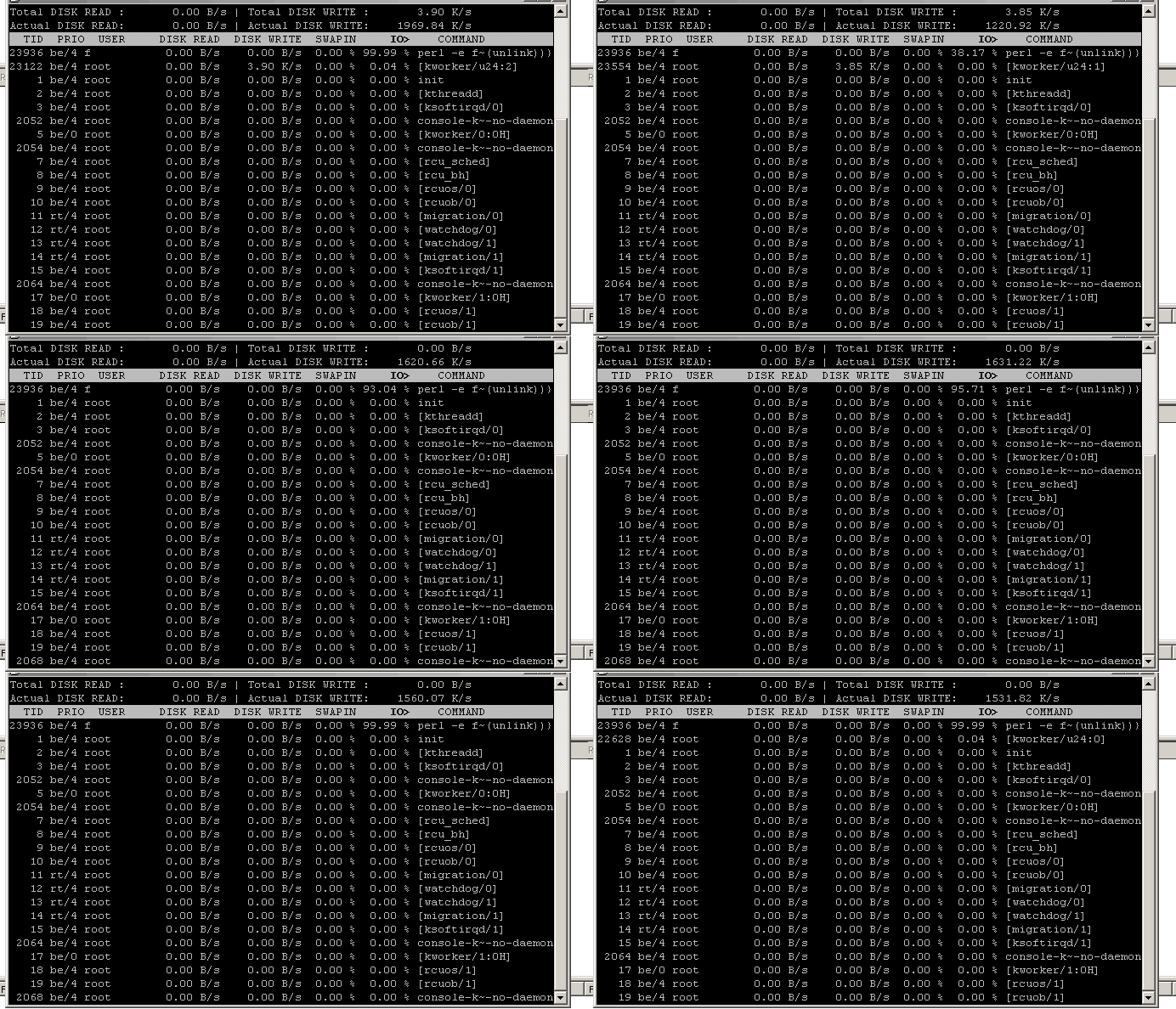
The video was taken as I was deleting the content of a folder with a few millions of files using perl -e 'for(<*>){((stat)[9]<(unlink))}', on Kubuntu 14.04.3 LTS x64.
iotop was launched using sudo iotop.
Answers:
Thank you for visiting the Q&A section on Magenaut. Please note that all the answers may not help you solve the issue immediately. So please treat them as advisements. If you found the post helpful (or not), leave a comment & I’ll get back to you as soon as possible.
Method 1
The information shown by iotop isn’t gathered in the same way for individual processes and for the system as a whole. The “actual” global figures are not the sum of the per-process figures (that’s what “total” is).
All information is gathered from the proc filesystem.
- For each process, iotop reads data from
/proc/PID/io, specifically thercharandwcharvalues. These are the number of bytes passed inreadandwritesystem calls (including variants such asreadv,writev,recv,send, etc.). - The global “actual” values are read from
/proc/vmstat, specifically thepgpginandpgpgoutvalues. These measure the data exchanged between the kernel and the hardware (more precisely, this is the data shuffled around by the block device layer in the kernel).
There are many reasons why the per-process data and the block device layer data differ. In particular:
- Caching and buffering mean that I/O happening at one layer may not be happening at the same time, or the same number of times, at the other layer. For example, data read from the cache is accounted as a read from the process that accesses it, but there’s no corresponding read from the hardware (that already happened earlier, possibly on behalf of another process).
- The process-level data includes data exchanged on pipes, sockets, and other input/output that doesn’t involve an underlying disk or other block device.
- The process-level data only accounts for file contents, not metadata.
That last difference explains what you’re seeing here. Removing files only affects metadata, not data, so the process isn’t writing anything. It may be reading directory contents to list the files to delete, but that’s small enough that it may scroll by unnoticed.
I don’t think Linux offers any way to monitor file metadata updates. You can monitor per-filesystem I/O via entries under /sys/fs for some filesystems. I don’t think you can account metadata I/O against specific processes, it would be very complicated to do in the general case since multiple processes could be causing the same metadata to be read or changed.
All methods was sourced from stackoverflow.com or stackexchange.com, is licensed under cc by-sa 2.5, cc by-sa 3.0 and cc by-sa 4.0