This is my test code:
from keras import layers
input1 = layers.Input((2,3))
output = layers.Dense(4)(input1)
print(output)
The output is:
<tf.Tensor 'dense_2/add:0' shape=(?, 2, 4) dtype=float32>
But What Happend?
The documentation says:
Note: if the input to the layer has a rank greater than 2, then it is
flattened prior to the initial dot product with kernel.
While the output is reshaped?
Answers:
Thank you for visiting the Q&A section on Magenaut. Please note that all the answers may not help you solve the issue immediately. So please treat them as advisements. If you found the post helpful (or not), leave a comment & I’ll get back to you as soon as possible.
Method 1
Currently, contrary to what has been stated in documentation, the Dense layer is applied on the last axis of input tensor:
Contrary to the documentation, we don’t actually flatten it. It’s
applied on the last axis independently.
In other words, if a Dense layer with m units is applied on an input tensor of shape (n_dim1, n_dim2, ..., n_dimk) it would have an output shape of (n_dim1, n_dim2, ..., m).
As a side note: this makes TimeDistributed(Dense(...)) and Dense(...) equivalent to each other.
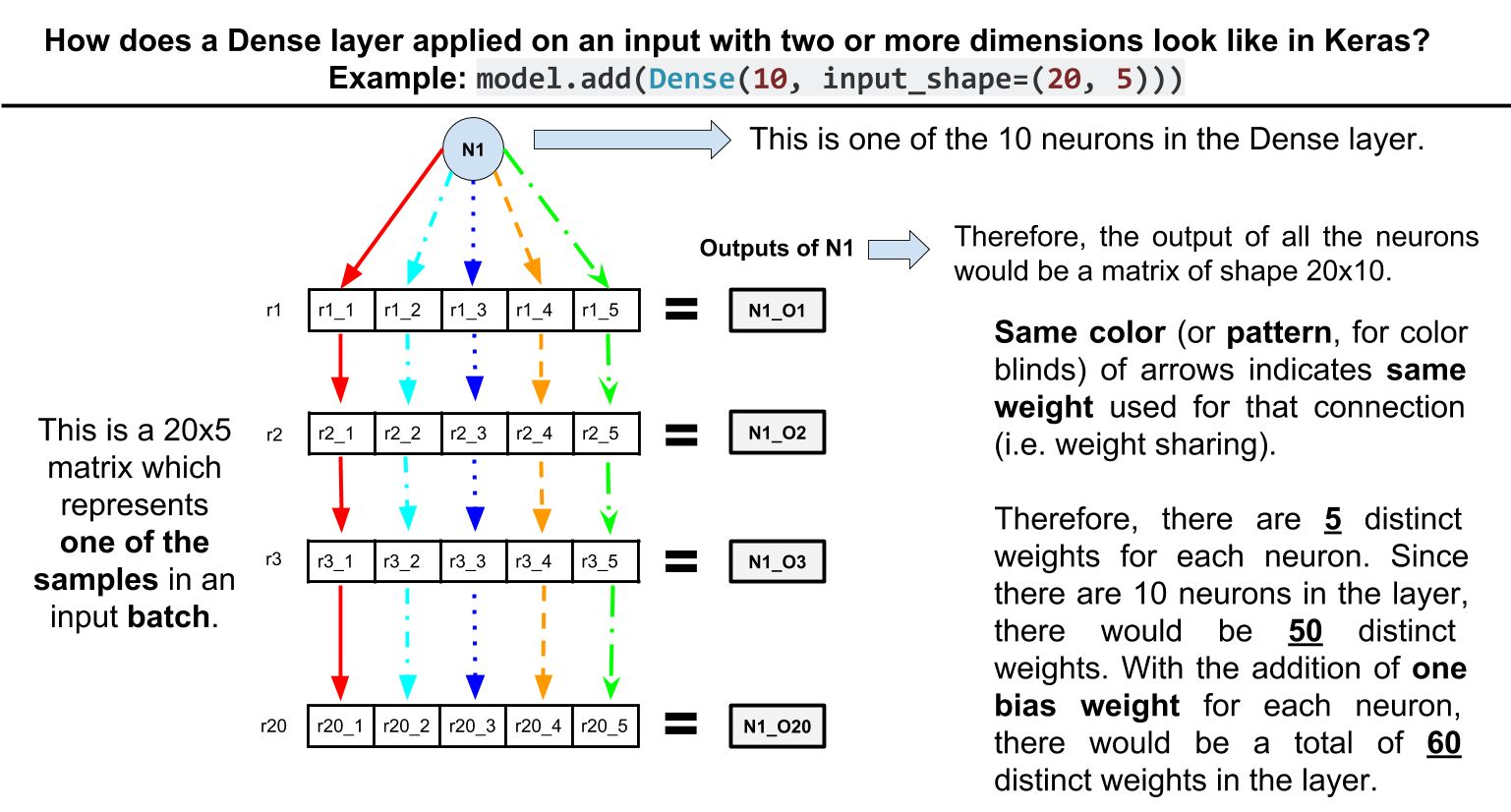
Another side note: be aware that this has the effect of shared weights. For example, consider this toy network:
model = Sequential()
model.add(Dense(10, input_shape=(20, 5)))

model.summary()
The model summary:
_________________________________________________________________
Layer (type)                 Output Shape              Param #
=================================================================
dense_1 (Dense)              (None, 20, 10)            60
=================================================================
Total params: 60
Trainable params: 60
Non-trainable params: 0
_________________________________________________________________
As you can see the Dense layer has only 60 parameters. How? Each unit in the Dense layer is connected to the 5 elements of each row in the input with the same weights, therefore 10 * 5 + 10 (bias params per unit) = 60.
Update. Here is a visual illustration of the example above:
All methods was sourced from stackoverflow.com or stackexchange.com, is licensed under cc by-sa 2.5, cc by-sa 3.0 and cc by-sa 4.0