Has anyone implemented type hinting for the specific numpy.ndarray class?
Right now, I’m using typing.Any, but it would be nice to have something more specific.
For instance if the NumPy people added a type alias for their array_like object class. Better yet, implement support at the dtype level, so that other objects would be supported, as well as ufunc.
Answers:
Thank you for visiting the Q&A section on Magenaut. Please note that all the answers may not help you solve the issue immediately. So please treat them as advisements. If you found the post helpful (or not), leave a comment & I’ll get back to you as soon as possible.
Method 1
Update
Check recent numpy versions for a new typing module
https://numpy.org/doc/stable/reference/typing.html#module-numpy.typing
dated answer
It looks like typing module was developed at:
https://github.com/python/typing
The main numpy repository is at
https://github.com/numpy/numpy
Python bugs and commits can be tracked at
The usual way of adding a feature is to fork the main repository, develop the feature till it is bomb proof, and then submit a pull request. Obviously at various points in the process you want feedback from other developers. If you can’t do the development yourself, then you have to convince someone else that it is a worthwhile project.
cython has a form of annotations, which it uses to generate efficient C code.
You referenced the array-like paragraph in numpy documentation. Note its typing information:
A simple way to find out if the object can be converted to a numpy array using array() is simply to try it interactively and see if it works! (The Python Way).
In other words the numpy developers refuse to be pinned down. They don’t, or can’t, describe in words what kinds of objects can or cannot be converted to np.ndarray.
In [586]: np.array({'test':1})   # a dictionary
Out[586]: array({'test': 1}, dtype=object)

In [587]: np.array(['one','two'])  # a list
Out[587]:
array(['one', 'two'],
      dtype='<U3')

In [589]: np.array({'one','two'})  # a set
Out[589]: array({'one', 'two'}, dtype=object)
For your own functions, an annotation like
def foo(x: np.ndarray) -> np.ndarray:
works. Of course if your function ends up calling some numpy function that passes its argument through asanyarray (as many do), such an annotation would be incomplete, since your input could be a list, or np.matrix, etc.
When evaluating this question and answer, pay attention to the date. 484 was a relatively new PEP back then, and code to make use of it for standard Python still in development. But it looks like the links provided are still valid.
Method 2
Numpy 1.21 includes a numpy.typing module with an NDArray generic type.
From the Numpy 1.21 docs:
numpy.typing.NDArray = numpy.ndarray[typing.Any, numpy.dtype[+ScalarType]A generic version of
np.ndarray[Any, np.dtype[+ScalarType]].Can be used during runtime for typing arrays with a given dtype and unspecified shape.
Examples:
>>> import numpy as np
>>> import numpy.typing as npt

>>> print(npt.NDArray)
numpy.ndarray[typing.Any, numpy.dtype[+ScalarType]]

>>> print(npt.NDArray[np.float64])
numpy.ndarray[typing.Any, numpy.dtype[numpy.float64]]

>>> NDArrayInt = npt.NDArray[np.int_]
>>> a: NDArrayInt = np.arange(10)

>>> def func(a: npt.ArrayLike) -> npt.NDArray[Any]:
...     return np.array(a)
As of 11/10/2021, support for shapes is still a work in progress per numpy/numpy#16544.
Method 3
At my company we’ve been using:
from typing import TypeVar, Generic, Tuple, Union, Optional
import numpy as np

Shape = TypeVar("Shape")
DType = TypeVar("DType")

class Array(np.ndarray, Generic[Shape, DType]):
    """
    Use this to type-annotate numpy arrays, e.g.
        image: Array['H,W,3', np.uint8]
        xy_points: Array['N,2', float]
        nd_mask: Array['...', bool]
    """
    pass

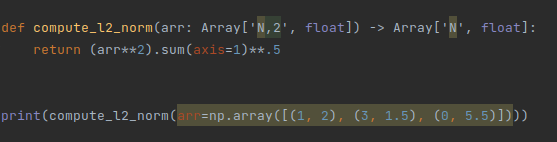
def compute_l2_norm(arr: Array['N,2', float]) -> Array['N', float]:
    return (arr**2).sum(axis=1)**.5

print(compute_l2_norm(arr = np.array([(1, 2), (3, 1.5), (0, 5.5)])))
We actually have a MyPy checker around this that checks that the shapes work out (which we should release at some point). Only thing is it doesn’t make PyCharm happy (ie you still get the nasty warning lines):
Method 4
nptyping adds lots of flexibility for specifying numpy type hints.
Method 5
Check out DataShape. It uses the datatypes as well as some syntax for how big the input and output arrays should be.
Method 6
What i did was to just define it as
Dict[Tuple[int, int], TYPE]
So for example if you want an array of floats you can do:
a = numpy.empty(shape=[2, 2], dtype=float) # type: Dict[Tuple[int, int], float]
This is of course not exact from a documentation perspective, but for analyzing correct usage and getting proper completion with pyCharm it works great!
All methods was sourced from stackoverflow.com or stackexchange.com, is licensed under cc by-sa 2.5, cc by-sa 3.0 and cc by-sa 4.0