What is a “subreaper” process?
The word “subreaper” is used in some answers. Searching Google also turn up entries where the word is “just used”.
The word “subreaper” is used in some answers. Searching Google also turn up entries where the word is “just used”.
When I used killall -9 name to kill a program, the state become zombie. Some minutes later, it stopped really.
So, what’s happening during those minutes?
I have a general question, which might be a result of misunderstanding of how processes are handled in Linux.
I’ve noticed, that all mate-terminal instances I start, be it inside a mate-terminal or via a link button, have the same PID.
I start a new process from GNOME Terminal and then this process fork a child.
But when I killed the parent process the orphaned process’s parent id became something other than 1 which represent init --user pid.
When I do this in virtual terminals, the parent pid is 1 which represent init process.
How can I execute new process from GNOME Terminal so that when it is died, the child process’s parent pid became 1 and not pid of init --user process?
Thanks a lot.
I’m looking for a way to limit a processes disk io to a set speed limit. Ideally the program would work similar to this:
Is there any package which shows PID of a window by clicking on it?
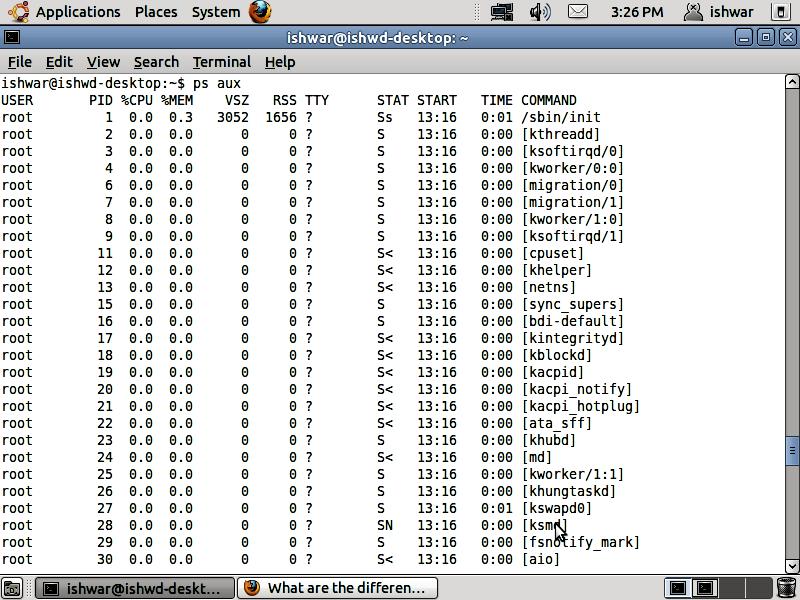
I use Ubuntu Server 10.10 and I would like to see what processes are running. I know that PostgreSQL is running on my machine but I can not see it with the top or ps commands, so I assume that they aren’t showing all of the running processes. Is there another command which will show all running processes or is there any other parameters I can use with top or ps for this?
I know that pkill has more filtering rules than killall. My question is, what is the difference between: